Start With Your Target, Not The Specs
I spent years answering questions at the optics counter. In that time, I learned that a good binoculars buying guide is rarely about complex optical theory. It is almost entirely about practical reality. The most common mistake I saw was someone walking up to the counter, holding a box with impressive numbers, and asking if it was the best option available. They were asking the wrong question. You have to ask yourself what you actually plan to do with them before you worry about the specifications.
The right binoculars for bird watching, the right binoculars for hunting, and the right binoculars for stargazing are different instruments. Yes, they share the exact same basic technology. They all use lenses and prisms to magnify a distant image. But they optimize for completely different things. A birder needs to focus on a branch 10 feet away in a fraction of a second. A hunter needs to gather the last usable light of the day at 300 yards. A stargazer needs to pull in faint light from objects literally light-years away.
If you buy a generic pair without thinking about your activity, you will probably end up with glass that does an okay job at everything but a great job at nothing. The secret to choosing binoculars is mapping the numbers directly to your environment. Here is how the requirements shift depending on what you are looking at.
Binoculars For Bird Watching: Speed and Field of View
When shopping for birding binoculars, what you are NOT looking for is maximum magnification. Most beginners overestimate how much power they need, assuming a 10x or 12x will help them see tiny birds better. In reality, 8x is almost universally the right answer. Higher magnification narrows your field of view, making it incredibly frustrating to track a fast-moving warbler darting through dense foliage. You want a wide field of view to catch that movement instantly.
The critical specs that actually make a difference for birding are close focus, field of view, and eye relief. Close focus is highly underrated; while general-purpose models focus at 20 feet, a good birding binocular needs to focus at 8 feet or less so you can clearly see the birds at your backyard feeder. Eye relief is equally crucial. If you wear glasses, you need at least 15mm of eye relief (or 17mm for progressive lenses) to see the full image without dark rings blocking the edges of your view.
Field Note: I have watched this play out more times than I can count. Someone would bring in a premium 10×42 they bought for birding, complaining that they could never find the bird in the lenses before it flew away. I would hand them an 8×42. The slightly lower magnification opened up the field of view so dramatically that their success rate in finding the target tripled immediately.

Fully multi-coated lenses and phase-coated BaK-4 prisms deliver bright, crisp, color-accurate images across all lighting conditions, with a wide 7.4 degree field of view for easy tracking. The rubber-armored polycarbonate body is waterproof, nitrogen-purged, and tripod-adaptable for extended sessions. Backed by a Celestron Limited Lifetime Warranty and US-based support.
Check On AmazonIf you click this link and buy, we earn a commission at no additional cost to you.
Binoculars For Hunting: Terrain Dictates the Glass
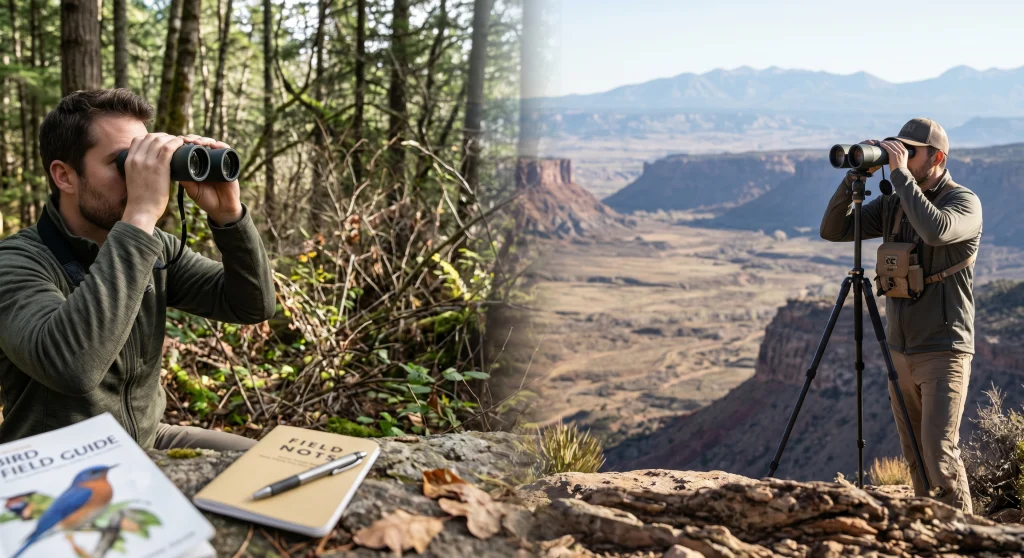
When choosing hunting binoculars, what you are NOT looking for is a specific brand name before defining your environment. The single most important variable is your terrain. A hunter sitting in an eastern hardwood forest looking for whitetail deer has totally different optical requirements than a western hunter glassing for elk across an open valley. Terrain dictates everything.
For eastern timber or stand hunting, sightlines are short, and low-light performance is your absolute priority. Deer move most during the 30 minutes of legal shooting light before sunrise and after sunset. An 8×42 is the standard here because it creates a 5.25mm exit pupil (objective lens divided by magnification), which perfectly matches a human’s dilated eye in the dark, delivering a remarkably bright image. Western mountain hunting, however, requires resolving fine antler detail at 400 to 800 yards. This is where 10×42 becomes the baseline, and serious hunters step up to 12×50 or 15×56 models mounted firmly on a tripod.
Note: Bow hunters have an entirely different set of rules. Carrying heavy, 42-millimeter objective lenses in a tight tree stand gets in the way of drawing a bow silently. Because bow shots are taken at close range, many bow hunters successfully drop down to a compact 8×32 configuration to save weight and maintain mobility.

Fully multi-coated lenses paired with BAK-4 prisms deliver bright, sharp, crystal-clear images at 10x magnification with a wide 1,000 yard field of view. The lightweight rubber-armored body is shock and slip resistant, and twist-up eyecups with a central focus wheel make quick adjustments easy with or without glasses. Note that these are water-resistant rather than fully waterproof.
Check On AmazonIf you click this link and buy, we earn a commission at no additional cost to you.
Binoculars For Stargazing: Aperture Is King
For astronomy, the rules change entirely. What you are NOT looking for is high magnification. The biggest mistake new stargazers make is buying a 15x or 20x binocular and trying to hold it by hand. At that power, the natural tremor in your arms makes the stars bounce violently across the view. If you are not using a tripod, 10×50 is the absolute limit for handheld astronomy.
In the night sky, aperture (the size of your objective lenses) matters more than magnification. Because stars are infinitely distant points of light, magnifying them does not make them look larger; it only amplifies your hand shake and narrows your view. You need to gather as much faint light as possible. A 50mm objective lens will pull the Andromeda Galaxy out of the darkness in a way a 42mm lens simply cannot. Interestingly, a good pair of 10×50 binoculars will often provide a better, more intuitive experience than a cheap department store telescope, allowing you to sweep the Milky Way comfortably with both eyes open.
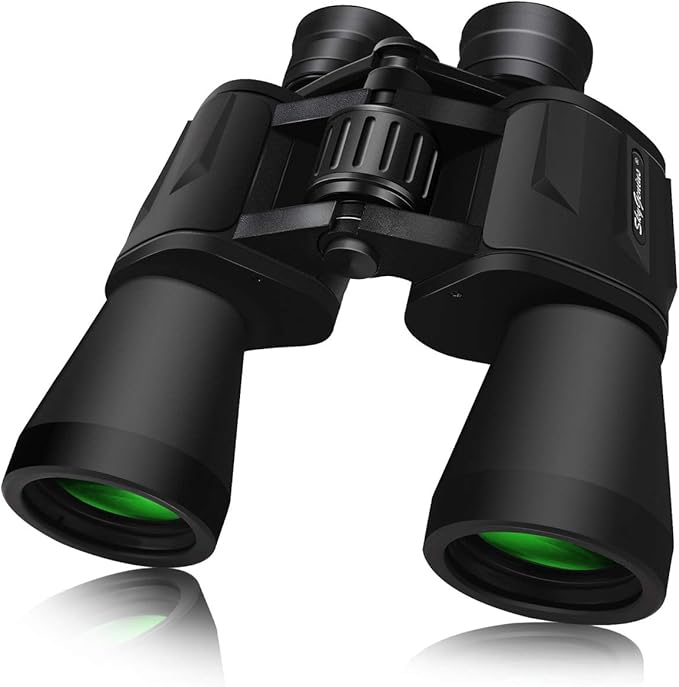
Aspherical lenses with multi-layer coating deliver bright, high-contrast images across a wide 367 foot field of view, making them capable in low light though not in complete darkness. The 50mm objective lens and 10x magnification excel at tracking fast-moving subjects like birds and sports. Odorless rubber armor provides shock resistance and a firm grip, with a smooth center focus knob, diopter adjustment, and twist-up eyecups for comfortable use with or without glasses.
Check On AmazonIf you click this link and buy, we earn a commission at no additional cost to you.
The Overlap Dilemma: When You Do More Than One Thing
One of the most frequent questions I got at the counter was from people who did not want to be boxed into just one activity. They wanted to watch birds in the morning, hike in the afternoon, and look at the moon at night. If you overlap activities, you have to accept that your binoculars will be a compromise. You must identify your primary activity and accept slightly reduced performance in your secondary activity.
If you split your time between birding and casual stargazing, an 8×42 is your best overlap point. It gives you the fast focus and wide field for birds, and just enough light-gathering capability to see major star clusters. However, you have to accept that you will not see faint deep-sky nebulae the way a dedicated 10×50 astronomy binocular would show them. Conversely, if you try to use a heavy 10×50 astronomy binocular for a five-mile birding hike, the weight will quickly become a burden.
Buying a heavy, high-magnification 10×50 to ensure you can see stars at night, then forcing yourself to carry it on long, strenuous daytime hikes where you only look at things 50 yards away.
Buying a budget-friendly 8×42 that perfectly handles 90 percent of your daytime hiking and birding, while accepting that your nighttime viewing will be limited to the moon and brighter constellations.
Activity Framework Overview
To summarize how different use cases demand different optical priorities, here is the basic mapping framework. This is the exact logic I used to point customers down the right aisle.
| Primary Activity | Top Priority Specification | Ideal Starting Configuration |
|---|---|---|
| Forest Birding | Field of View & Close Focus | 8×42 |
| Backyard Birding | Close Focus (under 8 feet) | 8×32 or 8×42 |
| Eastern Stand Hunting | Low-Light Performance & Exit Pupil | 8×42 |
| Western Open Glassing | Magnification & Resolution | 10×42 or 12×50 |
| Stargazing (Handheld) | Aperture (Light Gathering) | 10×50 |
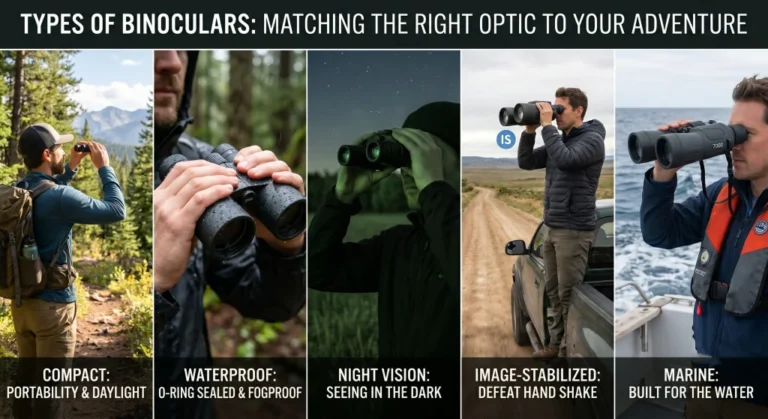
If you need to understand the mechanical definitions behind these numbers before you proceed, you can learn the technical side at our guide to understanding binocular numbers. If you are debating between a compact frame or a full-size frame, check our breakdown of binocular types.

These 8x binoculars deliver steady, color-accurate views ideal for birdwatching, hiking, and road trips. Fully waterproof with a floating design, they stay buoyant if dropped in water. The rubber-armored body handles wind and cold with ease, while twist-up eyecups ensure all-day comfort with or without glasses. At 1.59 lbs, they are light enough to keep in a glove box and ready for any adventure.
Check On AmazonIf you click this link and buy, we earn a commission at no additional cost to you.
Final Thoughts: Pick Your Path
Choosing binoculars does not have to be an overwhelming process. The numbers on the box are just tools to help you achieve a specific goal in the field. Once you define what you are looking at and where you will be standing, the correct specifications reveal themselves naturally.
Now that you know your primary activity, you need to look at the specific budget tiers, performance thresholds, and common pitfalls for that exact environment. The overviews above only scratch the surface of what makes glass perform in the field. You need to know exactly which models deliver the close focus required for birding, or which lens coatings actually make a difference in low light.
Below, you will find our dedicated activity hubs. These guides dig deep into the exact requirements for your chosen pursuit, including what to expect at different price points and how to avoid buying features you will never use. Pick your path below to find the right glass for your job.
Specific Activity Hubs
Select your primary activity to see the deep-dive recommendations, exact specification requirements, and the gear that actually survives real-world use.
| Activity Focus | What You Will Learn |
|---|---|
| Binoculars for Bird Watching | The specific specs that matter for birding, the magnification instinct correction, and why close focus determines your success. |
| Binoculars for Hunting | How your hunting terrain dictates your glass, the eastern versus western split, and the truth about low-light performance. |
| Binoculars for Stargazing | Why aperture beats magnification, the tripod threshold, realistic expectations of what you can actually see, and which configurations actually deliver. |
FAQs
🔭 What magnification is best for general use?
For most people, 8x is the best magnification for general use. It provides a wide field of view, is easy to hold steady without a tripod, and performs reliably across various lighting conditions.
👓 Do I need special binoculars if I wear glasses?
You do not need a special type of binocular, but you must check the eye relief specification. Look for models with at least 15mm of eye relief so you can see the full field of view without removing your glasses.
🦉 Can I use the same binoculars for birding and stargazing?
You can use an 8×42 for both, but it will be a compromise. Birding requires close focus and a wide field, while stargazing favors much larger objective lenses, like 50mm, to gather faint light from space.
⚖️ Does weight matter when choosing binoculars?
Weight matters immensely depending on your activity. A 30-ounce binocular is fine for sitting on a back porch, but if you are doing a long spot-and-stalk hunt or a full-day birding hike, you will want a lighter 8×32 or 8×42 model.
🌧️ Are waterproof binoculars worth the extra money?
Yes, in almost all outdoor scenarios. Waterproofing typically means the optical barrels are nitrogen or argon purged, which prevents the internal lenses from fogging up when transitioning between hot and cold environments.
💡 What is the most important spec for low-light viewing?
Exit pupil size and lens coating quality determine your low-light performance. You want an exit pupil of around 5mm, which matches your dilated eye at dusk to provide the brightest possible image without wasting light.