Why Your Hunting Terrain Decides Your Specs
The single most important question when choosing binoculars for hunting is not which brand to buy or how much to spend. It is simply asking yourself where you hunt. The answer to that question changes everything that follows. I have watched this confusion play out more times than I can count at the optics counter. A hunter walks in asking for the absolute best pair of binoculars, assuming there is a universal gold standard that works for every situation.
That universal standard does not exist. Optics are specialized tools. If you buy a massive, high-magnification setup designed for sweeping open country, you will hate carrying it through a thick pine forest. Conversely, if you take a compact, low-magnification pair designed for tree stands out to the Rocky Mountains, you will spend your entire trip struggling to evaluate animals at a distance. Finding the right hunting binoculars starts with ignoring the marketing hype and looking honestly at the ground you cover.
Field Note: One of the most common mistakes I saw was guys buying 15×56 binoculars for Georgia pine forests simply because they read those were the most powerful option available. I would take them outside, point them at a treeline fifty yards away, and watch them struggle to find a specific branch in the narrow field of view. Magnification is a tool, not a high score.
Eastern Forests vs. Western Mountains: The Primary Divide
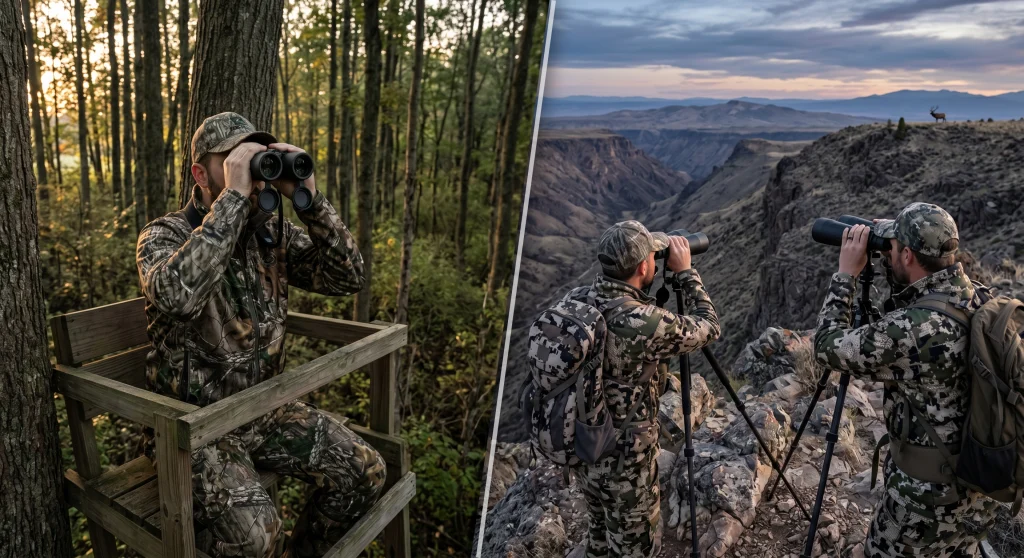
The easiest way to narrow down your options is to look at the classic eastern versus western hunting divide. These two environments require fundamentally different optical solutions. When you start looking at binoculars for deer hunting in eastern forests, you are typically dealing with whitetail deer in thick cover. Your sightlines are broken by trees, brush, and terrain folds. Your observations are almost always inside 200 yards.
At these shorter ranges, a wide field of view is vastly more important than high magnification. You need to be able to catch the flick of an ear or the horizontal line of a back moving through vertical timber. For this environment, the 8×42 configuration is almost universally the right answer. It gives you a wide enough view to track a moving deer, and it remains bright enough for late evening. If you try to use a 10x or 12x magnification in this setting, the field of view is so narrow that finding a moving target becomes incredibly difficult.
Turkey hunting presents an even more extreme version of the eastern scenario. You are hunting in dense spring cover, often in the lowest light of dawn, dealing with a bird that has exceptional eyesight at very close range. An 8×42 or even a specialized compact 8×32 gives you the wide field of view needed to spot a tom moving through thick brush without requiring excessive, noisy movement on your end to find the target.
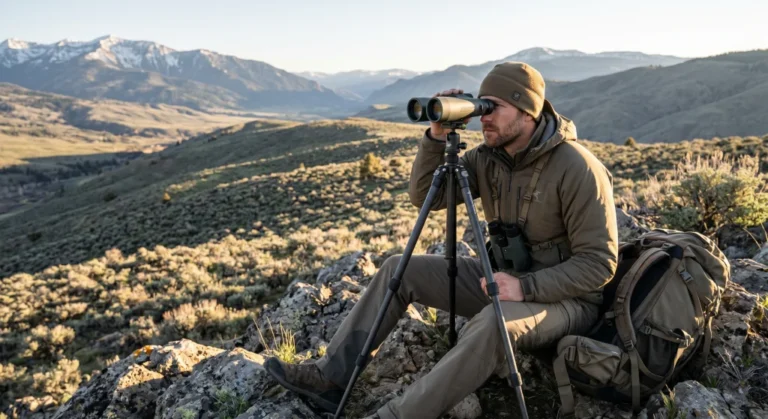
When you move out west for elk, mule deer, or pronghorn, the geometry of the hunt changes completely. You are suddenly looking at regular distances of 400 to 800 yards or more. You need to distinguish fine antler details against complex sagebrush backgrounds. In this open terrain, a 10×42 becomes the absolute minimum. Many serious western hunters move up to a 10×50 or even a 12×50 for serious open-country glassing. If you read through real field reports, like the ongoing 8x versus 10x magnification debates among western hunters on the Hunt Talk forum, experienced hunters consistently confirm this pattern. 10x is fine for general western navigation, but 12x or 15x is where dedicated long-range glassing really begins.
Quick Reference: Terrain and Specifications
To make the initial decision easier, here is a general breakdown of how terrain dictates your starting point. Use this matrix to orient your search before looking at specific models or price tags.
| Hunting Terrain | Typical Target Distance | Recommended Configuration |
|---|---|---|
| Eastern Hardwoods / Dense Timber | 50 to 200 yards | 8×42 or 8×32 |
| Midwestern Fields / Broken Woods | 100 to 400 yards | 8×42 or 10×42 |
| Western Mountains / Canyons | 400 to 800+ yards | 10×42, 10×50, or 12×50 |
| Extreme Long Range / Vantage Points | 800+ yards | 15×56 (Tripod required) |

ED glass virtually eliminates chromatic fringing for razor-sharp, true-to-life images, while ESP dielectric multi-layer prism coatings reflect over 99 percent of light for outstanding brightness and color accuracy. Advanced fully multi-coated lenses maximize light transmission across the full spectrum, and argon purging ensures superior waterproofing and thermal stability. A wide 8.1 degree field of view and long eye relief make these comfortable for extended use with or without glasses.
Check On AmazonIf you click this link and buy, we earn a commission at no additional cost to you.
Maximizing Performance at Legal Shooting Light
Hunting has a very specific optical requirement that casual birding often does not share. The absolute most critical moments of a hunt happen at the edges of the day. Legal shooting light typically begins about thirty minutes before sunrise and ends thirty minutes after sunset. Big game animals are crepuscular, meaning they are most active during these twilight hours. This is exactly when optical quality makes the biggest visible difference. If you are using cheap glass with poor coatings, those first and last thirty minutes of the day are effectively erased.
This is where understanding exit pupil becomes a practical field skill rather than just a math equation. Your exit pupil is the objective lens diameter divided by the magnification. An 8×42 configuration gives you a 5.25mm exit pupil. This aligns perfectly with how wide a human pupil naturally dilates in low light, which is typically around 5 to 7mm. A 10×42 drops that exit pupil down to 4.2mm. That single millimeter difference sounds insignificant when you are standing in a brightly lit retail store, but in a November dawn when a buck is moving along a dark tree line, that 8×42 will feed noticeably more light to your eye.
Key point: If you read through a general 8×42 vs 10×42 comparison, you will see that the 8×42 almost always wins the low-light test. If you absolutely need 10x magnification for distance but also hunt in deep twilight, stepping up to a 50mm objective lens is a smart compromise.
Many manufacturers try to sell hunters on a metric called “twilight factor” to prove their optics work well in the dark. In practice, twilight factor is just a mathematical formula that multiplies magnification and objective size. Independent field testers, including the extensive optic reviews published by Backwoods Pursuit, have repeatedly demonstrated that twilight factor numbers do not predict actual low-light performance. A budget pair of binoculars with a high twilight factor will still perform terribly in the woods if the glass is cheap. Focus on finding a 42mm or 50mm objective lens with fully multi-coated glass and phase-corrected prisms. That is what actually delivers a bright image when it matters most.

Select HD glass elements with fully multi-coated, dielectric-coated lenses deliver exceptional sharpness, color fidelity, and light transmission, while Armortek coating protects exterior surfaces from scratches and oil. Argon-purged and O-ring sealed for waterproof, fog-proof performance in any conditions. Includes a GlassPak chest harness and backed by Vortex's unlimited, unconditional, fully transferable lifetime VIP Warranty.
Check On AmazonIf you click this link and buy, we earn a commission at no additional cost to you.
Weather Resistance: Waterproofing and Fog-Proofing
Hunting exposes your optics to environments far harsher than a casual birding walk in the park. You will deal with river crossings, sudden downpours, freezing sleet, and the sharp temperature swings of a November morning. A binocular that fogs internally during the golden hour is completely useless, and it is a mistake you only make once.
When selecting your gear, look specifically for models that are nitrogen or argon purged and O-ring sealed. Purging removes the oxygen and moisture from inside the optical barrels and replaces it with an inert gas. This is what prevents internal fogging when you move from a warm truck cab into the freezing woods. The O-ring seals ensure that dust, dirt, and external moisture stay out of the barrel over years of hard use. Never buy a hunting optic that does not explicitly state it is both waterproof and fog-proof.
Scanning vs. Glassing: How You Actually Use Your Optics
Beyond the physical terrain, you have to look honestly at your personal hunting style. Hunters who sit in a stand all day use their optics very differently than hunters who climb to a vantage point and sit behind a tripod for hours. Your physical interaction with the equipment dictates which specs will feel comfortable and which will cause fatigue.
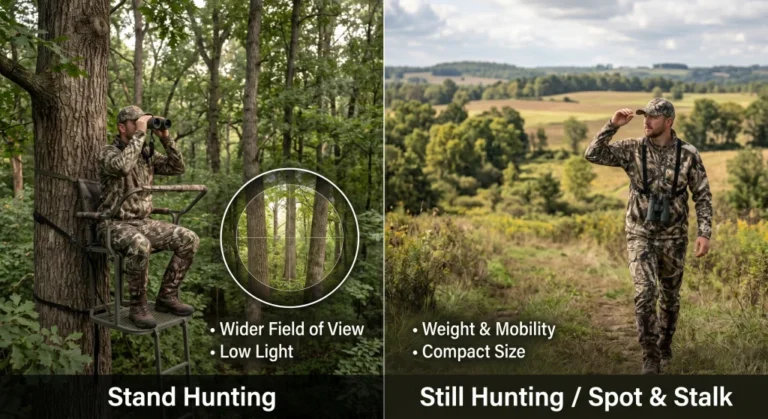
When you are stand hunting, your optic use is largely opportunistic spotting. You hear a branch snap, you raise the glass with one hand, you verify the target, and you drop the glass to ready your rifle or bow. For this fast-paced style, you need specific characteristics.
- A wide field of view to catch movement in your peripheral vision quickly.
- A fast, smooth focus wheel that allows you to jump from 20 yards to 100 yards instantly.
- A compact enough frame that the binoculars do not get in the way of your chest rig or bow string.
- Generous eye relief so you can get a full picture the second you pull them to your face.
Conversely, active glassing from a western vantage point is an endurance activity. You might be looking through the lenses for two hours straight trying to pick apart a distant ridgeline. For this sustained effort, magnification and tripod adaptability take absolute priority. Any time you move past 10x magnification, you introduce enough hand shake to cause severe eye fatigue over long viewing sessions. A 12×50 or 15×56 configuration is essentially useless without a tripod. The rule I always pass along is simple. If you plan to glass a single hillside for more than fifteen minutes at a time, you need to mount the optic to a stable platform.
The Binoculars vs. Spotting Scope Decision
As your hunting style shifts toward covering vast distances and requiring long glassing sessions from a tripod, you will likely start questioning if you need a secondary optic. The question of whether to carry binoculars or a spotting scope is a real field dilemma that trips up many hunters. The answer is that you should always start with binoculars. Binoculars are your primary tool for finding animals across a landscape. Using both eyes prevents severe fatigue over long sessions and helps you maintain depth perception in complex terrain.
Spotting scopes have a very narrow field of view and are used exclusively for evaluating an animal after you have already found it with your binoculars. Trying to scan a whole mountainside with a high-powered spotting scope is like trying to read a book through a straw. It is slow and exhausting.
Many experienced pack hunters solve the extreme distance problem by splitting their optical needs to manage weight. They carry a lightweight compact pair, like an 8×32 or 10×32, on their chest harness for quick navigation and broad scanning. They then keep a dedicated spotting scope in their pack for the specific moment they reach a vantage point and need to confirm a legal animal at extreme distances. This combined approach is often more manageable than carrying a single, incredibly heavy 15×56 binocular on your chest all day.
Buying a heavy 15×56 binocular for a mobile spot-and-stalk hunt, hoping you can hold it steady enough by hand to avoid carrying a tripod. You will end up with severe eye strain and a bouncing image.
Carrying a lightweight 10×42 on your chest for mobile hunting and opportunistic spotting, paired with a spotting scope in your pack for stationary, long-range evaluation.

This ergonomic X-shaped harness evenly distributes weight across your neck, back, and shoulders for fatigue-free all-day carry of binoculars or cameras. Fast-release high-grade plastic buckles and adjustable sliding brackets make setup quick and easy for all body sizes. Backed by a 100% satisfaction guarantee with no-questions-asked returns.
Check On AmazonIf you click this link and buy, we earn a commission at no additional cost to you.

CNC precision-cut from T6061 aluminum alloy, this lightweight 2.8 oz adapter features a detachable Arca-Swiss mount and standard quarter-inch 20 thread for broad compatibility with most binoculars and tripods. A quick-release mechanism with anti-drop safety lock keeps your gear secure even on uneven terrain, and the simple two-part design installs in under a minute. Backed by a lifetime warranty.
Check On AmazonIf you click this link and buy, we earn a commission at no additional cost to you.
Final Thoughts: Buying for the Hunt You Actually Do
The most expensive mistake you can make is buying optics designed for a hunt you only dream about, while ignoring the hunt you actually do every weekend. I always remind people looking for a binoculars buying guide that honesty is the best policy at the optics counter. If you spend ninety percent of your season in a midwestern tree stand, do not buy a heavy 15x magnification setup just because you plan to go out west once in the next five years. Buy the fast, bright 8×42 that will make your daily local hunts successful.
When you match your gear strictly to your primary terrain, the numbers on the box stop being confusing and start working as practical field tools. You will spot game faster, experience less eye fatigue, and actually enjoy looking through your glass. Evaluate your terrain, understand your physical hunting style, and let those two factors dictate the optic you carry into the woods.
FAQs
🦌 What binoculars for deer hunting are best in the woods?
For wooded environments and tree stand hunting, an 8×42 is almost universally the best choice. It provides a wide field of view to catch movement in dense timber and gathers enough light for dawn and dusk activity.
⛰️ Is 10x or 12x better for western hunting?
A 10x binocular is better for handheld versatility and mobile hunting. A 12x binocular provides noticeably better detail for counting tines at a distance, but it almost always requires a tripod for sustained, comfortable viewing.
🌅 Do I need a 50mm objective lens for hunting?
You only need a 50mm objective if you primarily hunt in extreme low light situations, such as deep pre-dawn or late dusk, and you are using 10x or 12x magnification. Otherwise, a 42mm lens is significantly lighter and sufficient for most daylight and standard twilight hunting.
🏹 Can I use the same binoculars for bow hunting and rifle hunting?
You can, but bow hunters often prefer compact models like an 8×32 to save weight and reduce bulk on their chest when drawing a bow. Rifle hunters usually benefit from full-size 42mm models because they offer better low-light performance at longer ranges.
🔭 Should I buy hunting binoculars or a spotting scope?
You should always buy binoculars first. Binoculars are for finding the animal across a landscape. Spotting scopes have a very narrow field of view and are used exclusively for evaluating the animal after you have already found it.