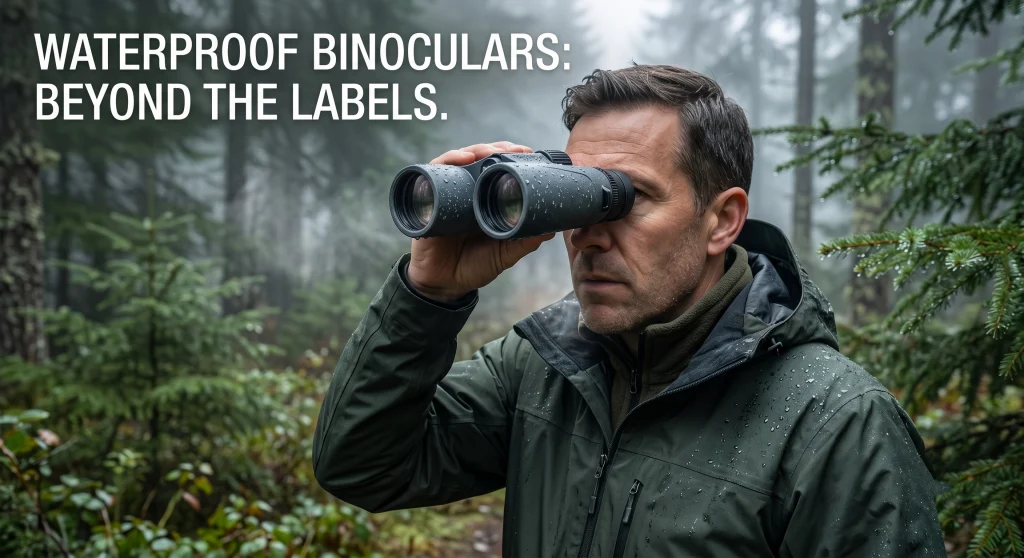
The Marketing Mess of Weather Ratings
If you are looking for waterproof binoculars, you have probably noticed a frustrating pattern on the packaging. Manufacturers use a variety of terms to describe how their products handle water. One brand will proudly stamp “waterproof” on a box that is only built to handle a light drizzle. Another brand will build a fully submersible optic but fail to list any official rating at all.
When you walk down the aisle of a major outdoor retailer, the packaging is designed to sell a lifestyle. You will see pictures of rugged hunters in downpours and sailors crashing through waves. The bold text on the cardboard makes sweeping claims about weather readiness. But the actual legal definitions of those terms are incredibly loose. Explaining waterproof ratings in simple terms is surprisingly difficult because “weather-resistant” might just mean the manufacturer sprayed a light water-repellent coating on the external rubber armor. It means absolutely nothing regarding the delicate internal mechanics of the focusing system.
I have watched this confusion play out more times than I can count at the optics counter. A customer would bring in a ruined pair of binoculars they took on a fishing trip. They were upset because the product description clearly said the unit was weather-resistant. I would have to explain the painful reality that weather-resistant usually just means the item survives light splashes. There is almost no industry enforcement of these terms on consumer packaging.
Warning: Never assume that an optic is safe to submerge just because the marketing copy features rain clouds. Unless you can verify the mechanical sealing methods, you are risking irreversible damage to your investment.
To give you a quick baseline, here is how you should translate the marketing labels you see on the shelf:
| The Label on the Box | What It Actually Means in the Field |
|---|---|
| “Weatherproof” | Splash only. Often just refers to the rubber armor. |
| “Water-resistant” | Survives light rain or a heavy splash, but not a dunk. |
| “Waterproof” (No specs) | Proceed with caution. Verify the mechanical sealing. |
| “O-ring sealed + Nitrogen” | Verified fully sealed chassis. Safe for heavy weather. |
To cut through this confusion, you have to stop looking at the bold marketing claims on the front of the box. Instead, you need to turn the box around and look for two specific mechanical features in the fine print. Once you know what these two features are, you can bypass the vague terminology completely.
The Two Indicators of True Waterproofing
Over time, I learned to teach customers a very simple rule for checking weather protection. If you want to know if an optic is truly sealed, you look for two specific terms working together. Those terms are O-ring sealed and nitrogen purged. If a product claims both of these features, it is built to a genuinely high standard of moisture protection.
O-rings are physical rubber gaskets placed at every point where two pieces of the binocular meet. They sit under the focus wheel, around the eyepieces, and at the objective lens housings. These mechanical barriers physically block liquid water from entering the internal chassis. Without them, rain will simply seep into the gaps around the moving parts of the focus mechanism.
However, O-rings alone are not enough to protect your view. The air inside the chassis must also be completely replaced with a dry gas. Regular atmospheric air contains ambient moisture. If a manufacturer just seals regular air inside the optical tubes with O-rings, that trapped moisture will eventually cause problems. The purging process removes all ambient moisture before the final seals are locked into place.
Trusting a binocular that says “weatherproof” on the front cover but lists no specific sealing technology in the manual.
Checking the specification sheet for explicitly stated “O-ring sealed” and “nitrogen purged” construction.
Some premium brands have started using argon instead of nitrogen for the purging process. The reasoning is that argon molecules are slightly larger than nitrogen molecules, which supposedly makes them less likely to leak out of the seals over time. In my experience, both gases perform identically in the field. The presence of either gas tells you the manufacturer took the sealing process seriously.

An upgrade to Bushnell's best-selling H2O series, these compact roof-prism binoculars feature fully multi-coated lenses and BaK-4 prisms for maximum clarity and light transmission. O-ring sealed and nitrogen-purged for 100 percent waterproof, fog-proof performance in any conditions. Rugged rubber armor with soft grip handles wet conditions with ease, and the package includes a strap, case, and lens covers. Backed by over 70 years of Bushnell optics expertise.
Check On AmazonIf you click this link and buy, we earn a commission at no additional cost to you.
What Fogproof Actually Means
Understanding the difference between waterproof vs fogproof binoculars is another major hurdle for first-time buyers. The two concepts are related but solve entirely different problems. Water protection stops liquid from getting in from the outside. What fogproof binoculars actually do is stop condensation from forming on the inside of the lenses.
A binocular that is water-resistant but not nitrogen-purged is not fogproof internally. This becomes painfully obvious when you move between extreme temperatures. If you take an unsealed binocular out of a warm truck cabin and step into freezing morning air, the ambient moisture trapped inside the chassis will immediately condense on the cold glass. You will be completely blinded by internal fog until the optic warms back up.
I have had people ask if they can just take their optics apart to wipe the internal condensation away. The answer is absolutely not. Modern binoculars are precision optical instruments aligned on specialized factory equipment. If you unscrew the objective barrels to wipe the inside of the glass, you will destroy the collimation, which is the delicate alignment between the two optical tubes. You will end up with a double image that makes you dizzy.
This internal condensation is not just a temporary annoyance. Over months and years of use, repeated internal fogging causes permanent damage. It creates the perfect environment for fungus to grow on the optical coatings. Once internal fogging or fungus takes hold, the binocular is essentially ruined unless you send it back to the manufacturer for a costly professional rebuild.
Field Note: I used to show customers a specific pair of old, unsealed binoculars we kept behind the counter. They had been used for years in a humid coastal environment. The inside of the lenses looked like frosted glass because fungus had eaten away the coatings. It was the fastest way to prove why internal fogproofing matters even if you never drop your gear in a lake.
Do You Actually Need a Sealed Optic?
After seeing that fungus damage, customers would usually step back and ask if they really needed to pay for a fully sealed optic for their specific hobbies. The honest answer depends entirely on the environments you frequent. If you only ever use your optics from a covered porch on bright, sunny afternoons, you can absolutely save money by buying an unsealed pair.
For stadium events, indoor concerts, or casual backyard bird feeding, a basic water-resistant model is perfectly adequate. These activities do not expose the gear to heavy rain, salt spray, or rapid temperature drops. Paying a premium for deep water protection in these scenarios is essentially buying insurance you will never claim.
However, the calculation changes the moment you step into the backcountry or onto a boat. In these environments, a sealed chassis is the only thing standing between your expensive glass and a permanently ruined internal focus mechanism. Here are the situations where full water protection is absolutely mandatory:
- Kayaking and canoeing: The risk of capsizing means your gear might be submerged for thirty seconds or more. Splash resistance will not survive a dunk in the river.
- Dawn and dusk hunting: These activities involve massive temperature swings. The fog protection is critical when waiting in a freezing blind after walking from a warm camp.
- Offshore boating: Saltwater spray is highly corrosive. You need a completely sealed chassis to prevent salt from working its way into the focus mechanics.
- Backpacking in variable weather: When you are miles from the trailhead, you cannot control when a sudden downpour hits. Your gear needs to survive the hike back.
The salt water damage issue is another factor that catches people off guard. Even if you never drop your gear in the ocean, coastal environments are filled with airborne salt spray. If a binocular is not fully sealed, that microscopic salt works its way into the greased focus wheel mechanism. Over a single season, it acts like sandpaper, grinding away the smooth action until the focus wheel completely seizes up. A fully sealed chassis keeps that corrosive salt out.

Premium BAK-4 prisms and fully multi-coated optics deliver bright, crisp images across a wide 396 foot field of view, with a generous 22mm eye relief and 6.8mm exit pupil for comfortable extended use. A built-in illuminated compass and internal rangefinder make these purpose-built for marine navigation. Fully waterproof and floating, nitrogen-purged, rubber-armored, and tripod-adaptable for rock-solid stability on the water.
Check On AmazonIf you click this link and buy, we earn a commission at no additional cost to you.
Why Most Products Do Not List an IPX Rating
If you research outdoor electronics, you are probably familiar with the Ingress Protection (IPX) rating system. It is a standardized scale that tells you exactly how much water a device can handle. For example, an IPX4 rating means the item can survive splashing water from any direction. An IPX7 rating means it can survive being submerged in one meter of water for thirty minutes.
Naturally, buyers look for these numbers when shopping for outdoor optics. The confusing part is that many of the best binoculars in the world do not list an IPX rating anywhere on their packaging or spec sheets. This omission leads a lot of people to assume the product is not truly protected.
The reality comes down to manufacturing costs. Manufacturers are not required to certify their products to the IPX standard in order to use the term waterproof. Sending optics out for official IPX certification testing costs a significant amount of money. Many established brands prefer to rely on their own internal testing rather than paying for the official badge.
It is important to remember that IPX ratings only measure water ingress. They do not measure fogproofing. A product could technically achieve an IPX7 submersion rating by using heavy O-rings, but if the factory assembled it in a humid room without purging the air, it would still fog up internally on a cold morning. This is why simply looking for an IPX sticker is not a complete strategy.
Pro Tips: Do not panic if you cannot find an IPX number on a reputable brand’s spec sheet. If the description explicitly states the unit is O-ring sealed and nitrogen purged, it is highly likely to perform at an IPX7 equivalent level. Trust the physical construction features over the presence or absence of a standardized sticker.

Fully multi-coated lenses and phase-coated BaK-4 prisms deliver bright, crisp, color-accurate images across all lighting conditions, with a wide 7.4 degree field of view for easy tracking. The rubber-armored polycarbonate body is waterproof, nitrogen-purged, and tripod-adaptable for extended sessions. Backed by a Celestron Limited Lifetime Warranty and US-based support.
Check On AmazonIf you click this link and buy, we earn a commission at no additional cost to you.
A Warning About Seal Degradation
Even if you buy a fully sealed, nitrogen-purged binocular, those O-rings will not last forever if you treat them poorly. I have seen perfectly good waterproof binoculars fail because the owner did not know that common chemicals could destroy the rubber gaskets in a single season.
The biggest enemies of your O-rings are the chemicals you probably already have in your hiking pack. Heavy applications of sunscreen and DEET-based insect repellents will actively break down the rubber seals around the eyepieces and focus wheel. If you have DEET on your hands, wash them or wipe them down before spending an hour adjusting your diopter.
Additionally, never use silicone sprays or harsh chemical cleaners on the mechanical joints of your optics. If your binoculars get covered in mud or salt spray, the best way to clean them is to rinse them gently with fresh water and let them air dry. A well-maintained seal will protect your glass for a decade, but chemical damage can ruin that protection in a matter of weeks.

This complete kit includes a 1 oz cleaning fluid, 10 moistened wipes, a cleaning brush, air blaster, microfiber cloth, and a carrying case for all-in-one lens care on the go. The ammonia-free, toxin-free, low-VOC formula is safe for anti-reflective, blue light blocking, prescription, and sunglass coatings, as well as binocular and camera lenses. Delivers streak-free results suitable for everyday use.
Check On AmazonIf you click this link and buy, we earn a commission at no additional cost to you.
Final Thoughts: Buy the Build, Not the Label
Shopping for outdoor optics becomes much easier once you stop reading the marketing adjectives. Words like weatherproof and weather-resistant are too vague to trust when your gear is on the line. By focusing strictly on mechanical features, you take the guesswork out of the process.
If the spec sheet confirms the two physical features we discussed, you are looking at a serious tool built for genuine outdoor use. If those features are missing, you are looking at a fair-weather instrument.
Before you spend money on a new pair of optics, you need to match this weather rating logic to the actual terrain you plan to cover. A kayaker needs a very different build than a backyard birder. Dive into the specific use-case guides below to see exactly where your activity falls on the protection spectrum.
Detailed Guides on Moisture Protection
If you want to look closer at how weather ratings impact specific outdoor activities, I have broken down the most common decision points below. These guides cover exactly how much protection you need for different environments, alongside our broader breakdown of all binocular categories.
| Guide Topic | What It Covers |
|---|---|
| Do I Need Waterproof Binoculars? | A realistic look at when you can safely skip full protection and when it is an absolute necessity. |
| Waterproof vs Water-Resistant | The long-term consequences of choosing a resistant model over a fully sealed chassis. |
| IPX Ratings Explained | A breakdown of the official testing numbers and how to evaluate optics that do not list them. |
| Binoculars for Kayaking | Why standard splash protection fails on a river and what submersion specs to look for instead. |
| Marine Binoculars Overview | How on-water use changes the requirements for magnification, focus mechanisms, and salt resistance. |
FAQs
💧 What is the difference between waterproof and fogproof binoculars?
Water protection prevents external liquid from entering the chassis, usually via O-rings. Fog protection uses dry nitrogen or argon gas to replace internal air, preventing condensation from forming on the inside of the lenses during temperature changes.
🌧️ Can I use water-resistant binoculars in the rain?
Water-resistant models can survive a brief, light drizzle. They are not built to withstand heavy downpours, sustained exposure to wet conditions, or accidental submersion in a puddle or stream.
🧊 Why do my binoculars get foggy on the inside?
Internal fogging happens when unsealed binoculars move from a warm environment to a cold one. The ambient moisture trapped inside the chassis condenses on the cold glass. Fully sealed, gas-purged models eliminate this issue entirely.
🛶 Do I need IPX7 rated binoculars for kayaking?
Yes. IPX7 means the optic can survive being submerged in one meter of water for thirty minutes. Since capsizing is a real possibility in paddle sports, standard splash resistance is not enough to protect your gear.
🔬 Does argon gas work better than nitrogen for fogproofing?
Argon molecules are larger, which some manufacturers claim makes them less likely to leak past seals over the years. In practical field use, both nitrogen and argon provide excellent and identical protection against internal condensation.