The 7×50 vs 10×50 Binoculars Decision
When someone at the optics counter asked me to compare 7×50 vs 10×50 binoculars, they usually assumed one was simply an upgraded version of the other. The reasoning makes sense on the surface. Both configurations have the exact same 50mm objective lens at the front, which means they gather the exact same amount of light and sit in the identical size and weight class. The entire comparison is purely about what happens when you push that gathered light through 7x magnification versus 10x magnification.
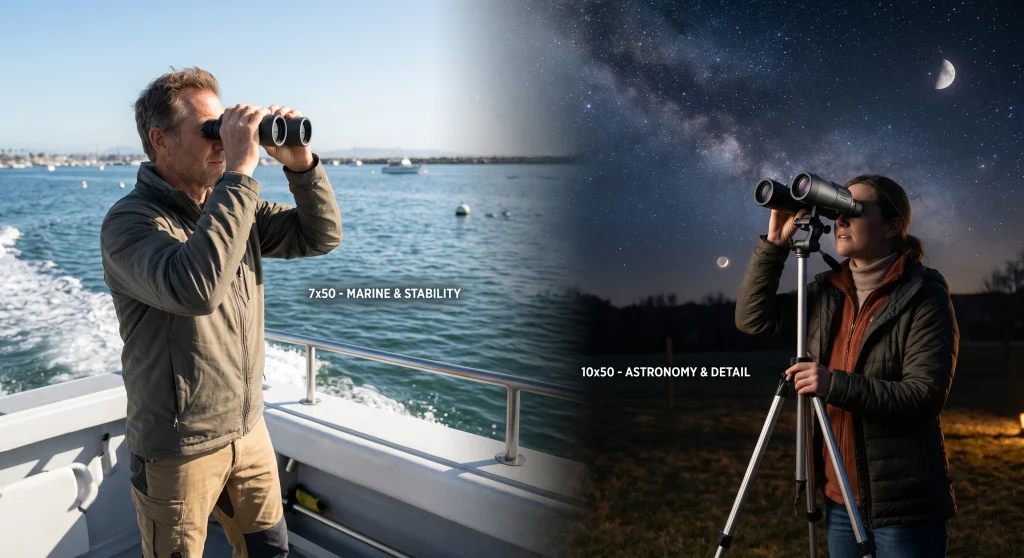
Most buyers assume more power is always the better choice. In reality, these two configurations excel in completely different environments and rarely overlap perfectly. One is the undisputed standard for marine use on the open water. The other is a heavy favorite for astronomy and long-distance terrestrial viewing from a fixed position. Understanding why requires looking at what happens to image stability and field of view when you increase the magnification power by roughly forty-three percent.
Exit Pupils and Low-Light Performance
To understand how these two configurations behave in the dark, we have to look at the exit pupil. The exit pupil is the small circle of light that hits your eye, and you calculate it by dividing the objective lens by the magnification. For a 10×50 binocular, that leaves you with a 5.0mm exit pupil. For a 7×50 binocular, you get a massive 7.14mm exit pupil, which is the largest of any commonly produced configuration on the market.
When you step outside at dusk, your human pupil dilates to around 5mm to 7mm. The 10×50’s 5.0mm exit pupil matches this effectively, resulting in a bright image. The 7×50’s 7.14mm exit pupil actually exceeds your eye’s maximum dilation. While your eye cannot process all that extra light, that oversized shaft of light creates a massive tolerance for eye alignment. This is also exactly why 7×50 is rarely the right choice for bright daylight use. At noon, your pupil shrinks to 2mm or 3mm. Pushing a 7.14mm column of light into a contracted pupil does not make the image better. It just means you are carrying around heavy 50mm lenses for light you cannot use.
Field Note: I used to hand customers a 7×50 pair and ask them to look at a dark corner of the store while deliberately shifting their eyes around the eyepieces. The image almost never blacked out. The 7.14mm exit pupil is so incredibly large that your eye can bounce around behind the lens and still capture the full picture. This creates a forgiving window of light that becomes extremely useful when your footing is unstable.
Why 7×50 Became the Marine Standard
The 7×50 configuration is printed on more marine binoculars than any other size. The choice of 7x was not accidental, and it has nothing to do with optical superiority in a vacuum. It has everything to do with the physical reality of standing on a moving boat. Any magnification power you look through amplifies the motion of your hands, and on a boat, it also amplifies the rolling pitch of the vessel.
On boating communities like The Hull Truth, the consensus among experienced mariners is incredibly consistent. They explicitly warn against wanting more than 7x magnification on a rocking boat, because anything higher becomes next to impossible to hold steady. If you attempt to use 10x magnification on the water, the horizon turns into a violently bouncing line, and reading a buoy number becomes an exercise in frustration. The 7x limit is the practical ceiling for handheld stability on the water.
Because of this strict stability ceiling, marine professionals universally default to the 7×50. If you are outfitting a boat, your only other mandatory specification check is ensuring the housing carries an IPX7 waterproof rating. Open water environments demand a fully submersible optic, not just basic weather resistance.

Designed for on-water use, these 7x50 binoculars feature a built-in rangefinder and compass for reliable navigation while boating or at sea. Fully multi-coated Porro prisms deliver a wide 396 foot field of view with a 6.8mm exit pupil for bright, clear images in low light. Waterproof, fog-proof, and wrapped in rubber armor, they weigh 2.2 pounds and include a tripod mount for steady extended viewing.
Check On AmazonIf you click this link and buy, we earn a commission at no additional cost to you.
Why 10×50 Excels at a Fixed Astronomy Position
The moment you step off a boat and plant your feet on solid ground, the stability problem drastically reduces. At a fixed astronomy position in your backyard, the 10×50 configuration starts to show its distinct advantages. When the ground is not moving under you, the extra magnification allows you to resolve significantly more detail in the night sky.
A 10×50 binocular will show you sharper craters on the Moon, pull tighter star clusters like the Pleiades into clearer view, and make deep-sky objects like the Andromeda Galaxy stand out against the black background noticeably better than a 7×50 can. Users on astronomy forums like Cloudy Nights regularly recommend both configurations for beginners, but the division is clear. They suggest the 7×50 for sweeping wide areas of the Milky Way, and the 10×50 for actually pulling out those specific celestial details.
The physical mechanics of stargazing also heavily favor the 10×50. Looking upward at steep angles inherently reduces your arm stability. While a 10×50 is manageable by hand for short scans, mounting it on a standard camera tripod transforms it into a serious astronomical tool. Furthermore, because astronomy happens on dry land, you do not need to pay the premium for marine-grade IPX7 waterproofing. You can put that money toward better lens coatings instead.

This hook-and-loop strap adapter instantly secures any size binoculars to a standard tripod without tools or screws, making it faster and easier to mount than traditional screw-based adapters. Compatible with virtually any binoculars, including models without a threaded tripod socket, and features a universal quarter-inch 20 screw thread for broad tripod compatibility.
Check On AmazonIf you click this link and buy, we earn a commission at no additional cost to you.
How Magnification Changes the Field of View
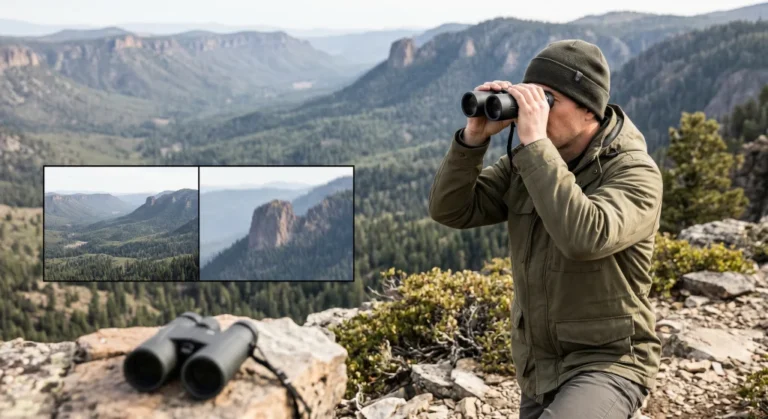
One of the most immediate differences you will notice between these two models is the field of view. Field of view is how wide of a picture you see when looking through the barrels. Because magnification acts like a crop on your image, the 7×50 will inherently deliver a wider viewing angle than the 10×50. This changes how you physically use the optic.
For sweeping a harbor to look for other boats or scanning the sky for constellations, the wider field of the 7×50 shows you more context at once. You spend less time panning and searching. Conversely, the 10×50 restricts your peripheral vision to give you a closer look at a specific target. Below is a realistic look at how these specifications compare in the real world.
| Specification | 7×50 Binoculars | 10×50 Binoculars |
|---|---|---|
| Exit Pupil | 7.14mm (Highly forgiving) | 5.0mm (Standard low-light) |
| Average Field of View | 350 to 400 feet at 1000 yards | 280 to 330 feet at 1000 yards |
| Handheld Stability | Excellent, even in motion | Manageable, requires solid stance |
| Best Environments | Marine, open water, general scanning | Astronomy, long-distance terrestrial |
Keep in mind that exact field of view numbers vary by manufacturer and optical design. The ranges in the table above reflect standard Porro prism models from major optics brands, frequently referenced on community forums like Rokslide and Cloudy Nights. Within any given product line, the 7x model will always offer a noticeably wider view than its 10x counterpart.

Designed as an affordable entry into astronomy, these 7x50 binoculars feature large 50mm multi-coated objectives that gather ample light for bright, detailed views of comets, star clusters, and the Milky Way across a wide 6.6 degree field of view. Tripod-adaptable for steady extended sessions, they double as capable daytime binoculars with a 26.2 foot close focus. Backed by a Celestron Limited Lifetime Warranty and US-based support.
Check On AmazonIf you click this link and buy, we earn a commission at no additional cost to you.
Choosing for Dual-Use: When You Sail and Stargaze
Many buyers walk into the store wanting one pair of binoculars that can handle both their summer sailing trips and their winter stargazing sessions. When you are comparing two specific configurations for multiple hobbies, you are essentially looking for the safest compromise. In this scenario, the choice usually leans in one specific direction.
If you sail and stargaze, the 7×50 is definitively the safer choice. A 7×50 works exceptionally well for both activities, offering beautiful wide-angle views of the stars while remaining perfectly usable on a moving boat. A 10×50, on the other hand, is excellent for astronomy but genuinely frustrating to use at sea. If you are struggling to decide, ask yourself these basic questions:
- Will I primarily use these from a moving platform like a boat or a vehicle? If yes, choose 7×50.
- Am I setting up a tripod in my backyard for dedicated planetary viewing? If yes, choose 10×50.
- Do I wear glasses and need the most forgiving eye placement possible? If yes, choose 7×50.
- Is identifying small details at extreme distances my top priority? If yes, choose 10×50.
In my experience, buyers who purchase the 10×50 for marine use end up leaving them in the cabin because they cause motion sickness. Buyers who purchase the 7×50 for astronomy still use them constantly, even if they occasionally wish for a bit more detail.

Aspherical multicoated eco-glass lenses deliver bright, clear images across a wide range of lighting conditions in a lightweight, ergonomically designed body. Rubber armor ensures a secure non-slip grip even in wet conditions, while turn-and-slide eyecups and a smooth central focus knob make extended viewing comfortable and effortless with or without glasses.
Check On AmazonIf you click this link and buy, we earn a commission at no additional cost to you.
Final Thoughts: Making the Right Choice
The debate between 7×50 and 10×50 binoculars is not a matter of personal preference. It is a strict functional requirement dictated by your environment. You cannot cheat the relationship between magnification and stability, and you cannot force a high-powered optic to perform well on an unstable surface.
If you are stepping onto a boat, the 7×50 is the only correct answer. It guarantees a steady, bright image when the deck is pitching. If you are standing on solid ground and want to pull specific details out of the night sky, the 10×50 earns its higher magnification. Pick the configuration that matches where you will spend the majority of your time. If you are heading to the water, our guide on marine binoculars will help you nail the remaining specifications. If the night sky is your destination, our guide to binoculars for stargazing covers everything you need to complete the setup.
FAQs
🔭 Which is better 7×50 or 10×50?
Neither is inherently better. The 7×50 is better for marine use and scanning wide areas because it is easier to hold steady. The 10×50 is better for astronomy and long-distance viewing from a fixed position because it resolves finer details.
🚢 Are 10×50 binoculars good for marine use?
In most cases, no. The 10x magnification amplifies the rolling motion of the boat, making the horizon unreadable and potentially causing eye strain. Stick to 7x magnification for any serious use on the water.
✨ Are 7×50 binoculars good for astronomy?
Yes, they are highly recommended for beginner astronomy. They offer a massive 7.14mm exit pupil for excellent low-light performance and a very wide field of view, making it much easier to locate constellations and sweep the Milky Way.
👓 Do 7×50 binoculars work well with glasses?
Yes, they are generally very forgiving for glasses wearers due to the large exit pupil. However, you still need to check the specific eye relief measurement of the model you are buying to ensure it offers at least 14mm to 15mm of space.