The Pocket Optics Dilemma
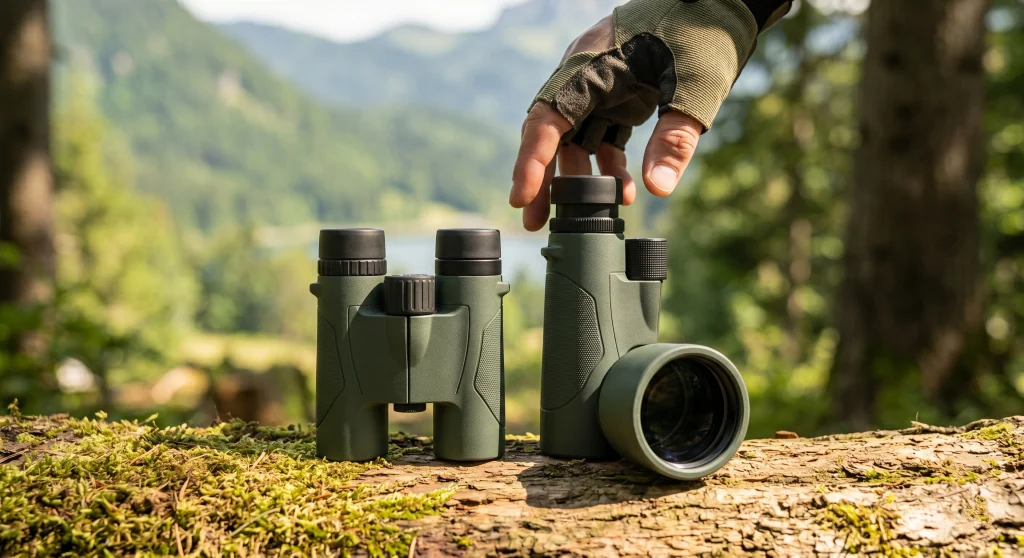
When both options fit in a jacket pocket, the binocular advantage over a monocular shrinks considerably. Most comparison articles assume you are looking at full-size optics. If you want to dive into that specific full-size dynamic, my breakdown of binoculars vs monocular covers exactly why binoculars dominate. But when you shrink everything down to pocket size, the optical rules change completely.
I have watched this confusion play out more times than I can count at the optics counter. People assume a compact binocular is just a miniaturized version of a premium hunting optic. It is not. Squeezing two complex optical tubes onto a tiny folding hinge means making heavy sacrifices in light transmission.
Because a monocular is just one tube, you can often fit much larger lenses into the exact same pocket space. To understand which portable tool you actually need, you have to look at what happens to the internal specs when the physical size goes down.
How the Optical Math Changes at Pocket Size
The most important number to understand from any spec sheet is the exit pupil, the shaft of light that actually hits your eye. As the binoculars explained guide covers in detail, this single number determines how bright your image looks in real conditions. In the compact category, this is where the monocular takes a massive lead.
Let’s look at a real comparison. A standard, high-quality compact binocular is usually an 8×25 configuration. If you divide the 25mm objective by the 8x magnification, you get an exit pupil of 3.1mm. That is fine for bright daylight, but it will look dim and muddy in the shadows of a forest or at twilight.
At a comparable price point, you can buy a 10×42 monocular. Divide 42 by 10, and you get an exit pupil of 4.2mm. The monocular pushes significantly more light to your eye while offering higher magnification. But why does a 10×42 monocular fit in the same space as an 8×25 binocular? A compact binocular is full of dead space. The central hinge, the gap between the two barrels, and the dual eyecups make it fold awkwardly. A monocular is a single, efficient cylinder that packs larger glass into the same footprint.
This is not just theory. I saw the results in person.
Field Note: I once helped a customer who was frustrated with his $200 compact 8×25 binoculars. He used them for spotting deer on his property right at dusk, and he could barely see anything. I handed him a $120 10×42 monocular. He took it outside, looked into the shadows, and came back amazed. The monocular fit in the exact same coat pocket but gathered nearly three times as much light because of the larger 42mm objective lens.
If your priority is seeing clearly in fading light without carrying a neck strap, a monocular will often outperform compact binoculars.

A BAK-4 prism and fully multi-coated 42mm objective lens reduce light loss by 99.99% for distortion-free, edge-to-edge clarity across a wide 360 foot field of view, with a close focus distance of under 3 yards. The 22.5mm eyepiece ensures comfortable viewing without blue-edge distortion, and a dual focus ring allows precise one-finger adjustments. Weighing under 9 oz at just 6.1 by 2.8 by 2.1 inches, it includes a hand strap, soft case, and neck strap for versatile everyday carry.
Check On AmazonIf you click this link and buy, we earn a commission at no additional cost to you.
The Biological Advantage of Two Eyes
If a monocular offers better light transmission for less money in the same physical size, you might wonder why anyone buys compact binoculars at all. The answer is biological. Your brain is wired to process visual information using two eyes working together.
When you look through a monocular, you are looking at a flat, two-dimensional image. You lose stereoscopic vision, which means you lose depth perception. If you are just trying to read a trail sign or confirm whether a shape on a distant ridge is a rock or an animal, a flat image is perfectly fine.
But if you are trying to track a moving object through complex terrain, depth perception is critical. Following a warbler hopping through dense tree branches is incredibly frustrating with a monocular because you cannot judge which branch is in front of the other. With compact binoculars, your brain instantly understands the 3D space.
Key Point: Extended viewing with one eye causes cognitive fatigue. Your brain has to work overtime to construct 3D information from a flat image. Looking through a monocular for twenty minutes will leave your eye feeling tired, while looking through compact binoculars for the same amount of time feels natural.

This compact metal-bodied monocular delivers high-resolution, true-to-life color images at 10x magnification with a 42mm objective lens. The ergonomic, streamlined design fits comfortably in a pocket yet feels solid and robust in hand during extended use. A versatile companion for hiking, hunting, birdwatching, wildlife viewing, and travel.
Check On AmazonIf you click this link and buy, we earn a commission at no additional cost to you.
The Price-to-Performance Reality
Manufacturing a binocular is hard. You have to grind two identical sets of lenses, build two identical prism systems, and then mount them on a central hinge that must stay perfectly parallel for years of use. If they get bumped out of alignment, you see double.
A monocular is mechanically simple. There is no hinge to break and no dual-barrel alignment to maintain. Because of this, your money goes directly into the quality of that single lens.
A high-quality pair of 8×32 compact binoculars from a reputable brand will usually start around $150 to $200. If you spend that same amount on a monocular, you are stepping into premium glass territory. A $150 monocular will often feature fully multi-coated lenses, BAK-4 prisms, and a rugged waterproof housing that easily outclasses the budget components found in a $150 compact roof-prism binocular.
The Porro Prism Exception
There is one exception here. If you are on a strict budget, looking for a compact Porro prism binocular can sometimes level the playing field. The classic staggered-barrel shape of a Porro prism is cheaper to manufacture than the straight roof prisms used in most modern compacts. A $100 compact Porro can sometimes offer a better exit pupil and brighter image than a cheap roof prism design. However, they are bulkier, which eats into the portability advantage.
That said, the real budget trap is not the Porro design. It is cheap roof prism compacts.
Buying a $50 pair of compact roof binoculars for a hiking trip. At this price, the hinge will likely be loose, the lenses will be poorly coated, and the alignment will give you a headache.
Spending that same $50 on a budget monocular. You still will not get premium glass, but because the manufacturing is so simple, a $50 monocular will be significantly sharper and more durable.

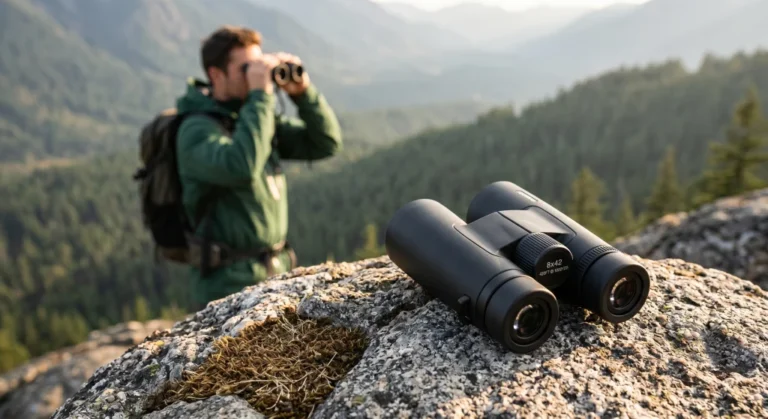
Fully multi-coated lenses deliver bright, high-contrast, true-to-color images from center to edge even in low-light conditions, in a compact foldable roof prism design that slips easily into a jacket pocket. Nitrogen-filled and O-ring sealed for full waterproof and fog-proof protection in any weather, with a rubber-armored body for shock absorption and a secure grip in wet or gloved hands. Includes a travel case, strap, and lens covers right out of the box.
Check On AmazonIf you click this link and buy, we earn a commission at no additional cost to you.
Making the Choice for Your Gear Bag
Choosing between these two options is about matching the optic to how you actually move through the outdoors. In my experience, people are much happier when they buy based on their daily habits rather than spec sheets.
| Feature | Compact Binoculars (e.g., 8×25) | Monocular (e.g., 10×42) |
|---|---|---|
| Low Light Brightness | Poor to Average | Excellent |
| Depth Perception | Full 3D processing | Flat 2D image |
| Viewing Comfort | High (good for long sessions) | Low (fatiguing over time) |
| Durability per Dollar | Moderate | High (fewer moving parts) |
| Pocket Fit | Bulky, irregular shape | Smooth, cylindrical fit |
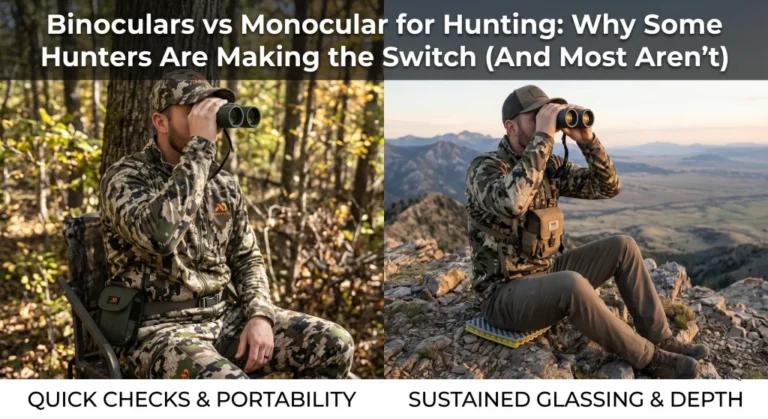
If you are an ultralight backpacker counting ounces, or a hunter who wants a quick way to check a ridge without digging into a pack, the monocular is the clear winner. It drops into a shirt pocket and gives you a bright image instantly. But if your goal is to spend time actually studying nature, the calculation changes.
When Compact Binoculars Win
- Travel birding: Following fast-moving subjects through trees requires instant spatial awareness. Two eyes keep you locked on the target.
- Extended viewing: If you plan to glass a hillside or watch a sporting event for more than a few minutes, two-eye viewing prevents the cognitive fatigue of processing a flat image.
When a Monocular Wins
- Pure portability: A monocular slides into the side pocket of a backpack much easier than folded binoculars with their awkward hinges and eyecups.
- The Smartphone Adapter Factor: A monocular pairs exceptionally well with a cheap smartphone adapter for digiscoping. If you want to snap a quick photo of a distant elk, clamping a phone to a single eyecup is fast and stable. Doing this with compact binoculars is awkward and often misaligned.
- Strict budgets: If you have less than $100 to spend, a monocular will give you drastically better glass and build quality.

This patent-pending aluminum alloy adapter features precise three-axis adjustment in all directions including Z-axis for correct eye relief, ensuring razor-sharp alignment between your phone camera and any eyepiece. Compatible with smartphones from 2.36 to 3.44 inches wide and eyepieces from 0.86 to 2.4 inches in diameter, fitting most telescopes, spotting scopes, binoculars, and monoculars. Includes a Bluetooth shutter remote for shake-free hands-free capture.
Check On AmazonIf you click this link and buy, we earn a commission at no additional cost to you.
Closing Thoughts: The Best Pocket Optic
The choice between compact binoculars or a monocular should not be based on what traditional birders or hunters tell you is proper gear. It is purely about your mobility and your patience.
If you regularly stop to study wildlife, track movement, or glass for extended periods, you need the biological comfort of two eyes. Check out our breakdown of compact binoculars to find the specific models that do not sacrifice too much light for their size.
But if your optic is a backup tool, something you pull out for thirty seconds to identify a trail marker, a distant peak, or a stationary animal, stop carrying the extra barrel. A good monocular gives you premium glass in a streamlined package that will never get left behind in the truck.
FAQs
🎒 Is a monocular good for hiking?
Yes, a monocular is excellent for hiking. It is lighter than binoculars, deploys easily with one hand for quick spot-checking, and takes up minimal space in a backpack pocket.
🔭 Are compact binoculars better than a monocular?
They are better for extended viewing sessions and tracking moving objects. However, they usually offer worse low-light performance than a monocular at the same price due to smaller objective lenses.
👓 Can you use a monocular if you wear glasses?
Yes, but you must check the eye relief specification. Look for a monocular with at least 14mm to 15mm of eye relief and a twist-up eyecup that can be retracted to accommodate your glasses.
🦅 Which is better for travel birding?
Compact binoculars are almost always better for birding. Tracking fast movement in complex foliage requires two-eye spatial awareness, making binoculars the standard choice.