Binoculars vs Monocular: Choosing the Right Tool for the Field
A monocular is not a worse binocular. It is an entirely different tool. When people ask me to compare binoculars vs monocular options at the optics counter, they usually expect me to talk strictly about size and weight. We get to that eventually, but the real conversation always has to start with how the human brain processes images. Making the wrong choice here usually means leaving your expensive optics sitting at home because they do not fit the way you actually move outdoors.
If you are holding a box for a compact binocular in one hand and a premium monocular in the other, you are looking at a classic trade-off. One gives you a three-dimensional view of the world. The other gives you incredible portability and often better glass for the exact same amount of money. Over the years, I have helped hundreds of people navigate this exact decision.
The answer is rarely about which piece of equipment is objectively better. It is about matching the optic to your specific activity, your tolerance for carrying gear, and how your eyes handle sustained focus. Here is how to tell which one your situation actually calls for.
The Functional Difference Between Binoculars and Monocular Optics
The most fundamental difference between binoculars and monocular devices is not the number of barrels. The real difference is depth perception. Human beings have stereoscopic vision, which means our eyes face forward and provide two slightly different viewing angles of the same scene. The brain instantly merges these two images to calculate distance, track movement, and separate objects from their background.
When you look through a binocular, you are feeding your brain the stereoscopic input it expects. You retain your ability to read the depth of a terrain, judge the distance to a perched bird, and track three-dimensional movement through dense cover. This is not just about image quality. It is about the physical processing of spatial information.
Field Note: One of the most common things I heard at the counter was hunters coming in to return a high-end monocular they had taken on a weekend trip. They always told me the same thing: the image looked flat. The glass was perfectly fine, but without binocular vision, they could not easily spot a deer standing still against a background of brown brush. Their brain could not separate the animal from the trees without depth perception.
When you use a monocular, you surrender that depth perception completely. You are looking at a compressed, flat, two-dimensional image. This is perfectly fine for reading a trail sign across a valley or confirming the identity of a static object. It becomes a significant disadvantage when you are trying to find a camouflaged animal or follow a bird weaving through a thick canopy.
The Hidden Cost of One Eye: Depth Perception Fatigue
There is a physical consequence to looking at a flat image for a long time. Sustained monocular use does not make you see less detail, but it absolutely makes your brain work harder. Your visual cortex is constantly trying to construct three-dimensional information from a flat image. Over a short period, you will not notice this at all. Over a longer session, this cognitive load is very real and highly measurable.
If you try to glass a hillside for thirty minutes using only one eye, you will likely develop a headache. Your active eye will begin to water. Your closed eye will feel strained from being squeezed shut. This is what we call depth perception fatigue. It is a compounding issue that ruins extended observation sessions.
This is the primary reason why extended wildlife watching demands binoculars. If you plan to sit on a ridge and scan for elk for three hours, or if you plan to spend a full morning watching a wetland habitat, a monocular will punish you. You need the relaxed, natural viewing experience that only comes from using both eyes simultaneously. Before diving into specific models, you can read more about how these core optical principles work in our comprehensive guide to understanding binoculars.
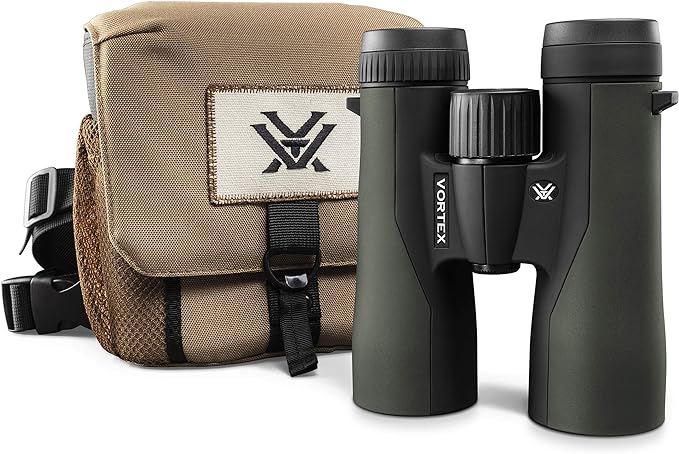
Select HD glass elements with fully multi-coated lenses deliver exceptional edge-to-edge sharpness, color fidelity, and light transmission in a compact roof prism design. Nitrogen-purged and O-ring sealed for waterproof, fog-proof performance in any conditions, with rubber armor for shock resistance and a secure grip. Tripod-adaptable and backed by Vortex's unlimited, unconditional, fully transferable lifetime VIP Warranty.
Check On AmazonIf you click this link and buy, we earn a commission at no additional cost to you.
When You Should Buy a Monocular
Despite the lack of depth perception, there are situations where a monocular is undeniably the superior choice. The first and most obvious advantage is the form factor. A monocular offers the exact same aperture and magnification as a half-binocular, but it fits into a jacket pocket. It enables an always-on-body carry strategy that binoculars simply cannot match without a dedicated chest harness.
One-Handed Operation
The physical operation is another factor. You can pull a monocular from a pocket, raise it, and focus it entirely with one hand. If you hike with trekking poles, walk dogs, or have limited mobility in one hand, this is a massive operational advantage. A binocular inherently requires both hands to hold steady and adjust focus comfortably.
The Digiscoping Advantage
Digiscoping is a growing use case where the monocular actually beats the binocular. If you use your phone to take pictures through your optics, a monocular is far easier to set up. You only have to align your phone camera with one single eyepiece. The lighter weight of the monocular also puts much less stress on the phone adapter, preventing the whole rig from shifting around while you try to capture a shot.
The Cost to Quality Ratio
Cost is the second massive advantage. Building a binocular is expensive because of collimation. The manufacturer has to perfectly align two separate optical tubes so they point at the exact same microscopic spot. If they are off by a fraction of a millimeter, the user gets double vision and a migraine. A monocular completely eliminates the need for collimation. All the manufacturing budget goes into a single tube and a single set of glass.
Because of this, a monocular gives you much better raw materials per dollar. To show exactly how this plays out, here is what the optical quality gap looks like at different price points.
| Price Tier | What it buys in a binocular | What it buys in a monocular |
|---|---|---|
| Under $100 | Poor coatings, fragile build, high risk of misalignment | Decent glass, functional coatings, reliable alignment |
| $100 to $300 | Acceptable entry-level optics, basic multi-coating | Premium glass, high-end coatings, excellent low-light performance |
| Over $300 | Premium features become standard (ED glass, phase correction coatings) | Excellent optical performance and premium glass; the optical gap versus binoculars narrows, but the portability advantage remains |
The hunting community has started to embrace this for specific scenarios. A contributor at GearJunkie hunted multiple trips with nothing but a Maven M.2 12×50 monocular, noting how freeing it was to ditch a clunky harness. For hikers who just want to casually spot-check a trail ahead, or for weight-obsessed backpackers, the monocular is a brilliant, highly functional tool.

Weighing just 8.09 oz, this ultra-portable monocular features fully multi-coated optics and a Swiss-designed BaK-4 prism for bright, edge-to-edge clarity across a wide 405 foot field of view. IPX7 rated with a medical-grade O-ring and nitrogen sealing, it handles submersion up to 3 feet for 30 minutes without compromise. A patented wave grip, three-position twist eyecup, and a no-matter-what lifetime warranty make it a confident everyday carry for kids and adults alike.
Check On AmazonIf you click this link and buy, we earn a commission at no additional cost to you.
When Binoculars Are Absolutely Required
If you are deciding between binoculars or monocular setups for serious observation, the binocular wins almost every time. There are a few specific situations where sacrificing depth perception is simply not an option.
Bird Watching and Fast Acquisition
Bird watching is the most obvious example. Bringing binoculars to your eyes is a trained, automatic motion that most birders execute in under two seconds. You spot the bird with your naked eye, lock your gaze, and bring the optic up without moving your head.
With a monocular, you add several cognitive steps. You have to close one eye, bring the optic up, center it over your open eye, and then try to re-acquire the target in a flat image. For fast-moving birds in dense foliage, that delay costs you the view. By the time you find the branch, the warbler has already flown away.
Sustained Glassing and Dense Cover
Buying a high-power monocular for a full week of spot-and-stalk hunting to save weight, only to realize you cannot scan a ridgeline for more than ten minutes without getting a severe headache.
Accepting the extra weight of a binocular harness for sustained observation days, and keeping a small, inexpensive monocular in your truck glovebox for quick roadside checks.
Hunting in dense cover is another area where two eyes are mandatory. When you are looking into a thick patch of woods, you need binocular vision to punch through the layers of branches. Your brain uses the stereoscopic input to look past the foreground obstructions and focus on the background. A monocular forces everything into a single flat plane, making a deer perfectly blend into the trees surrounding it.

This lightweight cross-design nylon harness evenly distributes weight across the neck and shoulders to eliminate fatigue during extended carry, keeping binoculars snug against the chest for instant one-handed access. Fully adjustable on both front and back to fit any body type, and compatible with most binoculars, cameras, and rangefinders.
Check On AmazonIf you click this link and buy, we earn a commission at no additional cost to you.
Binoculars vs Monocular: The Decision Checklist
If you are still struggling to choose, you need to step away from the spec sheets and look honestly at how you spend your time outdoors. Most buyers over-estimate how long they will actually spend looking through their optics. I always ask my customers to walk through a specific set of questions to narrow down the reality of their use case.
Before you make a purchase, use this checklist to force a decision based on your actual habits.
- Are your observation sessions longer than ten minutes? If yes, choose binoculars. The depth perception fatigue of a monocular will ruin extended viewing.
- Do you need a free hand while observing? If yes, choose a monocular. It operates perfectly with one hand while the other holds a trekking pole or dog leash.
- Is your budget strictly under one hundred dollars? If yes, choose a monocular. Cheap binoculars are frustrating, but a cheap monocular can still be highly functional.
- Are you trying to track fast-moving birds in dense cover? If yes, choose binoculars. You need two eyes to instantly lock onto movement through branches.
- Do you leave your optics at home because of the size? If yes, choose a monocular. The best glass in the world is useless if it sits in your closet.
There is also a middle ground to consider. Some users find that navigating the different types of binoculars leads them to compact models. A high-quality compact binocular can sometimes bridge the gap, offering two-eye viewing in a package that is nearly as portable as a large monocular.

Fully multi-coated lenses and phase-coated BaK-4 prisms deliver bright, crisp, color-accurate images across all lighting conditions, with a wide 7.4 degree field of view for easy tracking. The rubber-armored polycarbonate body is waterproof, nitrogen-purged, and tripod-adaptable for extended sessions. Backed by a Celestron Limited Lifetime Warranty and US-based support.
Check On AmazonIf you click this link and buy, we earn a commission at no additional cost to you.
Final Thoughts on the One Eye Versus Two Debate
At the optics counter, I always watched customers try to buy the absolute best optical view possible, often completely ignoring how they actually planned to carry the equipment. The reality is that your tolerance for carrying gear dictates what you will use. The smartest buyers I saw did not optimize for the perfect view. They optimized for the reality of their patience and carrying capacity.
A monocular forces you to give up depth perception, but it guarantees you will actually have an optic in your pocket when a hawk lands in a nearby tree. Binoculars demand more space and more money, but they reward you with a relaxed, immersive view that you can comfortably enjoy for hours. Look hard at how you actually move outdoors, not just how clearly you want to see.
More Specific Comparisons
Once you have decided between one eye and two, the context of your activity will dictate the exact specifications you need. I have broken down how this exact debate plays out across different specific use cases so you know exactly what you are getting into before you buy.
| Deep Dive Topic | What You Will Learn |
|---|---|
| Binoculars vs Monocular for Birding | Find out exactly why raising a monocular costs you views of fast-moving birds, and why 3D tracking is non-negotiable for this hobby. |
| Binoculars vs Monocular for Hunting | Learn why eastern tree stand hunters can easily get away with a pocket monocular, while western elk hunters absolutely need binocular vision. |
| Compact Binoculars vs Monocular | Discover the specific optical trade-offs when comparing two optical devices that both fit directly in a jacket pocket. |
FAQs
👁️ Is a monocular as good as binoculars for everyday use?
For quick spot-checking and reading trail signs, a monocular is fantastic and much easier to carry. However, for anything requiring more than a few minutes of continuous viewing, binoculars are much better because they prevent eye strain and provide depth perception.
🔭 Can you use a monocular if you wear glasses?
Yes, but you must check the eye relief specification before buying. Just like binoculars, a monocular needs at least 14mm to 15mm of eye relief to present a full, clear image to a user wearing eyeglasses.
🦅 Are monoculars good for bird watching?
They are generally not recommended as a primary birding tool. Birding requires fast target acquisition and tracking movement through three-dimensional branches, which is extremely difficult to do without the stereoscopic vision that binoculars provide.
💰 Why are binoculars so much more expensive than a monocular?
Binoculars require two optical tubes to be perfectly aligned with microscopic precision, a process called collimation. A monocular only requires one tube, meaning the manufacturer can put better glass and coatings into a much cheaper final product.