The Common Frustration of the Dark Ring
Learning how to use binoculars with glasses usually starts with a moment of frustration. You bring the lenses up to your eyes, and instead of a bright, wide picture, you get a tunneled view surrounded by a thick black ring. It feels a lot like looking down a dark pipe. From what I have seen at the optics counter, almost everyone assumes they are just holding the optic wrong or that their glasses are simply incompatible with the equipment.
If you understand what your glasses are physically doing to the distance between your eye and the lens, the fix becomes obvious. Your frames create a physical barrier. They stop your eye from getting flush against the rubber eyecup. Because binoculars are designed to project their image a very specific distance away from the rear lens, that barrier changes everything.
Two Reasons You Are Losing Field of View
When you cannot see the full image, the picture is being clipped because your eye is sitting too far back from the lens. This happens for two distinct reasons.
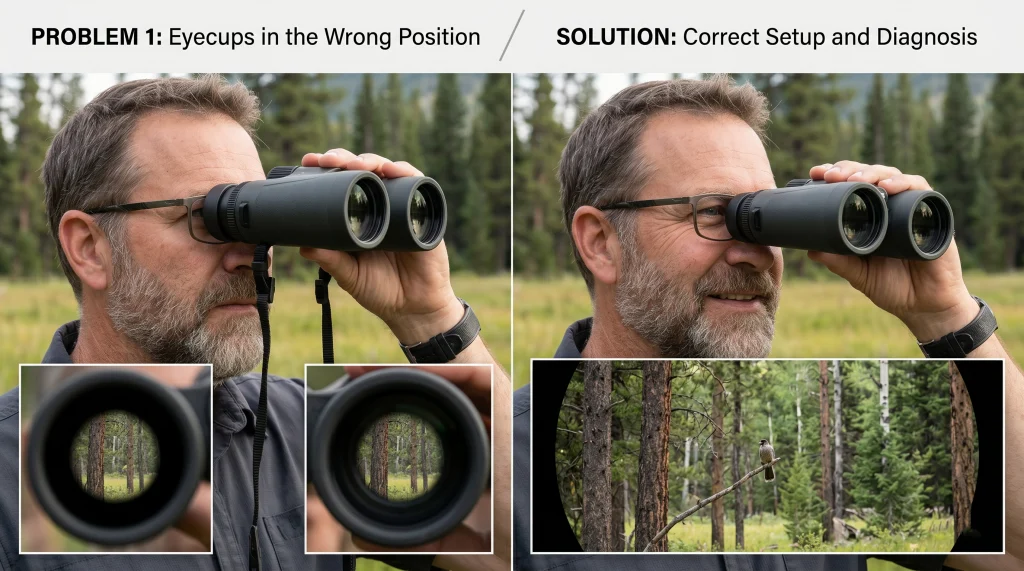
Problem 1: The Eyecups Are in the Wrong Position
Modern binoculars have eyecups that twist up and down. Older models have rubber eyecups that physically fold back. The entire purpose of these eyecups is to create distance for people who do not wear glasses. When you twist them up, they hold a naked eye at the exact perfect distance to see the full picture.
When using binoculars with eyeglasses, your glasses are already providing that physical distance. If you leave the eyecups twisted up or extended, you are stacking distance on top of distance. The eyecup pushes your glasses back, and your glasses push your eye back even further. You end up sitting way outside the designed viewing window.
Leaving the eyecups fully extended while wearing glasses. This guarantees you will see a dark ring and lose up to half of your visible image.
Twisting or folding the eyecups completely down before bringing the binoculars to your glasses. This brings your eye close enough to catch the full picture.
Problem 2: The Eye Relief Spec Is Too Short
This is the problem you cannot fix with a physical adjustment. Every binocular has a specification called “eye relief.” This is a measurement in millimeters that tells you exactly how far back your eye can sit while still seeing the entire edge-to-edge image.
If a binocular has an eye relief of 11mm, the image is perfectly formed exactly 11mm behind the glass. But standard eyeglasses typically place your eye 14mm to 15mm away from the lens. If you own binoculars with 11mm of eye relief, your eye physically cannot get close enough to see the whole picture. The glasses hit the housing before your eye reaches that 11mm sweet spot. No matter how much you press the binoculars into your face, that dark ring will persist because your frames are acting as a hard stop.

ED glass lenses with dielectric multilayer prism coatings virtually eliminate chromatic aberration and deliver bright, true-to-life color from dawn to dusk. A close focus distance of 8.2 feet and a broad field of view make tracking birds and wildlife effortless, while the smooth center focus knob allows precise adjustments on the move. Nitrogen-purged and O-ring sealed in a lightweight rubber-armored body, with turn-and-slide eyecups for all-day comfort.
Check On AmazonIf you click this link and buy, we earn a commission at no additional cost to you.
The Five-Second Diagnostic Test
Because these two issues look identical from your side of the lenses, you need a way to figure out which one is happening. You can run this test in your living room or out in the field.
First, take your binoculars and fully retract the eyecups. If they are the twist-up style, twist them all the way down until they bottom out. If they are the older rubber style, fold the rubber completely back over the barrel. Now, put your glasses on and bring the binoculars up so the lenses gently touch your eyeglass frames.
| What You See | What It Means |
|---|---|
| The dark ring disappears and you see the full, wide image. | Problem 1. Your eyecups were just in the wrong position. Keep them rolled down whenever you wear your glasses and the optic will work perfectly. |
| The dark ring is still there, blocking the outer edges. | Problem 2. Your binoculars do not have enough eye relief. You are using the wrong hardware for your eyes. |
Field Note: I used to do this exact diagnostic test with customers at the counter all the time. Someone would hand me a pair of binoculars, frustrated that they were defective because the view was tiny. I would twist the eyecups down, hand them back, and watch their entire posture change. It is easily the most common user error I have ever seen.
How Your Diopter Interacts With Your Prescription
Once you have confirmed which problem you have, the next question most people ask is whether they even need to keep their glasses on at all. The answer is yes, sometimes, but it depends entirely on your specific eye prescription.
If you are simply nearsighted or farsighted, the focus wheel on the binoculars can often compensate for your vision. You can take your glasses off, extend the eyecups, and use the center focus wheel to bring the image into sharp clarity. If you decide to take them off, you will need to completely reset your diopter to match your naked eyes. You can read my full breakdown on how to use binoculars to get that dial set correctly for your uncorrected vision.
However, if you have astigmatism, taking your glasses off is not an option. Nearsightedness just shifts where the light focuses. Astigmatism actually distorts the shape of the light entering your eye. Binoculars only shift focus, they cannot reshape light. If you take your glasses off with astigmatism, you will never get a perfectly crisp image, no matter how much you turn the dials. You must keep your glasses on.
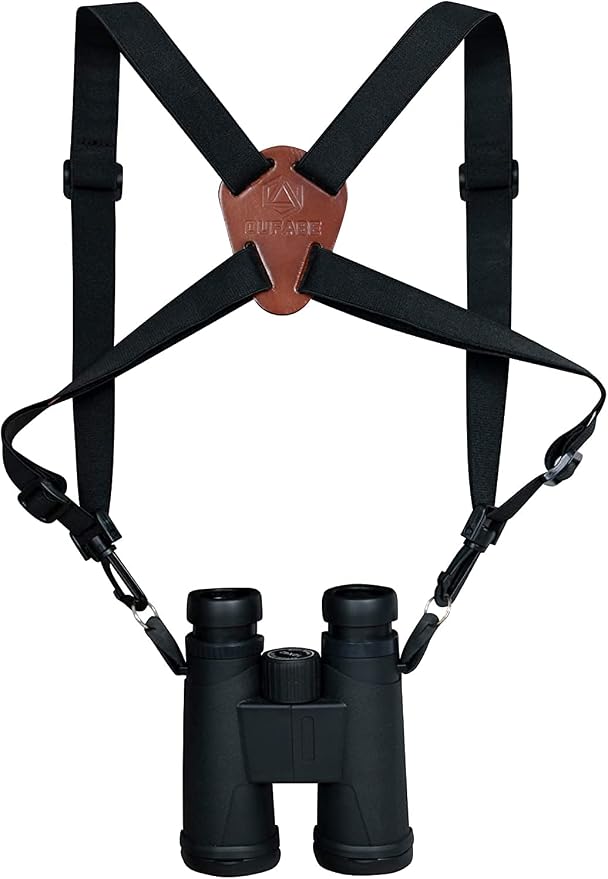
Double-stitched nylon and Lycra construction with premium leather accents delivers maximum durability and a tactical look built to last. The X-shaped shoulder design evenly distributes weight across your shoulders and back, eliminating neck fatigue during extended wear. Fully adjustable straps reduce chest sway and allow quick sliding into viewing position, fitting all binoculars with a half-inch eyelet as well as heavy cameras.
Check On AmazonIf you click this link and buy, we earn a commission at no additional cost to you.
How Frame Styles and Bifocals Change the View
Even with perfect eye relief, the specific style of your glasses can introduce entirely new viewing problems. Two frame types commonly cause issues in the field.
Bifocals and Progressive Lenses
If you wear progressive lenses, you might experience a blurry image even when everything else is dialed in. When you tilt your head up to look through the optics, it is incredibly easy to accidentally look through the lower reading zone of your lenses instead of the upper distance zone. Adjusting your chin downward is a simple technique for wearing glasses with binoculars that takes a bit of practice, but it solves the progressive lens blur immediately.
Sports and Wrap-Around Frames
Heavily curved wrap-around frames create a geometry problem. The curve holds the center of the lens further away from your eye than a standard flat frame would. This means a 15mm eye relief specification might not be enough, because the curve of the frame forces the binocular housing further out. If you primarily wear sports frames, you will likely need to shop in the 17mm to 18mm eye relief range to compensate.

Select HD glass elements with fully multi-coated, dielectric-coated lenses deliver exceptional sharpness, color fidelity, and light transmission, while Armortek coating protects exterior surfaces from scratches and oil. Argon-purged and O-ring sealed for waterproof, fog-proof performance in any conditions. Includes a GlassPak chest harness and backed by Vortex's unlimited, unconditional, fully transferable lifetime VIP Warranty.
Check On AmazonIf you click this link and buy, we earn a commission at no additional cost to you.
The Checklist Every Eyeglass Wearer Needs Before Buying
If you are currently shopping for a new pair, or if you just failed the diagnostic test above, you need to know exactly what to look for on the spec sheet. Getting this wrong means buying a tool you will hate using.
If you are looking for practical binoculars tips for eyeglass wearers, the most important ones happen before you reach the checkout counter.
- Look for a minimum of 14mm eye relief: In my experience, 14mm is the absolute floor for most standard eyeglass frames. If you wear thicker frames or have a strong prescription with thicker lenses, you should be looking for 16mm or more.
- Avoid most compact binoculars: Pocket-sized compact binoculars are notorious for having terrible eye relief. Many of them sit around 10mm to 12mm. While they are great for hiking, they are often a nightmare for people with glasses.
- Check the eyecup quality: Because you will be keeping the eyecups twisted down permanently, the rim of the eyepiece will tap against your eyeglass lenses repeatedly. Make sure the binoculars you buy have rubber bumpers on the rim so you do not scratch your glasses against bare metal or hard plastic.
- Pre-focus your diopter with your glasses on: When you set the right-eye diopter to balance your vision, make sure you are wearing your glasses during the setup process.
Eye relief is just one part of the puzzle, but for glasses wearers, it is the most critical. If you are still trying to make sense of the other numbers on the box, my guide on binoculars explained covers how the rest of the specs interact with each other in the field.
Pro Tips: If you are setting up specifically for fast-moving targets in the woods, the eye relief rule applies even more strictly. When you lose field of view to a dark ring, you lose the ability to track movement. You can check my guide on binoculars for bird watching to see why getting a wide, unblocked view becomes a major factor when wearing glasses.

Each 6 by 7 inch cloth is made from premium microfiber that lifts and absorbs dust, oil, fingerprints, and smudges without scratching, streaking, or leaving lint behind. Versatile enough for eyeglasses, camera lenses, phones, laptops, and screens of all types. Comes as a set of 6 individually packaged cloths, always clean and ready to use straight out of the bag.
Check On AmazonIf you click this link and buy, we earn a commission at no additional cost to you.
Final: The Right Setup Should Feel Effortless
Using binoculars with glasses should not feel like a compromise. You should not have to squint, press the housing painfully against your brow, or accept a tiny window of view. If you have to fight the equipment, something is set up wrong.
Once you match the right eye relief with the correct eyecup position, the optic practically disappears, leaving you with nothing but the view.
FAQs
👓 Do I really need to wear my glasses when using binoculars?
It depends on your prescription. If you are simply nearsighted or farsighted, you can usually take them off and let the binoculars focus for you. If you have astigmatism, you must keep them on to get a sharp image.
🔭 What does eye relief mean on binoculars?
Eye relief is the distance in millimeters that your eye can sit behind the lens while still seeing the entire image. Glasses wearers need longer eye relief to compensate for the space their glasses take up.
📏 Is 15mm eye relief enough for glasses wearers?
In most cases, yes. 14mm to 15mm is generally considered the minimum requirement for people wearing standard eyeglasses. If your frames are unusually thick, you might need 16mm or more.
🦅 Why do I see black shadows when I look through my binoculars?
Black shadows or a dark ring around the edge means your eyes are sitting too far away from the lenses. If you wear glasses, make sure the eyecups are fully twisted down to bring your eyes closer.
👁️ Can binoculars correct for astigmatism?
No, standard binoculars cannot correct for astigmatism. The focus wheel only adjusts distance, not the shape of the light. You will need to wear your glasses while looking through them for a crisp view.