The Habitat Rule for Birding Optics
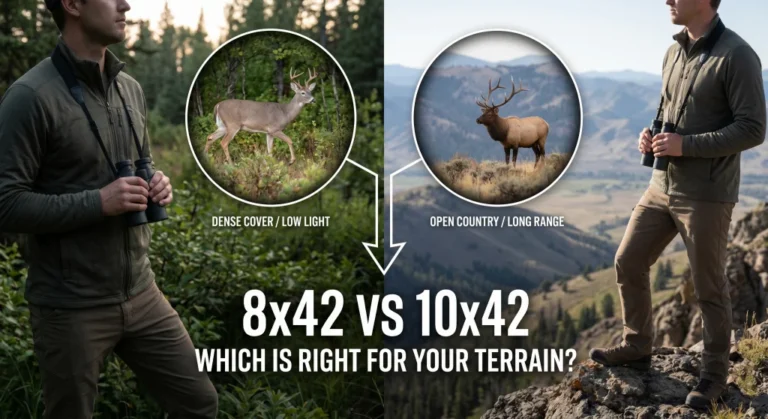
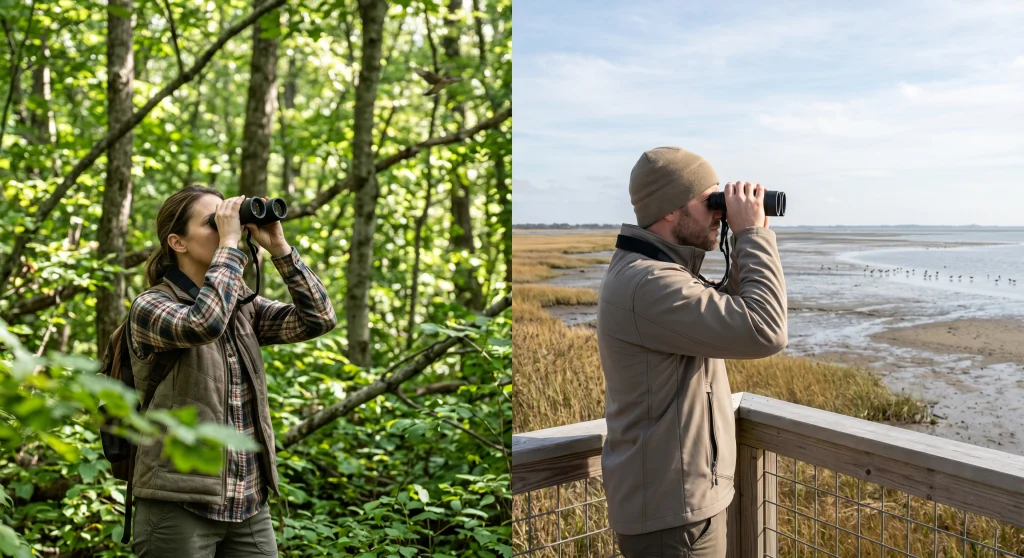
When choosing between these two magnifications, most people assume it is just a matter of how close you want the bird to look. I have watched this play out countless times at the optics counter. A customer will buy the higher magnification, only to bring it back a week later frustrated that they cannot locate warblers in the trees. If you are walking through dense woods, you need a completely different tool than someone standing on a coastal observation deck. Both are 42mm objective binoculars, but the entire comparison rests on what those extra two magnification steps do to your viewing angle, your image stability, and your minimum focus distance.
Why the 8×42 Dominates Most Birding
The 8×42 is the most recommended binocular configuration in the world for a specific reason. In dense brush, forest trails, or scrub habitats, birds move fast and stay hidden. An 8×42 gives you a significantly broader visual sweep compared to a 10×42. When you raise the binoculars to your eyes, that extra peripheral space makes it much easier to catch a fleeting shape before it darts behind a branch.
The FOV Gap in Real Numbers
To put numbers to this advantage, consider a typical mid-range line. The Athlon Midas G2 8×42 offers 426 feet of viewing angle at 1,000 yards. The exact same binocular in 10×42 drops to 341 feet. That is 85 feet of lost viewing width. When you are trying to track a fast-moving target in thick foliage, that missing window is the difference between a positive identification and staring at empty leaves.
The Dawn Chorus Test
Bird activity peaks just before and after sunrise. Stand at a forest edge at 5:30 AM in November and you will feel this difference immediately. An 8×42 produces a 5.25mm exit pupil, which delivers a brighter, more forgiving image to your dilated eyes than the 4.2mm exit pupil of a 10×42. In that dim light, a bright image of a small bird is infinitely more useful than a dark, murky image of a slightly larger one.
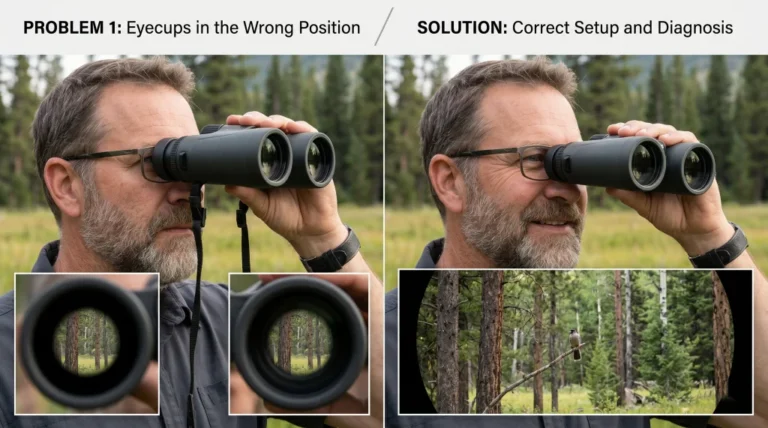
This larger exit pupil is also exactly why I steer glasses wearers toward the lower magnification. Eyeglasses physically push your face away from the lenses. A 5.25mm exit pupil creates a wider column of light, making it easier to align your eyes without getting black shadows around the edges. If you need a refresher on how this math works across all sizes, our main guide on binoculars explained covers the baseline specs.
Field Note: The most common mistake I see is beginners buying a 10×42 for backyard birding, then struggling to find the birds in their own trees. While hunters often make the 8×42 vs 10×42 binoculars decision based on terrain distance, birders must factor in acquisition speed just as heavily.
The Hidden Advantage of Close Focus
There is one specification that birders care about more than almost anyone else, and it heavily favors the lower magnification. That is the close focus distance. A typical 8×42 model will focus down to five or eight feet. The equivalent 10×42 model in the exact same product line will often bottom out around eight to twelve feet.
This sounds like a minor detail until you are watching a hummingbird at a feeder or trying to identify an insect near your boots. For garden birding, the ability to focus on something just a few paces away is critical. The optical design required to achieve higher magnification inherently pushes that minimum focus distance further out, making the 10×42 frustrating for close-quarters observation.

Fully multi-coated lenses and phase-coated BaK-4 prisms deliver bright, crisp, color-accurate images across all lighting conditions, with a wide 7.4 degree field of view for easy tracking. The rubber-armored polycarbonate body is waterproof, nitrogen-purged, and tripod-adaptable for extended sessions. Backed by a Celestron Limited Lifetime Warranty and US-based support.
Check On AmazonIf you click this link and buy, we earn a commission at no additional cost to you.
When a 10×42 is the Better Tool
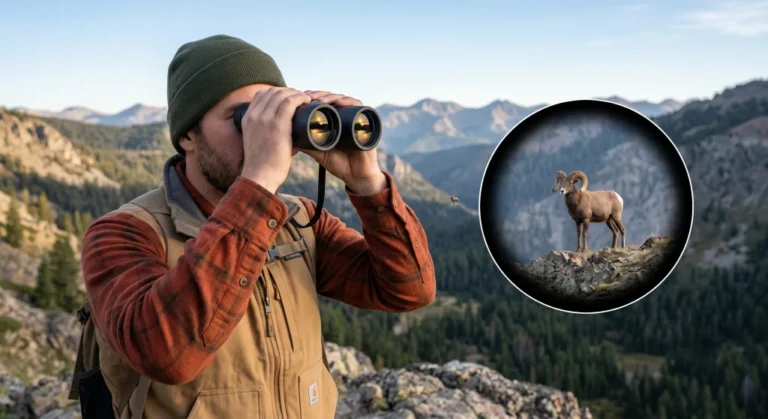
Despite everything I just covered, there are specific birding situations where an 8×42 falls short and a 10×42 becomes necessary. The rule here is open space and stationary targets. If you spend your weekends on hawk watch platforms, identifying pelagic birds from a boat deck, or scanning vast mudflats for shorebirds, the higher power becomes the right call.
In these open habitats, you are typically dealing with birds that are very far away and not darting rapidly between branches. You have the time to find them in a narrower field of view, but you need the extra resolving power to see minute plumage details. When a bird is perfectly still at two hundred yards, that extra magnification is what resolves the subtle field marks you need for a positive identification. Trying to read a leg band on a distant gull is a task uniquely suited for a 10×42.
The tradeoff is that you have to hold them perfectly steady. A 10x optic amplifies your hand tremors noticeably more than an 8x optic. For distant scanning, many experienced birders will brace their elbows on a railing or use a specialized harness to keep the image stable during long observation sessions. It requires a bit more technique, but the reward is a level of detail that lower magnification simply cannot reach.

This ergonomic X-shaped harness evenly distributes weight across your neck, back, and shoulders for fatigue-free all-day carry of binoculars or cameras. Fast-release high-grade plastic buckles and adjustable sliding brackets make setup quick and easy for all body sizes. Backed by a 100% satisfaction guarantee with no-questions-asked returns.
Check On AmazonIf you click this link and buy, we earn a commission at no additional cost to you.
The Beginner Rule for Birding Optics
If this is your first dedicated pair of optics, I always recommend sticking with the lower magnification. When you are just starting out, the absolute hardest part of the hobby is simply getting the bird in the glass before it flies away. The larger viewing angle is a massive crutch while you build the muscle memory of raising the binoculars directly to your line of sight.
I have seen many enthusiastic beginners quit because they bought too much magnification and felt like they were constantly looking through a shaky straw. An 8×42 is forgiving of imprecise eye placement, forgiving of hand shake, and forgiving of sloppy pointing. It allows you to actually enjoy the process of watching the bird rather than fighting the tool.

Fully multi-coated lenses and phase-coated BaK-4 prisms deliver sharp, color-accurate images at 10x magnification across a 5.8 degree field of view. The rubber-armored polycarbonate body is waterproof, nitrogen-purged, and tripod-adaptable for steady extended sessions. Backed by a Celestron Limited Lifetime Warranty and US-based support.
Check On AmazonIf you click this link and buy, we earn a commission at no additional cost to you.
Mapping Your Local Habitat
To make this completely concrete, you need to look at where you actually plan to go. Forget about what an online forum says is objectively better. Look at the trees, the sightlines, and the distances you deal with on an average Saturday morning. The right tool for a dense temperate rainforest is the wrong tool for a desert canyon.
The following list and table break down common birding scenarios so you can match the tool to the terrain. Evaluating your most frequented spots will prevent a costly mistake at the optics counter.
- Dense forests and woodland trails: An 8×42 is mandatory here. The birds are close, fast, and often obscured by leaves.
- Backyard and garden setups: The close focus ability of an 8×42 makes it the clear winner for feeder watching and observing insects.
- Coastal shorelines and mudflats: A 10×42 excels here. Distances are extreme, and the birds are relatively stationary while foraging in the open.
- Hawk watching and raptor ID: The 10×42 provides the necessary reach to spot distant silhouettes against an open sky.
| Birding Habitat | Recommended Magnification |
|---|---|
| Dense Woodlands | 8×42 |
| Backyard / Garden | 8×42 |
| Mixed / Suburban | 8×42 |
| Open Grasslands | 10×42 |
| Coastal / Shorebirds | 10×42 |
| Hawk Watching | 10×42 |
If Your Habitat Changes
If you split your time evenly between dense woods and open coastlines, or if you travel frequently, the default tiebreaker should always go to the lower magnification. An 8×42 can function adequately on a shoreline, even if it lacks reach. A 10×42, however, is genuinely frustrating to use in thick brush. When in doubt, buy the more versatile option.

This pocket-sized cleaning tool combines a retractable natural hair brush for dust removal with a revolutionary non-liquid compound that safely eliminates smudges, fingerprints, and oily residue without spilling or drying out. Reduces static charge buildup and is safe for use on all lenses, all in a lightweight package small enough to carry anywhere.
Check On AmazonIf you click this link and buy, we earn a commission at no additional cost to you.
Final: Making the Choice for Your Daily Carry
Choosing the right configuration does not require overthinking. Look at the terrain where you park your car most Saturday mornings. If you are stepping onto a woodland trail or watching feeders from your porch, buy the 8×42. The speed of finding the bird will save you constant frustration.
If you are walking out onto an observation deck overlooking a massive mudflat, buy the 10×42. You will need the reach to resolve details on distant, stationary targets. Match the tool to the terrain you actually frequent, and the optics will get out of your way so you can just watch the birds.
FAQs
🦅 What is the best magnification for bird watching?
8x is the standard for most habitats because of the wide viewing angle. 10x is better for open plains or coastal shorebirds. If you are unsure, default to 8x.
🦉 Are 10×42 binoculars too shaky for birding?
They amplify hand tremor more than an 8x. Most adults can hold a 10×42 steady for short bursts. However, extended viewing without resting your elbows can cause eye fatigue.
🌳 Is 8x or 10x better for backyard birding?
8x is significantly better for backyards. It usually has a shorter minimum focus distance, allowing you to clearly see birds on feeders just a few feet away. The wider view also helps track birds hopping between close branches.
🦆 Can I use 10×42 binoculars in the woods?
You can use them in the woods, but it will be much harder to find birds quickly. The narrower optical window means you have to be extremely precise when raising the optics to your eyes. For dense brush, it is usually an exercise in frustration.