
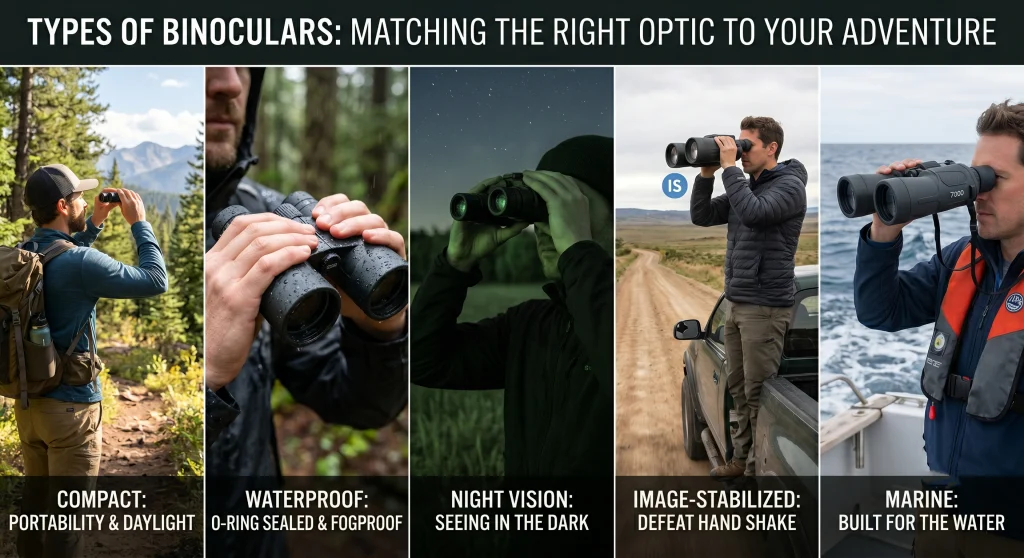
The Reality of Choosing Between Binocular Categories
The most common mistake I see people make at the optics counter is choosing a magnification number before they even know what types of binoculars they are looking at. The difference between binocular types isn’t about brand or price. It’s about what the binoculars are built to do. Understanding these binocular categories takes just a few minutes, but it routinely saves people from buying the wrong tool for their environment.
When you look at a wall of glass at a sporting goods store, they all essentially look like two tubes hinged together. But internally and structurally, a marine binocular and a compact hiking binocular are completely different instruments. If you buy one expecting it to do the job of the other, you will be disappointed, regardless of the optical quality or how much money you spent.
Instead of starting with numbers, the better approach is to ask yourself: what kind of binoculars do I need for the exact places I plan to stand? Are you going to be on a rocking boat in saltwater? Carrying them up a mountain in a backpack where every ounce matters? Sitting in a hunting blind at dusk when the light is fading? The answers to those practical questions dictate the category you need to be shopping in.
Field Note: I’ve watched this confusion play out more times than I can count. A customer will come in holding a heavy, rubber-armored marine binocular they bought online, complaining that it’s too heavy for their birding walks. It’s a fantastic piece of glass, but it was built for a boat deck, not a forest trail. Matching the category to the activity is step one.
To help you navigate the options, I have broken down the different types of binoculars into five functional families. If you want a deeper dive into how the specific numbers work across all these categories, you can read my comprehensive breakdown on how binoculars are explained. For now, let’s look at the physical designs themselves.
Type 1: Compact Binoculars (The Portability Trade-Off)
Compact binoculars are defined by their smaller objective lenses—typically between 25mm and 32mm. Because the front lenses are smaller, the entire chassis can be scaled down. They are noticeably shorter, and they usually weigh 20% to 35% less than a standard full-size optic. For anyone traveling by air, backpacking, or just wanting a pair of glass they can throw in a jacket pocket, the physical size difference is a massive advantage.
But that reduction in size is not magic; it requires a trade-off. The smaller objective lens means the binocular cannot gather as much ambient light. In bright daylight, you might never notice the difference. A quality 8×32 compact will perform beautifully under the midday sun. The moment you step into deep forest shade, or try to glass a field at dawn, the image will appear noticeably dimmer than what you would get from a full-size model.
When people ask me about the compact vs full size binoculars debate, I always steer the conversation toward the time of day they plan to use them. If you are a casual hiker who only goes out in good weather and bright daylight, the compact is often the smarter choice simply because you are more likely to actually carry it. If it stays in your truck because it’s too heavy, a full-size binocular is useless to you.
Buying a sub-compact 8×25 binocular as your primary optic for serious dawn and dusk wildlife watching, expecting the image to remain bright when the sun drops.
Choosing a compact model for daytime travel and hiking, accepting that you are trading low-light performance for the convenience of extreme portability.
There are generally two main configurations in this category: the true pocket-sized 8×25, and the mid-compact 8×32. The 8×25 is incredibly light but suffers the most in low light. The 8×32 is often the sweet spot, bridging the gap between portability and decent optical performance. Over the years, I’ve noticed that buyers who upgrade to a high-quality 8×32 are often shocked by how close it performs to a heavy 8×42 in standard daylight conditions.

Weighing just 16.7 oz, these compact binoculars pack fully multi-coated optics and a Swiss-designed BaK-4 prism for bright, edge-to-edge clarity across a wide 387 foot field of view. Rated IPX7, they handle submersion up to 3 feet for 30 minutes and stay fog-free thanks to nitrogen sealing. A patented wave grip, multi-stop twist eyecups, and a no-matter-what lifetime warranty round out the package.
Check On AmazonIf you click this link and buy, we earn a commission at no additional cost to you.
Type 2: Waterproof Binoculars (More Than Just Rain Protection)
While compact models save you weight on the trail, the next category—waterproof binoculars—saves your optic from a much quieter threat. You might look at the “waterproof” label and think, “I don’t plan on birding in a rainstorm, so I don’t need this.” This is a completely logical assumption, but it ignores the hidden enemy of all optical equipment: internal condensation.
A genuinely waterproof binocular is sealed with heavy-duty O-rings. More importantly, during manufacturing, the normal, moisture-laden air inside the optical tubes is vacuumed out and replaced with a dry gas—usually nitrogen or argon. Because there is no moisture inside the tubes, the lenses cannot fog up from the inside when you move from a warm environment to a cold one.
If you take an unsealed binocular out of a heated truck cabin and step into freezing morning air, the warm air trapped inside the binocular hits the cold glass. Condensation forms internally. Over time, that repeated internal moisture leads to permanent water spots and eventually fungus growth on the lens coatings, ruining the optic.
Key Point: If a manufacturer claims a binocular is “fogproof,” it must be nitrogen or argon purged, which inherently means it is also waterproof. You cannot have a genuinely fogproof binocular that isn’t sealed against water.
The label confusion in this category is rampant. You will see terms like “weather-resistant” or “weatherproof” thrown around on budget models. These usually just mean the outer rubber armor can shed a light drizzle. They are not sealed, and they are not purged with dry gas. If you are investing in a primary pair of binoculars for outdoor use, ensuring they are O-ring sealed and gas-purged protects your investment, even if you never intend to take them out on a boat.

BaK-4 prisms and multi-coated optics deliver crisp, clear images with strong light transmission, while the fully waterproof, O-ring sealed, nitrogen-purged body ensures fog-free performance in any condition. At 8x magnification with a 42mm objective and 12 foot close focus distance, they handle everything from wildlife to detail work. Non-slip rubber armor, a large center focus knob, twist-up eyecups, and a limited lifetime warranty complete the package.
Check On AmazonIf you click this link and buy, we earn a commission at no additional cost to you.
Type 3: Night Vision Binoculars (Three Distinct Technologies)
The night vision category is arguably the most confusing for beginners because it lumps three entirely different technologies under one umbrella. The price range spans from one hundred dollars to well over ten thousand, and choosing the wrong type for your specific use case is an incredibly common, expensive mistake.
There are three distinct technologies you need to be aware of when entering this category. Each works differently in the dark, and they are not interchangeable.
- Digital Night Vision: This uses a digital sensor, very similar to a digital camera, to amplify ambient light. In complete darkness, it relies on a built-in infrared (IR) illuminator to act as an invisible flashlight. These are affordable, can record video, and are great for backyard security or casual observation. However, their range is strictly limited by how far that IR beam can reach.
- Image Intensifier (Gen 1, 2, 3): This is the classic “green screen” night vision. It takes whatever faint ambient light exists (moonlight, starlight) and multiplies the actual photons through a vacuum tube. It provides excellent resolution and allows you to identify specific details like facial features or antler points, provided there is at least some ambient light available.
- Thermal Imaging: Instead of looking for light, thermal sensors detect heat signatures. A warm body will glow brightly on the screen regardless of how dark it is. Crucially, thermal sees through light brush, tall grass, and fog.
Field Note: A hunter once came to the counter frustrated that his expensive image intensifier night vision couldn’t spot feral hogs in thick brush. I had to explain that if a hog is standing behind a bush, standard night vision just shows you a glowing green bush. Thermal imaging, on the other hand, detects the body heat glowing right through the vegetation. Knowing what you are trying to detect dictates the technology you need.

Powered by a 1080p Full HD sensor and an 850nm infrared LED, these digital night vision binoculars let you see clearly over 200 yards in complete darkness. The included 32GB memory card allows HD video recording, with footage easily transferable to PC or Mac via USB. A wrap-around eyepiece design maximizes comfort while blocking light bleed for a fully immersive viewing experience.
Check On AmazonIf you click this link and buy, we earn a commission at no additional cost to you.
Type 4: Image-Stabilized Binoculars (Defeating the Hand Shake)
Every time you hold a pair of binoculars to your eyes, your hands introduce a micro-tremor. At lower magnifications like 8x, your brain easily filters this out. But as you push the magnification up to 12x, 14x, or 16x, that slight tremor is magnified along with the image. The view becomes incredibly shaky, making it impossible to resolve fine details. Image-stabilized (IS) binoculars were designed to solve this exact physical limitation without requiring a tripod.
Inside an IS binocular, sensors detect the movement of your hands. Depending on the brand, a gyroscope or an electronic mechanism shifts the internal prisms or lenses to instantly counteract that movement. When you press the stabilization button, the image suddenly locks into place, completely freezing in your field of view.
This technology is genuinely transformative, but it is not necessary for everyone. If you are standing on solid ground using standard 8x or 10x binoculars, your stance is usually stable enough that the premium price of stabilization isn’t justified. You are better off spending that money on higher-quality standard glass.
Where IS technology pays off is on a moving platform. If you are glassing from a boat rolling in ocean swells, from a moving truck on a bumpy dirt road, or from a helicopter, standard binoculars are practically useless. In those environments, image stabilization completely changes what you are able to see. Just remember the trade-offs: they are heavier, they are bulkier, and they require batteries. If the batteries die in the field, you are left holding a very heavy, standard pair of binoculars.

Built with Canon's EF lens image stabilization technology, these compact binoculars eliminate shake at 10x magnification for steady, sharp views in hand. Porro II prisms and a doublet field-flattener deliver clear, distortion-free images edge to edge, while the 14.5mm eye relief ensures comfortable use with or without glasses. Lightweight and low-reflective, they are ideal for birdwatching and travel.
Check On AmazonIf you click this link and buy, we earn a commission at no additional cost to you.
Type 5: Marine Binoculars (Built for a Rocking Deck)
While image stabilization handles the vibration of motorized vehicles, there is one specific moving platform that demands an entirely different optical approach: the open ocean. Marine binoculars are easily recognizable by their rugged, bulky exterior, but the true differences are in the specifications. These optics are built specifically to handle the unforgiving environment of the open water. They are fully waterproof to submersion standards, meaning if they are dropped in the shallows, they will survive.
The most defining characteristic of a true marine binocular is its magnification and objective lens size—almost universally 7×50. Why? Because 7x is the maximum magnification you can comfortably hand-hold on a pitching, rolling boat deck. Anything higher, like a 10x, will make you seasick as the horizon violently jumps around in your view. The 50mm objective lens gathers a massive amount of light for navigating dark waterways, and it creates a very large “exit pupil.”
This massive 7.14mm exit pupil means your eye doesn’t have to be perfectly aligned behind the eyepiece to see the image, which is crucial when the boat is bouncing around. This specific combination of low 7x magnification (minimizing image jump) and a large exit pupil (forgiving eye placement) is exactly why regular binoculars fall severely short on a rocking boat deck.
Pro Tips: If you are shopping for a marine binocular, look closely at the focus mechanism. Most dedicated marine models use “individual focus” eyepieces rather than a center focus wheel. Because there is no moving center mechanism, there are fewer entry points for corrosive saltwater to penetrate the chassis. You set the focus once for your eyes, and everything from roughly 60 feet to infinity remains perfectly sharp.
Many marine models also feature an integrated compass illuminated by ambient light or a battery. While modern GPS chartplotters handle primary navigation, a bearing compass inside your binocular is incredibly useful for communicating heading to your crew or confirming the bearing of a distant buoy while keeping your eyes on it.

Designed for on-water use, these 7x50 binoculars feature a built-in rangefinder and compass for reliable navigation while boating or at sea. Fully multi-coated Porro prisms deliver a wide 396 foot field of view with a 6.8mm exit pupil for bright, clear images in low light. Waterproof, fog-proof, and wrapped in rubber armor, they weigh 2.2 pounds and include a tripod mount for steady extended viewing.
Check On AmazonIf you click this link and buy, we earn a commission at no additional cost to you.
A Quick Note: When Categories Overlap
One important thing to remember is that these categories are not mutually exclusive. A marine binocular is, by definition, always waterproof, but a waterproof binocular is not always marine. You will often find high-end compact binoculars that are fully O-ring sealed, or image-stabilized models built into a marine-grade waterproof chassis. Don’t feel forced to choose just one feature if your environment demands two. Instead, prioritize the primary challenge of your activity—whether that is extreme portability, boat movement, or low light—before adding secondary features.
Quick-Decision Matrix
If you need to make a quick call, here is how the primary binocular types stack up based on their best use cases and the key specifications that define them.
| Binocular Type | Best For | Not For | Key Defining Feature |
|---|---|---|---|
| Compact | Backpacking, travel, bright daylight | Dawn/dusk, low-light wildlife | 25mm–32mm objective lens |
| Waterproof | All outdoor use, temperature shifts | Indoor stadiums, budget toys | O-ring sealed + gas purged |
| Night Vision | After-dark security, predator hunting | Daylight use, detailed astronomy | IR illuminator or Thermal sensor |
| Image-Stabilized | Moving vehicles, 12x+ magnification | Stationary land use at 8x/10x | Electronic/Gyroscopic sensors |
| Marine | Boating, open ocean, salt water | Hiking, long walks (too heavy) | 7×50 format + Individual focus |
Choosing the Right Category for Your Situation
At the end of the day, there is no single “best” type of binocular. There is only the right type for the environment you intend to use it in. If you buy a massive 7×50 marine binocular for a backpacking trip, you will hate carrying it. If you buy a cheap, unsealed compact binocular for a week-long hunting trip in the rain, it will likely fog up and ruin your view.
Start your decision process by acknowledging your environment. Identify whether weight, light-gathering, weatherproofing, or stabilization is your primary constraint. Once you lock in the correct category, choosing the specific brand and magnification becomes a much simpler process. For a complete look at how to navigate those next steps, my binoculars buying guide walks through the exact process I used at the counter to help people narrow down their final choice.

Fully multi-coated lenses and phase-coated BaK-4 prisms deliver bright, crisp, color-accurate images across all lighting conditions, with a wide 7.4 degree field of view for easy tracking. The rubber-armored polycarbonate body is waterproof, nitrogen-purged, and tripod-adaptable for extended sessions. Backed by a Celestron Limited Lifetime Warranty and US-based support.
Check On AmazonIf you click this link and buy, we earn a commission at no additional cost to you.
Explore the Core Categories
If you have identified the category that fits your needs, or if you want to understand the deeper nuances and specific use cases for each design, dive into the dedicated guides below. Each covers exactly what you trade away, what you gain, and when to spend your money.
| Binocular Category | What It Covers |
|---|---|
| Compact Binoculars | What you actually give up in low light, and the specific travel scenarios where the weight savings make perfect sense. |
| Waterproof Binoculars | Decoding the difference between water-resistant and fully sealed, and why internal fogging is the real enemy. |
| Night Vision Binoculars | A breakdown of digital, intensifier, and thermal technologies, mapping each to its realistic capability and price tier. |
| Image-Stabilized Binoculars | The specific magnification thresholds and moving platforms that justify the high premium of electronic stabilization. |
| Marine Binoculars | Why the 7×50 format dominates the water, and when your standard outdoor optics are actually fine for casual boating. |
FAQs
🔍 What are the main binocular guide types for beginners?
The primary types you should understand are compact (for extreme portability), standard full-size (for all-around use and low light), marine (built for water and boat movement), and night vision/thermal (for seeing in the dark). Always pick the category based on your physical environment first before worrying about magnification numbers.
💧 Is it worth paying extra for waterproof models if I never go out in the rain?
Yes. Fully waterproof models are purged with dry gas and sealed with O-rings, which prevents internal fogging. Even on dry days, moving an unsealed binocular from a warm house to cold outside air can cause internal condensation that eventually leads to lens-ruining fungus.
🌙 Do digital night vision binoculars work in pitch black conditions?
They do, but only because they rely on a built-in infrared (IR) illuminator that acts like an invisible flashlight. If you turn the IR feature off, a digital night vision sensor cannot see anything in complete, total darkness because there is zero ambient light to amplify.
⛵ Why are marine binoculars almost always 7x magnification instead of 10x or 12x?
On a boat, the movement of the water is amplified by the lenses you look through. Anything higher than 7x magnification makes the image jump around so violently that it becomes unusable and often causes seasickness. 7x provides the perfect balance of reach and handheld stability on a rolling deck.