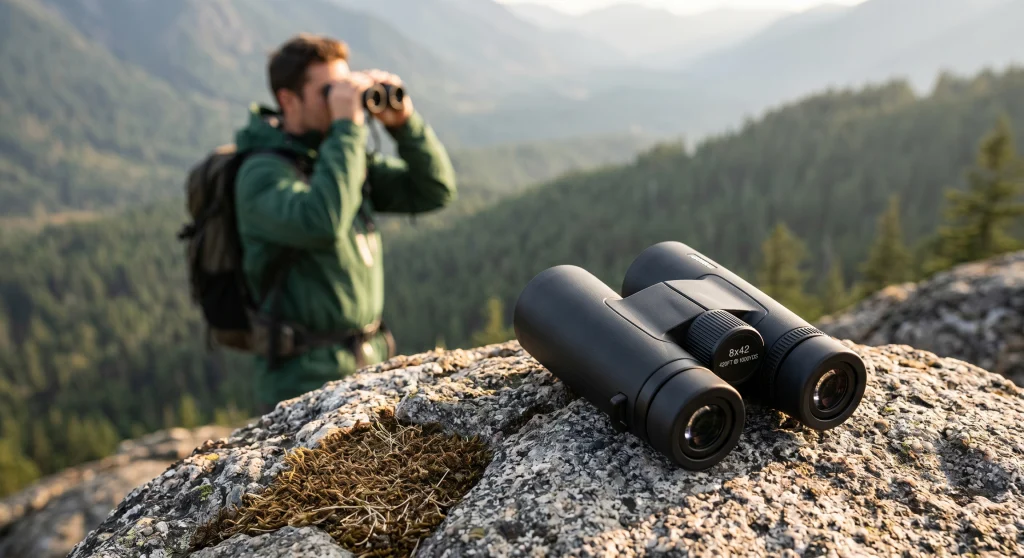
The Truth About the Numbers on the Box
A $90 department store binocular and a $400 dedicated optics brand both show 8×42 on the box. If you only look at those digits, you might assume they deliver the exact same view. In reality, they perform nothing alike.
When someone walks up to the optics counter holding two identical-looking boxes with vastly different price tags, the first question is always about those two numbers. People want to know how to read binoculars numbers and what they actually predict about real field performance. The math itself is simple. The implications of that math take a bit more unpacking.
We are going to walk through what the numbers on binoculars mean in practice. We will look at the basic magnification, the objective lens, and the secondary specs that dictate how comfortable a pair is to use. More importantly, we will dive into the mechanical and optical factors that no manufacturer puts on the cardboard box.
The Two Main Numbers: Magnification and Objective Lens
Every pair of binoculars is defined by a primary combination of numbers, usually written as 8×42, 10×50, or 10×25. This is the starting point for understanding binoculars numbers. The number before the “x” is the magnification. The number after it is the objective lens diameter in millimeters.
Magnification tells you how many times closer an object will appear. With an 8x magnification, a bird sitting 400 feet away will look as though it is only 50 feet away. A 10x magnification brings that same bird to an apparent distance of 40 feet. It sounds like a pure upgrade to go with higher magnification, but every step up in power narrows your viewing angle and amplifies the natural tremor in your hands.
The objective lens is the large glass element at the front of the binoculars. A 42mm objective lens simply means that piece of glass is 42 millimeters across. This lens is the window that lets light into the system. A larger objective lens gathers more light, which translates to a brighter image in poor weather or fading evening sun. However, larger glass also means a heavier, bulkier frame to carry around your neck.
Field Note: I have watched this confusion play out more times than I can count at the counter. A customer will automatically reach for the highest magnification they can afford, assuming bigger numbers mean better views. When I hand them a 12×50 and an 8×42 to look through the store window, they almost always prefer the 8×42. It is brighter, easier to hold steady, and much faster to focus.
If you want to understand how these numbers interact across the entire landscape of optics, our main guide covering how binoculars are explained breaks down every feature from top to bottom.

Fully multi-coated lenses and phase-coated BaK-4 prisms deliver bright, crisp, color-accurate images across all lighting conditions, with a wide 7.4 degree field of view for easy tracking. The rubber-armored polycarbonate body is waterproof, nitrogen-purged, and tripod-adaptable for extended sessions. Backed by a Celestron Limited Lifetime Warranty and US-based support.
Check On AmazonIf you click this link and buy, we earn a commission at no additional cost to you.
Exit Pupil: The Secret to Low Light Performance
If you take your binoculars, hold them about ten inches away from your face, and point them at a bright wall, you will see a small circle of light floating in the center of each eyepiece. That circle is the exit pupil. It is arguably the most important number for anyone who plans to use their optics outside of broad daylight.
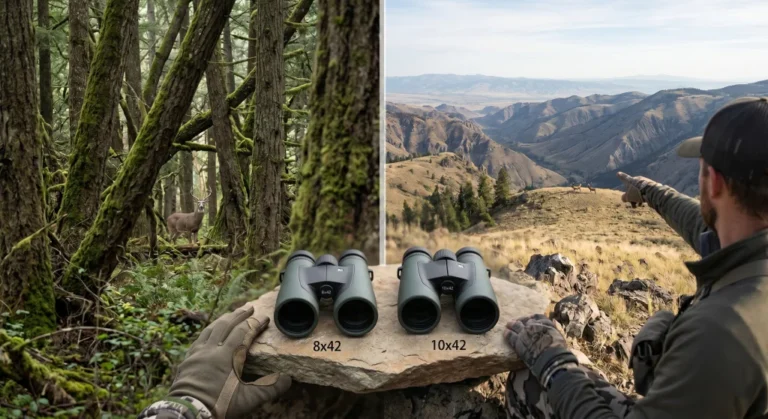
You find the exit pupil by dividing the objective lens size by the magnification. For an 8×42 configuration, you divide 42 by 8, which gives you an exit pupil of 5.25mm. If you run the same math on a 10×42, the exit pupil drops to 4.2mm. That one millimeter difference might look like a rounding error on paper, but it completely changes how the instrument performs at dawn and dusk.
To understand why, you have to look at the human eye. In bright sunlight, your own pupil contracts to about 2mm or 3mm. Both the 5.25mm and 4.2mm exit pupils are larger than your eye’s pupil, meaning both binoculars will look perfectly bright. But when the sun starts to set, your eye dilates to let in more light, typically opening up to 5mm or even 7mm.
In low light conditions, the 4.2mm exit pupil of the 10×42 no longer fills your dilated pupil. The image will start to look dim and constrained. Meanwhile, the 5.25mm exit pupil of the 8×42 still floods your eye with light, keeping the image bright and usable for an extra 15 to 20 minutes into the evening.
Field of View: Why Identical Specs Look Different
Field of view, often abbreviated as FOV, measures how wide of a picture you see when you look through the eyepieces. It is usually expressed as the width of the visible area in feet at a distance of 1,000 yards. This is where binoculars numbers explained on the box start to break down, because two models with the exact same 8×42 specs can have wildly different fields of view.
FOV is heavily influenced by the internal design of the eyepieces, not just the front lens. I have seen 8×42 models from different brands with fields of view as vastly different as 315 feet versus 420 feet at 1,000 yards. That is a massive discrepancy. The model with 420 feet gives you a wide, immersive window that makes it incredibly easy to track a bird jumping between branches. The 315-foot model will feel like you are looking down a narrow hallway.
A narrow field of view makes it frustrating to locate your target. You might spot a deer with your naked eye, raise your binoculars, and find nothing but a confusing wall of brush because your viewing angle is too restricted. When comparing two models, always check the FOV spec. A wider number is almost always better for general outdoor use, giving you superior situational awareness.
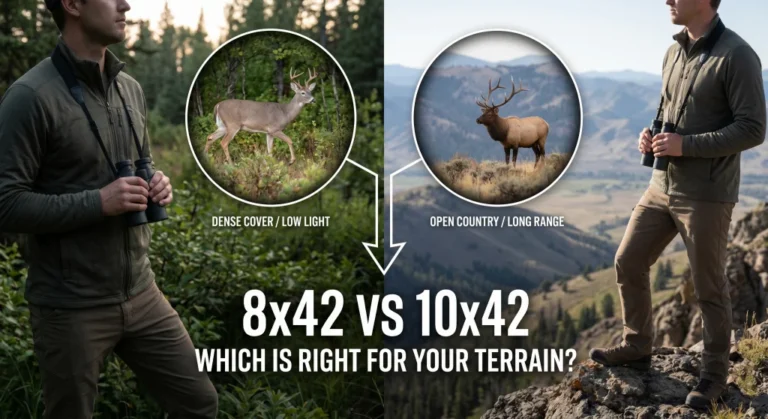
Key point: As a general rule of physics, higher magnification reduces your field of view. A 10×42 will naturally have a narrower FOV than an 8×42 from the same product line. This is a crucial trade-off to consider before buying.
Eye Relief: The Dealbreaker for Glasses Wearers
Eye relief is the optimal distance from the eyepiece to your eye where you can still see the entire field of view. If you do not wear glasses, you can largely ignore this number. You just extend the rubber eyecups, press them against your face, and the manufacturer has already set the correct distance for you.
If you do wear glasses, eye relief is the very first specification you need to check. Frustratingly, manufacturers usually bury this number three rows deep into a technical spec table, well below the marketing highlights. Glasses physically block your eyes from getting close to the binocular lenses. To compensate, you need a model with a long enough eye relief to project the image further back, bridging the physical gap your glasses create.
In my experience, glasses wearers need an absolute minimum of 14mm to 15mm of eye relief, and ideally closer to 16mm or 18mm. If you buy binoculars with an 11mm eye relief and try to use them with glasses, you will see a thick black ring blocking the edges of the image. You will lose all the benefits of a wide field of view simply because your eyes cannot get close enough to see the whole picture.

Phase-correction coated prisms and fully multi-coated 42mm lenses deliver sharp, bright, HD images with an exceptionally wide 430 foot field of view at 1,000 yards. A 2 meter close focus distance lets you zoom in on fine feather details with impressive clarity. Nitrogen-filled and fully sealed against water and fog, they come backed by a lifetime warranty and 30-day money back guarantee.
Check On AmazonIf you click this link and buy, we earn a commission at no additional cost to you.
Close Focus: Often Ignored, Sometimes Critical
The close focus specification tells you the absolute shortest distance at which the binoculars can produce a sharp image. For a lot of people, this number does not matter at all. If you are standing on a ridgeline glassing for elk across a canyon, you do not care if your optics can focus on something six feet away.
However, if you are a backyard birder watching feeders from your porch, or if you enjoy looking at butterflies and insects along a hiking trail, close focus becomes incredibly important. Many standard 10×42 models will not focus on anything closer than 10 or 12 feet. If a hummingbird lands right in front of you, a poor close focus spec leaves you with a blurred image.
Lower magnification models generally have an easier time focusing up close. Many 8×42 models can achieve a close focus of 6 to 8 feet, and some premium models can get down to 5 feet. It is a secondary number, but depending on your daily routine, it can be the difference between a great observation and total frustration.

Extra-Low Dispersion glass eliminates color fringing for razor-sharp, true-to-life images, while phase-coated BaK-4 prisms maximize light transmission even at dawn or dusk. The rubber-armored polycarbonate body is fully waterproof, nitrogen-purged, and features built-in tripod adapter threads for shake-free extended viewing. Backed by a Celestron Limited Lifetime Warranty and US-based support.
Check On AmazonIf you click this link and buy, we earn a commission at no additional cost to you.
What the Numbers on the Box Don’t Tell You
The biggest trap in the optics world is assuming that matching numbers mean matching performance. The raw specifications on the side of the box are merely mathematical constraints. They tell you nothing about the execution, the materials, or the quality control used in the factory. Two identical 8×42 models from different brands can look like night and day when you actually raise them to your eyes.
There are several major mechanical and optical components that completely alter the viewing experience, none of which are captured by the primary sizing numbers.
- Glass Purity: Cheap glass contains microscopic imperfections and bubbles that scatter light. You might not notice this at high noon, but it becomes glaringly obvious in low-contrast scenes. If you are trying to identify a brown bird in a shadowed forest canopy on an overcast day, budget glass washes out the details into a flat, murky silhouette. Premium glass is chemically purer, transmitting light efficiently to deliver crisp contrast when the lighting is terrible.
- Focusing Speed and Feel: The mechanical feel of the focus wheel is never listed on a spec sheet, yet it dictates your success in the field. Imagine a bird flushes from thick cover and lands on a branch. You have exactly two seconds to get your optics on it before it flies away. A cheap focus wheel often has a gritty dead space where you turn the dial but the internal lenses do not move immediately. A high-quality focus wheel is buttery smooth and precise, letting you lock onto a fast-moving target instantly without overshooting the focal point.
- Prism Grade and Alignment: The internal prisms that flip the image right-side up come in different grades. I frequently see people on outdoor forums complaining about a soft or blurry ring around the outside edge of their view, often without knowing why it is happening. That is a direct result of low-grade prisms and poor optical alignment. High-grade prisms keep the image sharp from edge to edge, which drastically reduces eye strain during a long glassing session.
- Hinge and IPD Adjustment: The central hinge that adjusts the width between the two barrels is called the interpupillary distance mechanism. Budget binoculars often have hinges that are either too stiff to adjust quickly or too loose to hold their position once you set them. If you are constantly having to readjust the barrel width every time you pull the binoculars out of your harness, the physical numbers on the box will not make up for that mechanical frustration.
- Lens Coatings Execution: Every time light hits a piece of bare glass, some of it reflects away. Manufacturers apply chemical coatings to reduce this reflection. However, the label fully multi-coated is heavily abused in marketing. A budget brand and a premium brand might both claim it, but the budget application is often thinner and less precisely applied, leading to noticeable glare when you are looking in the direction of the sun. For a deeper look at this specific trick, check out our guide on how lens coatings work.
When you are deciding whether to buy an 8×42 or a 10×42, remember that the numbers only get you into the right ballpark. The actual viewing experience is dictated by the engineering inside the chassis.

Multilayer-coated lenses with silver-alloy prism coating deliver vivid, sharp images from dawn to dusk. O-ring sealed and nitrogen-purged, they stay clear through rain, snow, and humidity. The fiberglass-reinforced polycarbonate body with rubber armor keeps them lightweight yet durable, with turn-and-slide eyecups for comfortable all-day use with or without glasses.
Check On AmazonIf you click this link and buy, we earn a commission at no additional cost to you.
Final Thoughts: What to Do With This Information
Knowing how to read binoculars numbers is only the beginning of the buying process. You now know that 8×42 controls the magnification and light gathering, that exit pupil dictates your low light window, and that eye relief is non-negotiable for glasses wearers. More importantly, you know that the spec sheet is a filter, not a guarantee of quality.
The best approach is to identify the physical constraints you need for your specific activity first, rather than chasing the highest magnification. Decide whether your priority is a wide field of view for fast action or high power for distant details. Once you pick the correct spec category for your needs, you can focus entirely on finding the best glass quality your budget allows. Pick your specific configuration from the guide below to see exactly what it will do in the field.
Deep Dives on Specific Binocular Numbers
If you have a specific size configuration in mind, the basic math applies differently to each one. We have broken down exactly what the most common combinations produce in the real world, and what activities they are best suited for.
| Configuration Guide | What You Need to Know |
|---|---|
| What 8×42 Means on Binoculars | The most recommended all-around size and why its exit pupil hits the sweet spot. |
| What 10×42 Means on Binoculars | The optical consequences of pushing 10x magnification through a 42mm lens. |
| What 10×50 Means on Binoculars | The counterintuitive reality of why this larger size often reduces your field of view. |
| What 7×50 Means on Binoculars | Why this specific math became the absolute gold standard for marine and boat use. |
| Magnification Explained | The hidden secondary effects of higher power, including depth of field reduction. |
| 7×50 vs 10×50 Comparison | How identical objective lenses serve two completely different activities based on power. |
FAQs
🔍 What do the numbers on binoculars mean, like 8×42?
The first number is the magnification, meaning objects appear 8 times closer. The second number is the objective lens diameter in millimeters, which measures 42mm and controls how much light enters the system.
👁️ What is exit pupil in binoculars?
Exit pupil is the size of the light beam hitting your eye, calculated by dividing the lens size by the magnification. A larger exit pupil (like 5mm or more) provides a brighter image during low light conditions at dawn and dusk.
👓 Does the eye relief number matter if I don’t wear glasses?
Not really. If you do not wear glasses, you can simply extend the rubber eyecups and the binoculars will position your eyes correctly. Glasses wearers are the ones who must specifically look for 14mm to 15mm of eye relief.
🏞️ Why do two 10×42 binoculars have different field of view numbers?
Field of view is dictated by the internal eyepiece design and prism geometry, not just the front lens sizing. Premium manufacturers often use more complex eyepiece designs to provide a wider viewing angle than budget models with the exact same 10×42 specs.
🦅 Is an 8x or 10x better for general use?
For most beginners and general users, 8x is significantly better. It provides a wider field of view for finding targets quickly, offers a brighter image in low light, and is much easier to hold steady without hand tremors ruining the view.