The Core Numbers On The Box
If you are standing in a store holding a box and trying to figure out the binoculars 8×42 meaning, you are dealing with the most versatile optical configuration available. I have watched this exact scenario play out countless times at the optics counter. People know they have been told to buy an 8×42, but they have no idea what those numbers actually do when they lift the glass to their eyes.
Before you look through the lenses, having your binoculars explained in practical terms changes how you evaluate them. The “8” tells you how much closer the subject will appear. The “42” tells you the physical size of the front glass gathering the light. Together, these two primary numbers mathematically dictate a whole set of secondary specifications.
Those secondary specs are what actually determine your viewing experience. Things like exit pupil, field of view, and image stability are all downstream results of choosing an 8×42 over another size. If you ever want to see how these math formulas apply to other sizes, you can look into what do the numbers on binoculars mean across the board. For now, we are looking specifically at what the 8×42 gives you.
What 8x Magnification Actually Feels Like
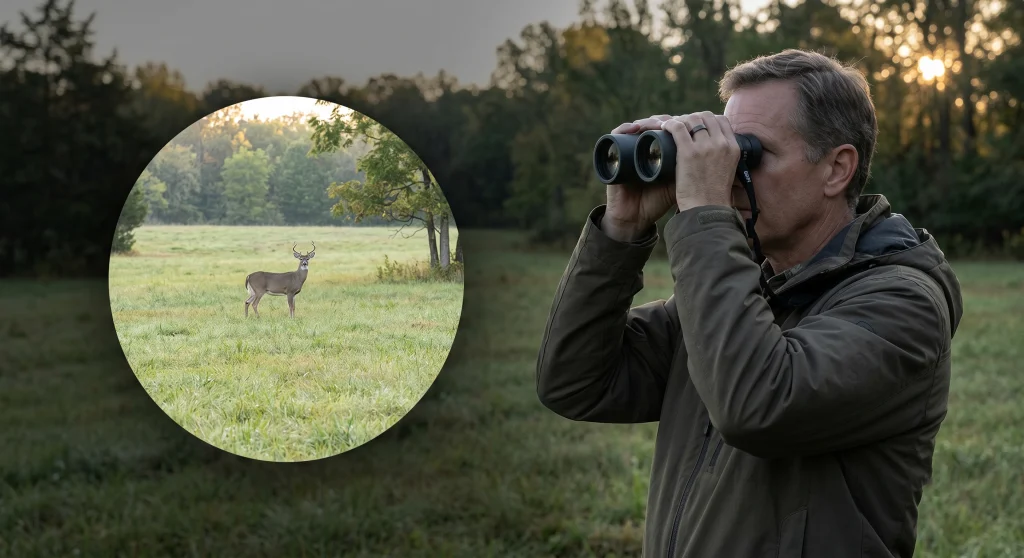
The number 8 before the “x” is your magnification power. This means that objects will appear exactly eight times closer to you than they do to your naked eye. If you are watching a bird sitting on a branch 400 feet away, looking through an 8x binocular makes that bird appear as if it were sitting just 50 feet away from you.
Many first-time buyers assume that more magnification is always better, but that is rarely the case in practical field use. Magnification does not just enlarge the image. It also enlarges every slight movement of your hands, your breathing, and your heartbeat. At 8x magnification, the vast majority of people can hold the image perfectly still without resting their elbows on a rail or using a tripod.
Field Note: The most common mistake I see is people choosing a 10x or 12x binocular because they want to see further, only to find the image is too shaky to actually identify any details. An 8x image is almost always sharper to the human eye simply because it is stable.
This stability is a massive advantage when you are tracking moving subjects. Whether you are scanning a treeline or trying to follow a moving animal, a stable 8x image is significantly less fatiguing on your eyes. If you are curious about the mechanics of this, reading about binoculars magnification explained will show you exactly how higher power degrades image stability.

Fully multi-coated lenses and phase-coated BaK-4 prisms deliver bright, crisp, color-accurate images across all lighting conditions, with a wide 7.4 degree field of view for easy tracking. The rubber-armored polycarbonate body is waterproof, nitrogen-purged, and tripod-adaptable for extended sessions. Backed by a Celestron Limited Lifetime Warranty and US-based support.
Check On AmazonIf you click this link and buy, we earn a commission at no additional cost to you.
The 42mm Objective Lens And Light Gathering
The second number in the 8×42 equation is 42. This represents the diameter of the objective lenses in millimeters. These are the large pieces of glass at the front of the binoculars farthest from your eyes. Their primary job is not magnification. Their job is to gather light.
Think of the objective lens as a window in a dark room. A 42mm window lets in significantly more light than a compact 25mm window. In bright daylight at noon, you might not notice much difference between the two. The real test happens when the sun dips below the trees, the shadows get long, and the available light drops significantly.
A 42mm objective lens is widely considered the sweet spot for a full-size binocular. It gathers enough light to keep the image bright and clear during the critical hours of dawn and dusk. At the same time, it is not so massive that the binoculars become a heavy burden around your neck. This perfect balance of light gathering and portability is why this size dominates the market.

Fully multi-coated optics and BAK-4 prisms deliver crisp, high-contrast, color-accurate images in bright and low-light conditions alike. Rated IPX7, argon-purged, and O-ring sealed, they handle full submersion and the toughest outdoor elements. At just 1.25 lbs, the rubber-armored body is easy to carry all day, and the package includes an upgraded universal smartphone adapter and a 360-degree swivel tripod for hands-free photo capture.
Check On AmazonIf you click this link and buy, we earn a commission at no additional cost to you.
The Magic Of The 8×42 Exit Pupil
When you divide the objective lens size by the magnification, you get the exit pupil. For this configuration, 42 divided by 8 gives you an 8×42 exit pupil of exactly 5.25 millimeters. The exit pupil is the literal shaft of light that exits the eyepiece and enters your eye. You can actually see it if you hold the binoculars a foot away from your face and look at the bright circles in the glass.
This 5.25mm number is incredibly important because of how human biology works. In bright daylight, your pupils contract to about 2 to 3 millimeters. Any binocular will look bright in those conditions. But at dawn and dusk, your pupils dilate to between 5 and 7 millimeters to let in more light. The 5.25mm shaft of light from an 8×42 nearly fills that dilated pupil window, giving you a bright image when you need it most. In fact, this configuration produces the best low-light exit pupil of any common 42mm setup on the market.
Understanding The 8×42 Field Of View
Your field of view is the width of the landscape you can see from left to right without moving the binoculars. A major advantage of lower magnification is a wider viewing angle. The 8×42 field of view typically ranges from 330 to 430 feet at a distance of 1,000 yards. This wide window is a massive tactical advantage in the field.
When you spot movement with your naked eye and raise your binoculars, a wide field of view means you are far more likely to have the subject immediately in the frame. If you have a narrow field of view, you often have to scan around to find what you were just looking at. This speed of acquisition is exactly why a wider view is preferred for tracking subjects that move rapidly through dense brush.
What most buyers do not realize is that the field of view can vary wildly between two different 8×42 models. The numbers on the box dictate the magnification and objective, but the internal eyepiece design determines the width of the view. You might pick up one 8×42 with a 330-foot field of view, and another that stretches to 430 feet. This gap between budget and premium models is one of the key hidden differences that specs alone rarely highlight, but you will immediately feel it when scanning a landscape.
Close Focus Capabilities
Close focus is the shortest distance a binocular can focus on an object while keeping the image sharp. Most people buy binoculars to look at things far away, so they completely ignore this specification. However, in practice, a good close focus distance is highly valuable.
Most decent 8×42 models can focus on objects down to 6 or 8 feet away. Some premium models can even pull focus as close as 5 feet. If you are watching a butterfly on a nearby bush or trying to identify a small bird right outside your kitchen window, you need an optic that can focus up close without blurring.

Multilayer-coated lenses with silver-alloy prism coating deliver vivid, sharp images from dawn to dusk. O-ring sealed and nitrogen-purged, they stay clear through rain, snow, and humidity. The fiberglass-reinforced polycarbonate body with rubber armor keeps them lightweight yet durable, with turn-and-slide eyecups for comfortable all-day use with or without glasses.
Check On AmazonIf you click this link and buy, we earn a commission at no additional cost to you.
What 8×42 Binoculars Specs Cannot Tell You
While knowing what 8×42 means on binoculars gives you a solid foundation, those numbers only tell you the physical geometry of the instrument. Two pairs of 8×42 binoculars can sit next to each other on a shelf, one costing $90 and the other costing $1,200. The numbers are the same, but the views are entirely different.
| Specification | What It Measures | Typical 8×42 Range |
|---|---|---|
| Magnification | How much closer the subject appears | 8x |
| Objective Lens | Front glass diameter for light gathering | 42 mm |
| Exit Pupil | Width of the light beam hitting your eye | 5.25 mm |
| Field of View | Width of scene visible at 1,000 yards | 330 – 430 ft |
| Close Focus | Minimum distance to achieve sharp focus | 5 – 8 ft |
The numbers on the box leave out several critical factors that determine how clear, crisp, and comfortable your view will be. First is the glass purity and lens coatings. Standard glass can produce soft edges and color fringing around high-contrast objects. Better models use fully multi-coated lenses to ensure maximum light transmission, meaning less light bounces off the glass and more reaches your eye.
Then there is focusing speed and mechanical feel. A premium 8×42 will have a focus wheel that moves smoothly with zero play, allowing you to snap from 10 feet to 100 feet instantly. Budget models often have stiff or “mushy” focus wheels that make you constantly hunt for the sharpest image. The numbers on the box also tell you nothing about the prism grade or build durability.
Pro Tips: When you are testing binoculars in the store, do not just look through them. Hold them at arm’s length and look at the small circles of light in the eyepieces. If those exit pupils are perfectly round, you are likely looking at high-quality BAK-4 prisms. If the circles look oval or have squared-off edges, the manufacturer used cheaper BK-7 prisms that will cut off light at the edges of your view. Also, check the spec sheet specifically for the words “phase corrected” if you are looking at roof prism models. If that is missing, put them back.
Warning: Never buy a binocular based solely on the 8×42 designation if you wear glasses. Always check the separate eye relief measurement on the spec sheet first to ensure you have at least 14mm of clearance.

Phase-correction coated prisms and fully multi-coated 42mm lenses deliver sharp, bright HD images across an extra-wide 430 foot field of view. A 2 meter close focus distance lets you pick out fine feather details with stunning clarity, while 8x magnification keeps distant subjects steady up to 1,000 yards. Nitrogen-filled and fully sealed against water and fog, backed by a 12-month warranty and 30-day money-back guarantee.
Check On AmazonIf you click this link and buy, we earn a commission at no additional cost to you.
Final Thoughts On Choosing This Configuration
The reason the 8×42 specification is so universally praised is because it demands the fewest compromises. You get enough magnification to see detail, but not so much that the image shakes. You get an objective lens large enough to perform beautifully at dusk, but small enough to carry on a hike. It is the definition of an all-around performer.
If you are still debating whether this is the right size for you, comparing it directly against its closest rival is usually the best next step. You can read my breakdown on 8×42 vs 10×42 binoculars to see how terrain and distance should dictate your final choice. If you want to see how this setup performs in specific habitats, my guide on binoculars for bird watching covers those exact scenarios. Otherwise, you can head back to the main binoculars numbers meaning hub to explore other sizes.
FAQs
🔭 What does 8×42 mean on binoculars?
The first number (8x) means the binoculars magnify the image so objects appear 8 times closer to you than with the naked eye. The second number (42) means the objective lenses at the front of the binoculars are 42 millimeters in diameter, which controls how much light they can gather.
📏 How far can you see with 8×42 binoculars?
You can see for miles, just like with your naked eye, but objects will appear 8 times closer. For example, a deer standing 800 yards away will look as though it is only 100 yards away through the lenses.
👁️ What is the exit pupil on 8×42 binoculars?
The exit pupil is 5.25mm, calculated by dividing the objective lens (42) by the magnification (8). This generous size is excellent for low-light viewing because it provides a shaft of light wide enough to fill your dilated pupils at dawn and dusk.
👓 Do 8×42 binoculars work if I wear glasses?
The 8×42 configuration itself is great for glasses wearers because the large exit pupil is very forgiving. However, you must still check the specific “eye relief” specification of the model you are buying and ensure it is at least 14mm or higher to see the full image with your glasses on.