The Honest Answer Depends on the Time of Day
People ask me all the time, are compact binoculars worth it? I used to answer this question almost daily at the optics counter. A customer would stand there balancing a lightweight 8×25 in one hand and a hefty 8×42 in the other, trying to figure out if saving a pound of weight meant ruining their view of the outdoors.
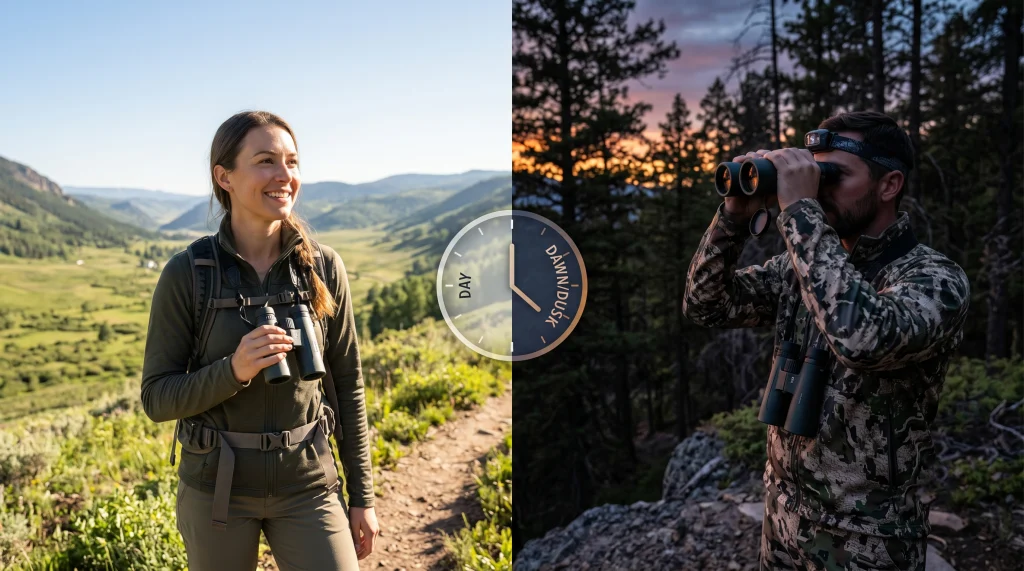
When exploring the different types of binoculars on the market, most folks assume the answer depends entirely on what they are looking at. They think you need big glass for birds and small glass for sports. From what I have seen, that is the wrong way to frame the problem. The real answer depends almost entirely on what time of day you plan to use them.
A compact binocular trades objective lens size for portability. Instead of a 42mm piece of glass at the front, you get a 25mm or 32mm lens. That physical reduction means less weight around your neck and a smaller footprint in your bag. But it also means a smaller funnel for gathering light. Understanding how that light-gathering math interacts with your own eyes is the only way to know if going small is the right move for your specific situation.
Field Note: I have watched this scenario play out more times than I can count. Someone buys a massive, premium full-size binocular for a hiking trip because they read it was optically superior. Two weeks later, they tell me the optics stayed in their backpack for the entire trip because they were too heavy and annoying to wear on the trail. The binocular you actually have in your hand always beats the superior one sitting zipped inside a bag.
Full Daylight: The Zone Where Compacts Win
If you only plan to use your optics in bright, sunny conditions, compact binoculars are not just a good compromise. They are often the smartest choice you can make. The reason comes down to basic human biology.
In full daylight, the pupil of your eye shrinks down to about 2 millimeters or 3 millimeters wide. An 8×32 compact binocular delivers a 4mm shaft of light to your eye (calculated by dividing the 32mm objective by the 8x magnification). Because the binocular is delivering a wider beam of light than your eye can physically accept, the image appears perfectly bright, sharp, and clear.
If you were to swap that 8×32 for a large 8×42 in the middle of a sunny day, the larger binocular would deliver a 5.25mm shaft of light. But your eye is still only 3mm wide. Your pupil physically blocks the extra light. In this scenario, you are carrying around an extra half-pound of glass and rubber for light-gathering capacity that your eyes cannot even use.
The New Generation Exception
The gap in compact binoculars performance used to be severe, but modern manufacturing has changed things. A massive 2023 review of 24 compact models by AllAboutBirds confirmed a trend I have noticed over the last few product cycles. The new generation of mid-tier compacts is exceptionally good. They found that several 8×32 models in the $300 to $500 price tier can stand on an equal footing with similarly priced full-size binoculars during normal daytime use. If you have a decent budget, the optical penalty for going small has never been lower.

Multilayer-coated lenses with silver-alloy prism coating deliver vivid, sharp images from dawn to dusk. O-ring sealed and nitrogen-purged, they stay clear through rain, snow, and humidity. The fiberglass-reinforced polycarbonate body with rubber armor keeps them lightweight yet durable, with turn-and-slide eyecups for comfortable all-day use with or without glasses.
Check On AmazonIf you click this link and buy, we earn a commission at no additional cost to you.
Dawn and Dusk: Where the Trade-Off Becomes Visible
If daylight makes compacts look like a miracle, dusk brings them back to reality. The moment the sun drops behind a ridge, or when you are standing in a dense, heavily shaded forest, the physics of small lenses become impossible to ignore. This rule does not just apply to the edges of the day. A heavily overcast afternoon deep in the woods behaves exactly like twilight as far as your pupils are concerned.
When ambient light drops, your pupils dilate to let more light in. A healthy adult eye might dilate to 5mm, 6mm, or even 7mm in low light conditions. As we established above, that 8×32 compact binocular is still delivering a 4mm beam of light. But your eye is now open to 6mm, starving for more light than the binocular can provide. The image through the compact optic suddenly feels dim, muddy, and flat.
Key point: The low-light threshold is not a subtle thing. If you are comparing compact binoculars vs full size models at 6:00 AM on a cloudy November morning, or at 7:00 PM on a fading August evening, the full-size model will show you vibrant colors and crisp details. The compact model will show you dark silhouettes.
This is where understanding your own habits is crucial. If your outdoor routine involves waking up early to catch the dawn wildlife activity, or staying out in the hunting blind until the absolute last minutes of legal shooting light, a compact binocular will cost you the ability to identify what you are looking at.
Buying a compact binocular as your primary optic for serious wildlife observation, assuming the light weight will make up for the dimmer image in the woods.
Buying a compact binocular because your primary activity happens between 9:00 AM and 4:00 PM, where the weight savings provide a massive comfort advantage with zero optical penalty.
When to Buy and When to Pass
To move past the theory, let us look at the practical applications. The value of a compact binocular shifts dramatically depending on what you are packing for. In my experience, there are very distinct patterns of who ends up loving these smaller frames and who ends up returning them.
Where Compacts Win the Argument
For certain activities, the physical footprint of the tool is the most important specification. If you cannot easily carry it, you will not use it.
- Air travel and backpacking: When every ounce in your luggage or on your back matters, an 8×25 or 8×32 is the only logical choice. To see exactly which specs matter most when packing light, taking a look at compact binoculars for travel can help narrow down the field.
- The jacket pocket advantage: An 8×25 binocular can slide into a standard coat pocket. This means you can take them on casual walks where you otherwise would not bother bringing a dedicated optics harness.
- Concerts and stadium sports: These venues are heavily illuminated, meaning the small objective lens is not a hindrance. A full-size binocular is often bulky and uncomfortable to hold in tight stadium seating.
- As a secondary pair: Many experienced users keep a high-end 8×42 in their primary gear bag, and a durable 8×32 in their vehicle’s glovebox so they are never caught without glass.
Where Compacts Create Frustration
Knowing the compact binocular limitations will save you from an expensive mistake. There are scenarios where going small simply does not work.
- Primary dawn/dusk hunting: If you are glassing tree lines at last light looking for movement, a compact will fail you precisely when the animals are most active.
- Serious, dedicated birding: Is compact binoculars birding worth it? Only as a backup. If you are doing a dedicated birding trip that involves early morning forest walks, the small exit pupil will make it incredibly difficult to identify fast-moving birds in the shade.
- Users with shaky hands: Compact binoculars are physically very light, which actually makes them slightly harder to hold perfectly still compared to the stabilizing heft of a heavier full-size unit.
| Binocular Size | Typical Weight | Daylight View | Low Light View | Best Fit |
|---|---|---|---|---|
| 8×25 (Pocket) | 9 to 12 oz | Excellent | Very Poor | Air travel, casual walks, keeping in a jacket. |
| 8×32 (Mid-Compact) | 16 to 20 oz | Excellent | Fair | Hiking, travel birding, general daytime outdoor use. |
| 8×42 (Full-Size) | 22 to 28 oz | Excellent | Excellent | Primary birding, hunting, dawn and dusk observation. |

These pocket-sized 8x32 binoculars deliver bright, detailed views with a wide field of view, letting you scan broad sightlines then lock in on fine details at 1,000 yards. Lightweight and ergonomically designed with a non-slip grip, they are comfortable enough for kids and adults alike across long days outdoors. Backed by a replacement guarantee if damaged, making them the last compact binoculars you may ever need to buy.
Check On AmazonIf you click this link and buy, we earn a commission at no additional cost to you.
Practical Choices for the Field
Whether you have confirmed a compact frame is right for your routine or you are still weighing the options, exploring the broader category of compact binoculars will show you just how capable modern small frames have become. If going small makes sense for your needs, the next step is choosing the right design.
Based on what I have seen hold up in the field, I generally steer people toward the 8×32 configuration for the best balance of comfort and portability. Here are the models that consistently deliver strong performance without the bulk.

Fully multi-coated lenses and phase-coated BaK-4 prisms deliver bright, crisp, color-accurate images across all lighting conditions, with a wide 7.4 degree field of view for easy tracking. The rubber-armored polycarbonate body is waterproof, nitrogen-purged, and tripod-adaptable for extended sessions. Backed by a Celestron Limited Lifetime Warranty and US-based support.
Check On AmazonIf you click this link and buy, we earn a commission at no additional cost to you.
The Verdict on Going Small
The optics industry likes to sell the idea that bigger is always better, but real-world use tells a different story. If you are honest with yourself about when you actually pull your binoculars up to your eyes, the decision makes itself.
If you are a casual hiker, a traveler, or someone who enjoys watching wildlife in the middle of a sunny afternoon, a quality compact binocular is absolutely worth the money. You will get brilliant, sharp images without the neck strain that comes from lugging around a massive piece of glass.
But if your best hours in nature happen before the sun is fully up, or after it has started to set, you cannot cheat physics. You need the larger objective lens to gather the ambient light, and the extra weight is a mandatory price of admission. Choose the tool that fits the time on your watch, and you will rarely be disappointed.

Multilayer-coated lenses with silver-alloy prism coating deliver vivid, sharp images from dawn to dusk. O-ring sealed and nitrogen-purged, they stay clear through rain, snow, and humidity. The fiberglass-reinforced polycarbonate body with rubber armor keeps them lightweight yet durable, with turn-and-slide eyecups for comfortable all-day use with or without glasses.
Check On AmazonIf you click this link and buy, we earn a commission at no additional cost to you.
FAQs
⚖️ Do compact binoculars perform as well as full-size models?
In bright daylight, a quality compact binocular will perform nearly identically to a full-size model. The performance gap only becomes visible in low-light conditions like dawn, dusk, or heavy shade, where the full-size model’s larger lenses gather significantly more light.
🎒 Should I get 8×25 or 8×32 for hiking?
An 8×25 is a true pocket binocular, ideal when extreme weight savings are your only goal. An 8×32 is slightly larger but offers a wider field of view, a more forgiving eye box, and better overall optical comfort, making it the better choice for extended viewing on a hike.
👓 Can I use compact binoculars if I wear glasses?
Yes, but you must be careful when checking the specifications. Because of their compressed physical design, many compact binoculars have short eye relief (under 14mm), which will cause dark rings if you wear glasses. Always look for a model with at least 14mm of eye relief.
🦉 Are compact models good enough for serious bird watching?
They are excellent as a secondary or travel pair for birding in good light. However, for a primary birding tool, especially for catching the early morning dawn chorus in wooded areas, the limited light gathering of a compact model will be a noticeable disadvantage.