The Core Difference Between IS and a Tripod
When choosing between image-stabilized (IS) binoculars and a mechanical tripod, the decision comes down to your environment rather than just the magnification. People often assume that if they want a steady view at 12x or 15x, they automatically need electronic stabilization. In practice, this is not always true.
At the optics counter, I saw buyers consistently default to the most expensive technological fix for hand shake without considering the physical trade-offs. They would buy high-end electronics while completely ignoring the weight penalty. Image-stabilized models are typically twenty to thirty percent heavier than standard binoculars because of the internal motors, sensors, and battery compartments. Both a tripod and an internal stabilization system will give you a rock-solid image, but they achieve this through entirely different methods, and each method has harsh limitations depending on where you are standing.
If you are trying to decide which route to take, you have to look past the spec sheet. You need to look at the ground beneath your feet. A tripod requires solid earth and time to deploy. Image stabilization requires batteries and, given that extra weight, causes arm fatigue over long sessions, but it works instantly anywhere.
Where a Tripod Does the Exact Same Job
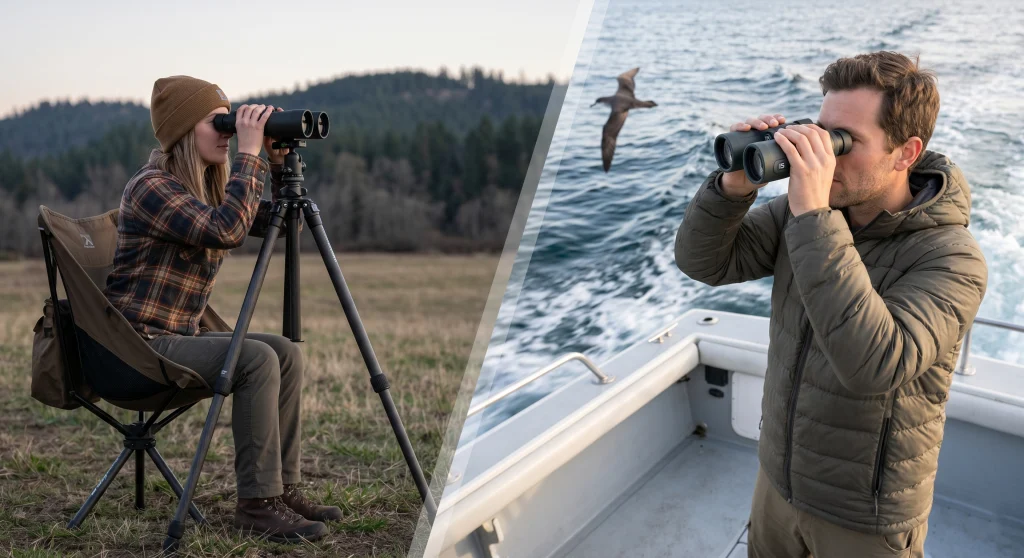
For stationary land use where you can set up before glassing, a tripod is almost always the smarter financial and optical choice. If you are sitting in a blind, observing from a back porch, or scanning a distant ridge from a fixed position, you have the luxury of stable ground. In these scenarios, a tripod eliminates hand shake just as effectively as the most advanced electronics.
The real advantage of a tripod comes down to optical value. Image stabilization technology is expensive. If you have a budget of a thousand dollars, buying an IS binocular means a significant portion of your money goes toward sensors and gyroscopes. If you spend that same thousand dollars on a standard binocular and a solid tripod, you get dramatically better glass. The standard binocular will have superior light transmission, better edge clarity, and a wider field of view.
A tripod makes the most sense in these specific situations:
- Seated birding at 10x or higher from a fixed blind or elevated viewing platform.
- Backyard astronomy where you can leave the equipment deployed for hours. Stargazing requires looking upward for extended periods, which causes severe arm and neck fatigue regardless of whether the image is electronically stabilized. A tall tripod carries that heavy weight for you.
- Long-duration glassing where the physical weight of holding any binocular causes arm fatigue.
- Target shooting observation where your focus remains on a static downrange location.
If you want to understand all your options and see how these tools fit into the broader optical landscape, you can explore the different types of binoculars available. For stationary observation, putting standard high-quality optics on a tripod is the proven, traditional method that still offers the best raw image quality per dollar spent.

The flagship of Nikon's PROSTAFF line, featuring phase-correction coated roof prisms with dielectric multilayer coating for maximum light transmission, lifelike color, and edge-to-edge clarity at 10x magnification. Waterproof, fog-proof, and wrapped in shock-resistant rubber armor over a fiberglass-reinforced polycarbonate body for dependable performance in any conditions. A locking diopter, turn-and-slide eyecups, long eye relief, and oil and water-repellent lens coatings round out this premium package.
Check On AmazonIf you click this link and buy, we earn a commission at no additional cost to you.
Where Image Stabilization Does Something a Tripod Cannot
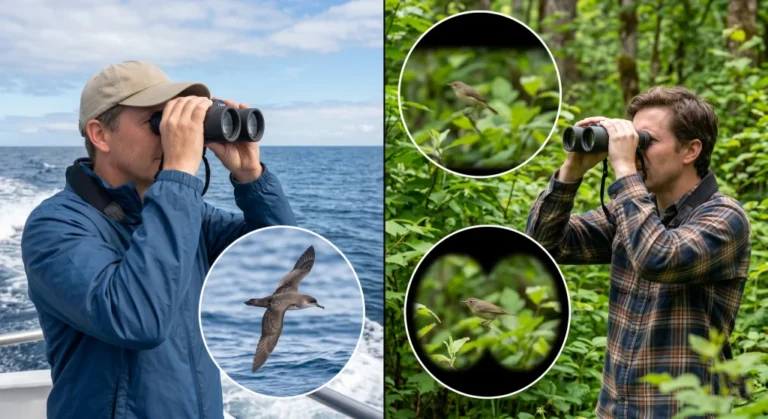
A tripod becomes completely useless the moment the ground beneath you starts moving. This is where the debate ends abruptly. If you are on a boat, a kayak, a moving truck, or horseback, a tripod cannot help you. In fact, resting binoculars on a hard surface on a boat actually makes the view worse. The tripod will just transfer the engine vibration and the pitch of the waves directly into your eyepieces.
Image stabilization systems detect these external movements and actively correct them. Manufacturers generally use either gyroscopic sensors that shift internal prisms (like many Canon or Fujinon models) or electronic sensor-shifts. Gyroscopic systems might have a slight fraction of latency but are incredibly stable against constant rocking, while electronic shifts react almost instantly to sudden impulsive motion. Regardless of the exact mechanism, on a moving platform, IS is not a luxury. It is a transformative tool that changes what you can actually see. A 10x binocular on a rolling deck is normally unusable. With IS engaged, it becomes a clear, readable window.
Field Note: I once watched a customer try to solve his pelagic birding problems by buying a heavy-duty tripod for his boat deck. He came back a week later, having realized that while the tripod held the binoculars steady relative to the deck, the entire boat was pitching over the waves. He ended up returning the tripod and looking closely at image-stabilized binoculars instead, which actually solved the environmental motion.

Canon's EF lens image stabilization technology delivers rock-steady views at 12x magnification, while Porro II prisms and a doublet field-flattener produce sharp, distortion-free images edge to edge. The 36mm objective lens provides clear, bright, high-resolution images with improved power efficiency for extended battery life in a compact, portable package ideal for birdwatching and hunting.
Check On AmazonIf you click this link and buy, we earn a commission at no additional cost to you.
The Hidden Factor: Why Wind Changes the Equation
Wind is the enemy of high magnification, and it exposes the main weakness of a physical mount. A tripod gives you a stable base at the feet, but the binocular itself acts like a small sail at the top. When strong wind hits the objective lenses, it travels down the adapter, into the center column of the tripod, and vibrates the entire rig.
A seasoned hunter on the Rokslide forum summed it up perfectly, noting that even off a tripod, you often get a small amount of vibration if there is any wind. For people glassing in open country, wind is an everyday reality. At 15x magnification, a tiny millimeter of vibration at the tripod head translates to a massive, frustrating blur in the image.
This is a rare scenario where IS outperforms a tripod on solid ground. Because the IS system actively detects and corrects micro-movements in real time, it cuts right through wind vibration. If you regularly observe in windy, exposed environments where tripod stability is compromised, the electronic stabilization provides a distinct edge.
Setup Time and the Missed Observation
The biggest practical difference between these two approaches is deployment speed. If you need to evaluate a tripod versus image stabilization for active use, you have to count the seconds. Deploying a tripod takes time. You have to unclip the legs, level the head, and attach the binocular adapter. A fast user might do this in fifteen seconds. A careful user might take thirty.
If you are tracking birds in flight, or if you spot an animal moving through dense brush, thirty seconds is an eternity. By the time the tripod is locked and ready, your subject is gone. Image stabilization is instant. You raise the optic to your eyes, push a button, and the image steadies. For quick-scan situations where deploying a tripod takes too long, IS is the only viable way to get a stable, magnified view.
Carrying a heavy tripod on a fast-paced hiking trip, assuming you will have time to set it up every time a bird flushes from the canopy.
Using image-stabilized binoculars for active, mobile wildlife observation where subjects appear quickly and disappear just as fast.
You also have to consider tracking. Following a moving subject with a tripod requires a fluid head and smooth manual panning. It restricts your movement to the mechanics of the tripod head. With IS, you can pan and tilt your body naturally. The system works with you to smooth out your tracking motion without restricting your physical freedom.
Side-by-Side Comparison
To make the decision clearer, it helps to look at exactly how these two stabilization methods compare across the realities of field use. Both methods work, but they excel in entirely different categories.
| Field Requirement | Tripod Setup | Image-Stabilized Binoculars |
|---|---|---|
| Optical Quality per Dollar | Excellent. Budget goes directly into premium glass. | Moderate. Budget is split between glass and electronics. |
| Setup Speed | Slow. Requires leg deployment and leveling. | Instant. Push a button and view. |
| Moving Platforms | Fails. Transfers vessel vibration to the user. | Excels. Actively cancels out engine and wave motion. |
| Wind Resistance | Poor. The rig catches wind and micro-vibrates. | Excellent. Sensors correct wind-induced vibration. |
| Long-term Comfort | Perfect. Zero weight on your arms. | Tiring. You still have to hold the optic, which is 20-30% heavier due to batteries and motors. |
This table highlights why neither tool is universally better. The right choice depends entirely on your environment and how fast you need to react to what you are seeing.
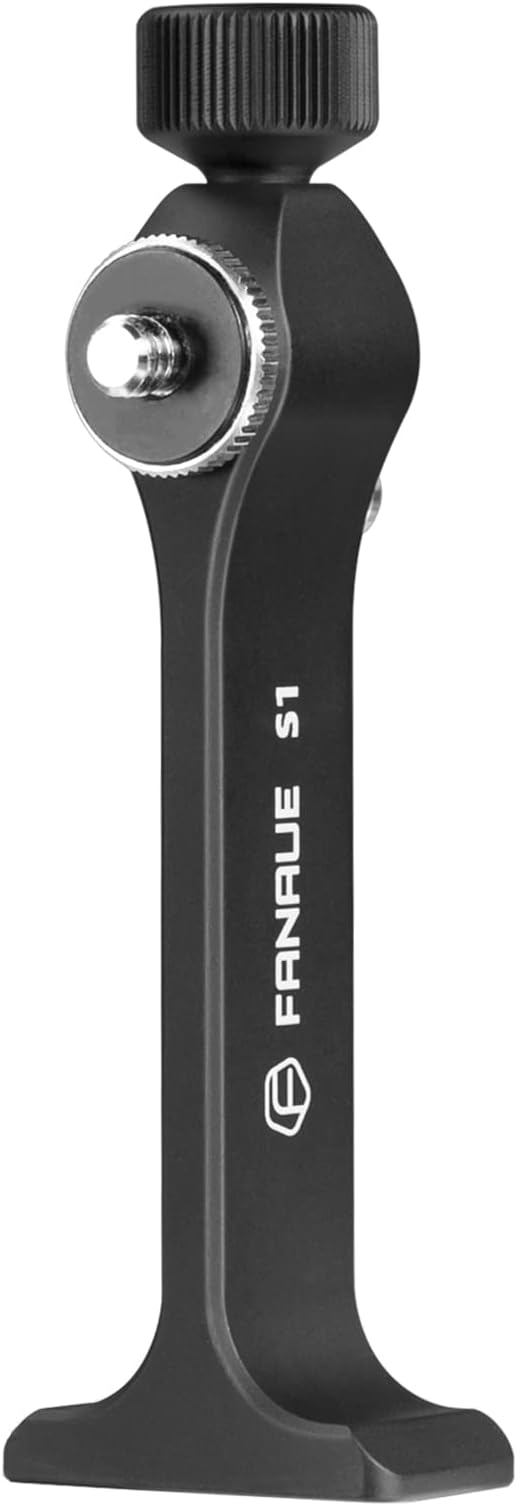
Precision CNC-cut from T6061 aluminum alloy, this sturdy adapter features an Arca-Swiss mount and a standard quarter-inch 20 thread for broad compatibility with most binoculars and tripods. A quick-release mechanism allows fast, effortless mounting and dismounting in the field. Backed by a lifelong warranty from FANAUE.
Check On AmazonIf you click this link and buy, we earn a commission at no additional cost to you.
The Practical Decision Framework
If you are still wondering what route to take, follow this practical breakdown based on how you actually plan to observe. For stationary glassing on land, a tripod combined with standard binoculars is the undisputed winner. It saves you money, provides better optical clarity, and relieves your arms of any weight over long hours. If this sounds like your use case, learning how to use binoculars on a tripod will solve your stability issues completely.
There is also a practical climate limitation to consider before buying electronics. In freezing temperatures, like a late-season hunt at dawn, alkaline and even lithium batteries drain significantly faster. If your IS batteries die in the cold, you are left holding heavy, non-stabilized binoculars. A tripod, being entirely mechanical, never runs out of power.
However, if your observation involves off-road vehicles, boats, or constant movement on foot, a tripod simply cannot keep up with complex external motion or rapid deployment needs. For a deeper look at whether the high price tag makes sense for your specific habits, you should consider are image-stabilized binoculars worth it for the terrain you frequent.
Key point: Buy a tripod when you control your environment and have time to prepare. Buy image-stabilized binoculars when the environment controls you and time is critical.

This versatile aluminum tripod features a Multi-Angle Center Column for limitless shooting angles, three-section legs with four angle positions from 20 to 80 degrees, and a unique twist-lock system for rock-solid stability. The 3-way fluid head includes dual telescopic handles, an Arca-type quick release, and a bubble level, while a canopy suspension loop and 3/8 inch thread connection add counterbalance and accessory compatibility. Extends to 69 inches and folds to 29.8 inches at 5.7 lbs with an 11 lb max load capacity.
Check On AmazonIf you click this link and buy, we earn a commission at no additional cost to you.
Final Thoughts: Choosing Based on How You Actually Observe
The debate over mechanical tripods versus electronic setups rarely has a wrong answer, just a wrong application. Both tools are highly effective at curing the frustration of a shaky image. The mistake happens when buyers try to force one tool into the other’s territory. A tripod on a boat is a frustrating waste of deck space. An image-stabilized binocular mounted permanently on a back porch is a waste of expensive electronics.
Be honest about how much you move, how much wind you tolerate, and how much weight you are willing to hold to your eyes. Once you define your environment, the choice between mechanical stability and electronic stabilization makes itself.
FAQs
🔭 Do I need image-stabilized binoculars or tripod for astronomy?
A tripod is vastly superior for astronomy. Stargazing requires looking upward for long periods, which causes severe arm fatigue regardless of stabilization. A tall tripod allows you to observe the night sky comfortably with zero image shake and without draining batteries.
⛵ Is image stabilization vs tripod binoculars better for boating?
Image stabilization is the only solution that works on a boat. A tripod will simply transfer the vibrations of the engine and the rocking of the waves directly into your optic, making the view worse. IS actively compensates for the deck movement.
🦅 Can I track birds in flight easily with a tripod?
It is very difficult. A tripod restricts your movement to the mechanical limits of the pan head, making it hard to follow fast, erratic flight paths. Image-stabilized binoculars allow you to move freely while keeping the subject smooth and readable.
🔋 What happens if my image-stabilized binoculars run out of battery?
They will immediately function like standard, non-stabilized binoculars. You will still be able to see through them clearly, but any hand shake or external vibration will become instantly visible until you replace the batteries.