How to Use Binoculars on a Tripod: The 10-Second Compatibility Check
If you are wondering how to use binoculars on a tripod, the very first step has nothing to do with the tripod itself. You need to check if your binoculars can actually accept a mount. Most how-to articles skip this entirely, assuming every pair of binoculars is built the same way. In my experience, this assumption leads to a lot of wasted time and returned accessories.
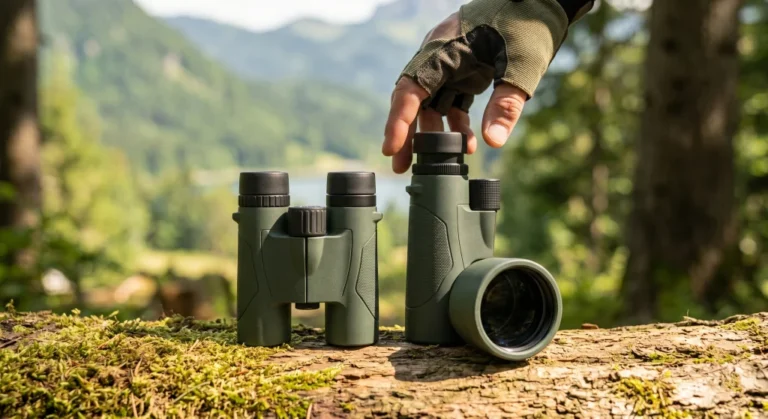
To check your binoculars, look at the front hinge, the pivot point between the two objective lenses that faces away from you when you hold them up to your eyes. On most full-size binoculars, you will see a small circular cap, often stamped with the manufacturer’s logo. If you grip the edges of this cap and turn it counterclockwise, it should unscrew. Beneath that cap is a standard 1/4-20 threaded socket. That socket is your mounting point.
Field Note: One of the most common things I heard at the counter was people coming in with an adapter they had just bought online, complaining it didn’t fit their compact binoculars. Many pocket-sized or sub-compact binoculars simply do not have a threaded hinge socket because their barrels are too close together to fit a standard adapter. Always check for the thread before buying the hardware.
If your binoculars have this threaded socket, a standard tripod adapter will work perfectly. If you cannot find a removable cap, or if the central hinge is solid metal with no threading, you are dealing with a closed design. You can still mount them, but you will need a universal strap-on adapter rather than a screw-in bracket, which changes the stability slightly.
What a Binoculars Tripod Adapter Is (And Which One to Get)
Mounting binoculars on tripod systems requires a bridge piece, commonly called a tripod adapter. Standard camera tripods have a flat mounting plate with a screw pointing straight up. Binoculars have a mounting socket pointing straight forward. The adapter bridges this 90-degree gap.
A standard binocular tripod adapter is a rigid L-shaped bracket. The vertical arm has a threaded screw knob that attaches to the front hinge of your binoculars. The base of the bracket has a threaded hole that accepts the screw from your tripod’s mounting plate.
When you are shopping for one, you will see options ranging from $10 to $30. The difference is materials and rigidity, which is immediately apparent once you attach 10×50 glass to it.
| Adapter Material / Type | Performance in the Field | Best Use Case |
|---|---|---|
| Plastic L-Bracket | Flexes under the weight of 10×42 or larger binoculars. Wind or touching the focus wheel causes the image to vibrate. | Very lightweight 8×32 models or occasional indoor use. |
| Machined Aluminum L-Bracket | Solid and rigid. Transfers the stability of the tripod directly to the binoculars without flexing. | Standard 10×42, 10×50, and 12×50 models used outdoors. |
| Universal Strap-On Mount | Uses a flat base and a tension strap over the binocular barrels. Less rigid than a threaded bracket. | Binoculars that lack a front hinge threaded socket. |
Warning: If you are running heavy 15×56 binoculars, skip the generic plastic brackets entirely. The plastic will flex, the image will bounce every time your heartbeat pulses through your hands, and you will defeat the entire purpose of using a tripod.

This ultra-lightweight 0.077 lb aluminum alloy adapter features a standard quarter-inch 20 thread on both top and bottom for broad compatibility with most binoculars and tripods. A unique tilting design with multi-directional rotation provides rigid, shake-free support for extended glassing sessions, with quick-turn top screws for fast, tool-free mounting and removal.
Check On AmazonIf you click this link and buy, we earn a commission at no additional cost to you.
Why Binoculars Tripod Use Changes Everything Above 10x
Most people buy a tripod adapter because they want to free up their hands or share a view with someone else. But the real reason binoculars tripod use is so critical comes down to optical fatigue and magnification physics. It is something we cover extensively when breaking down our binoculars overview, but the short version is that magnification amplifies your natural hand tremor.
At 8x magnification, most people can hold the image steady enough for a few minutes. At 10x, hand tremor is amplified 25% more visibly than at 8x. If you try to hold a 10×42 binocular steady for 15 minutes of continuous glassing, the micro-tremors in your arms and shoulders will start blurring the fine details. Your eyes have to work overtime to stabilize that bouncing image, which leads directly to eye strain.
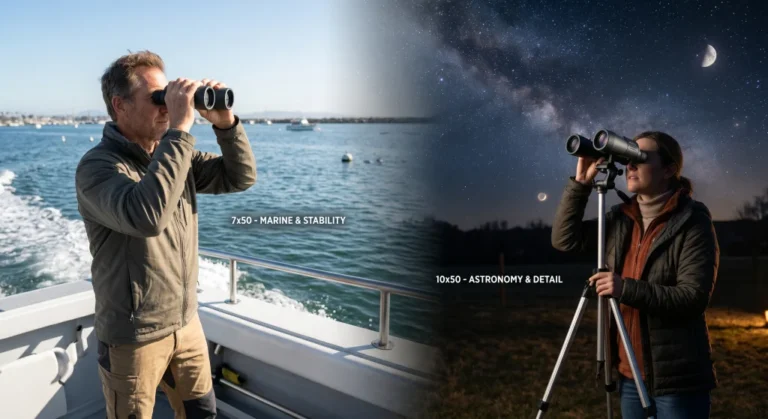
At 12x or 15x magnification, handheld viewing becomes highly impractical for anything other than a quick three-second glance. If you are trying to count antler tines at 600 yards or resolve the rings of Saturn, a tripod is not optional. It is mandatory.
Holding 12×50 binoculars by hand, resting your elbows on a shaky fence, and squinting to force the image to hold still.
Locking those same binoculars onto a solid tripod, resting your eyes, and watching the detail sharpen immediately as the physical shake disappears.

This sturdy aluminum alloy tripod extends from 34.6 to 79.5 inches via 3-section flip-lock legs with a triangle mid-spreader, supporting up to 17.6 lbs and folding to 36.2 inches for easy transport in the included carry bag. The fluid head delivers smooth 360 degree pan and minus 70 to plus 90 degree tilt with a detachable handle for left or right-handed operation. A quick-release plate with both quarter-inch and 3/8 inch threads ensures broad compatibility with Canon, Nikon, Sony, and most other DSLR cameras and camcorders.
Check On AmazonIf you click this link and buy, we earn a commission at no additional cost to you.
Choosing and Setting Up Your Tripod by Activity
You do not necessarily need a specialized optics tripod; a standard camera tripod will work. However, how you set that tripod up changes drastically depending on what you are trying to look at.
Binoculars Tripod for Astronomy
Using a binoculars tripod for astronomy introduces a unique physical challenge: looking straight up. If you put binoculars on a standard camera tripod and point them at the zenith (the sky directly overhead), you have to contort your neck into a deeply uncomfortable position to get your eyes to the eyepieces.
For casual stargazing, the easiest workaround is to extend the tripod high enough so you can sit in a reclined lawn chair beneath it. For serious astronomy, observers often invest in a parallelogram mount. This is an articulated arm that attaches to the tripod and holds the binoculars out away from the center column. You can raise and lower the binoculars while keeping them pointed at the same star, which is perfect for sharing the view with someone of a different height.
The Western Hunting Glassing Setup
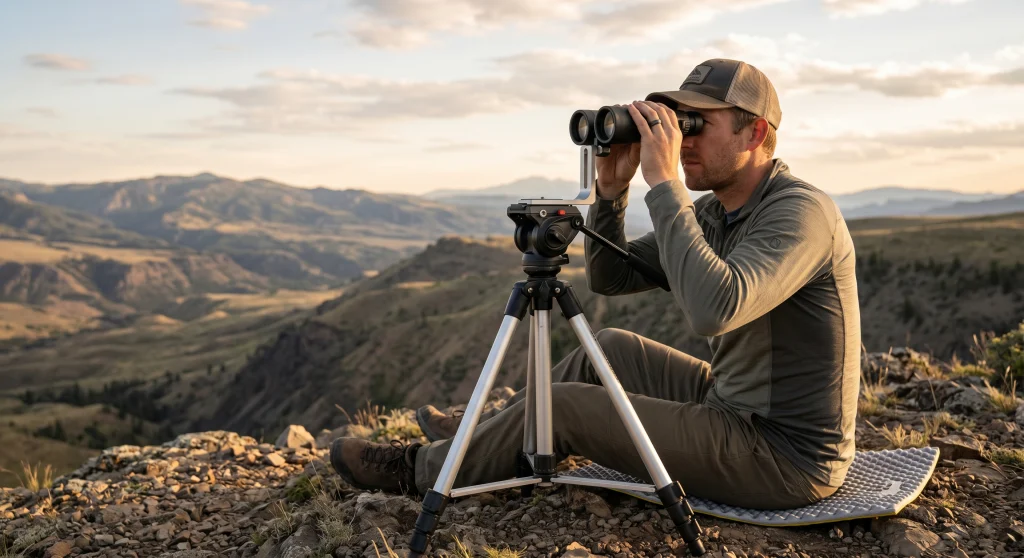
On the ground rather than overhead, the approach is entirely different. Hunters glassing open terrain for hours at a time have perfected tripod use. Instead of standing up in the wind, the standard protocol is to sit on the ground using a foam pad. You keep the tripod legs short and wide for maximum wind resistance. You bring the tripod head right to your seated eye level, then rest your elbows on your knees while looking through the glass.
This creates a rigid triangle of stability between your body and the tripod, allowing you to grid-search a distant ridge for an hour without neck or shoulder fatigue. If you want to dive deeper into the mechanics of adjusting the focus and diopter while seated, check out our guide on how to use binoculars properly to ensure your image is perfectly sharp before you lock the tripod down.
Tripod Head Types: Fluid, Pan-Tilt, or Ball?
The legs only do half the work; the tripod head dictates how easily you can scan a landscape. Avoid cheap plastic pan-and-tilt heads that jerk when you try to move them. Ball heads are fast to adjust but tend to drift under the weight of heavier binoculars, dropping your horizon line as soon as you let go. A fluid video head is the best choice for binoculars, allowing you to pan smoothly across a landscape without sticking, stuttering, or losing your aim point.
Leg Materials: When Carbon Fiber is Worth the Upgrade
Standard aluminum legs are perfectly fine for backyard astronomy or short walks. However, if you are a backcountry hunter or travel birder carrying your gear for miles, aluminum gets heavy fast. Carbon fiber legs reduce the overall weight by about 30% and dampen vibration better than aluminum, but they usually cost twice as much. The decision rule is simple: if you carry the tripod more than you look through it, carbon fiber is worth the price jump.
Field Techniques to Kill Residual Vibration
Even on a solid tripod, the image can still vibrate if the wind picks up or when you touch the focus wheel. To counter this, experienced users add mass to the center column. Most good tripods have a hook at the bottom of the center post. Hang a heavy backpack or a sandbag there to anchor the setup. When tracking a moving target, let the fluid head do the work. When locking in on a static detail, dial in your focus, take your hands completely off the binoculars, and give the system two seconds to settle before observing.

This rectangular-tube aluminum tripod extends from 16.9 to 69 inches via four flip-lock legs, with a weight hook at the base for added stability in windy conditions. Broad compatibility covers binoculars with quarter-inch threaded holes, spotting scopes, cameras, and smartphones via the included binocular adapter, rotating phone holder, and two quick-release plates. Folds to just 16.9 inches for easy carry in the included bag, backed by a 24-month warranty.
Check On AmazonIf you click this link and buy, we earn a commission at no additional cost to you.
The Image-Stabilized Alternative
Not every situation allows for a tripod at all. If you are standing on the deck of a rolling boat, trekking through dense brush where a tripod snags on every branch, or flying to a destination with strict luggage limits, traditional stabilization is off the table.
If you need high magnification but cannot use a tripod, the solution is image-stabilized (IS) optics. These binoculars use internal gyroscopes or shifting prisms to electronically cancel out your hand tremor. It is a different engineering solution to the identical problem. You get the steady view of a tripod without having to carry aluminum legs. For marine use or high-power travel birding, image-stabilized binoculars are often a better functional choice than a cumbersome mounting setup.

Canon's EF lens image stabilization technology eliminates shake at 10x magnification for steady, sharp views in hand. Porro II prisms and a doublet field-flattener deliver clear, distortion-free images edge to edge, while 14.5mm eye relief ensures comfortable use with or without glasses. Improved power efficiency extends battery life for longer sessions in a compact, portable package.
Check On AmazonIf you click this link and buy, we earn a commission at no additional cost to you.
Closing Thoughts: Stability Is the Last Upgrade Most Buyers Forget
Most buyers spend a lot of time debating glass quality and magnification, completely ignoring how they are going to hold the instrument steady. In my experience, a $300 pair of binoculars on a solid tripod will resolve more distant detail than a $1,500 pair held by shaky hands.
FAQs
🔭 Do all binoculars fit on a tripod?
No, not all binoculars fit on a standard tripod adapter. While most full-size models have a 1/4-20 threaded socket hidden under a cap on the front hinge, many compact binoculars and some premium models do not. If there is no socket, you must use a universal strap-on adapter.
🔩 What size thread is a binocular tripod adapter?
The standard thread size for almost all binocular tripod adapters is 1/4-20 (a quarter-inch diameter with 20 threads per inch). This is the identical mounting thread standard used by almost all consumer camera tripods globally.
✨ Do I need a tripod for 10×42 binoculars?
You do not strictly need a tripod for 10×42 binoculars for quick glances, but it is highly recommended for extended viewing. Holding 10x magnification steady for more than 10 to 15 minutes causes arm fatigue, and a tripod completely removes the shaky image caused by your natural hand tremors.
🌌 Can you use a regular camera tripod for binoculars?
Yes, any standard camera tripod will work for binoculars as long as you have the L-shaped binocular adapter bracket. For the best experience, a tripod with a fluid video head is preferred because it allows for smooth panning without jerky movements.