8×42 vs 10×42 Binoculars for Hunting: Terrain is the Deciding Factor
10×42 outsells 8×42 among western hunters. Eastern deer hunters split evenly. The difference is the terrain and the distances you regularly glass, not personal preference. When hunters ask me at the optics counter which configuration to buy, they usually expect me to ask what brand they prefer. Instead, I ask where they plan to hunt. A setup that works perfectly in the mountains of Colorado can be a frustrating liability in the cedar swamps of Michigan.
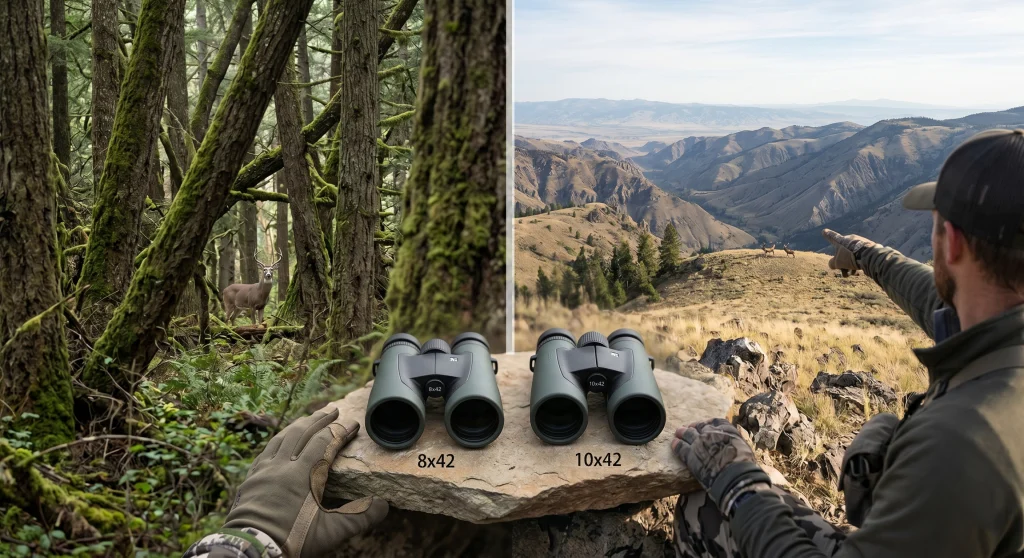
I have watched this confusion play out more times than I can count. A hunter will read a forum thread recommending a specific size, buy it, and then realize it does not fit the environment they actually hunt. The optical numbers on the box dictate how the tool performs in physical space. An 8×42 model offers a wider field of view and better stability. A 10×42 model sacrifices some of that width to bring distant objects closer. Deciding between them means understanding how those specific trade-offs react to trees, open plains, and distance.
If you want a broader look at how these two sizes compare across all outdoor activities, I have broken down the general trade-offs in my main 8×42 or 10×42 comparison guide. But if you are putting together a hunting kit, the rules change. We need to look specifically at how these optics function when you are trying to identify an animal in its natural habitat.
The Western Case: Why 10×42 Dominates Open Terrain
Over the years, I have seen a clear pattern with guys outfitting for western hunts. Whether they are chasing elk in Idaho or mule deer in Wyoming, they almost universally default to a 10×42 configuration. In wide open spaces, you are often sitting on a vantage point and glassing cross-canyon at distances of 400 to 800 yards before you ever decide to pick up your rifle and move.
At those extreme ranges, magnification has a very specific job. An 8×42 binocular will easily help you confirm that a brown shape under a pine tree is indeed an elk. However, a 10×42 binocular will give you the extra optical reach needed to count points on an antler. When you need to know if an animal is a legal shooter before hiking three miles across a valley, that extra 25 percent magnification is not a luxury. It is a strict necessity.
Field Note: I once had a customer insist on taking an 8×42 on a Montana elk hunt because he read they were lighter. He came back two weeks later to trade them in. He told me he spent the whole trip watching his guide successfully identify bulls at 600 yards with a 10×42, while he was left guessing. In the open west, 10×42 earns its keep.
There is a secondary factor at play here as well. In open country, animals are often stationary or moving slowly as they feed. You do not need a massive field of view to track them because there is no dense brush for them to quickly disappear behind. You can afford to trade some viewing width for the ability to pull distant details closer.

Fully multi-coated 42mm objective lenses with a large BAK-4 prism deliver bright, crisp, color-accurate images for wildlife viewing, hiking, and sporting events. Shock-absorbing rubber armor provides durable protection in tough weather conditions. Includes a wide-compatibility smartphone mount and backed by a Gosky lifetime warranty with full money-back guarantee.
Check On AmazonIf you click this link and buy, we earn a commission at no additional cost to you.
The Eastern Hardwoods: Where 8×42 Wins on Speed
The story changes completely when you move into the eastern half of the country. Whitetail hunting in thick hardwoods, overgrown cut-overs, or southern pine plantations rarely involves glassing anything beyond 100 or 200 yards. In this environment, you do not need extreme magnification. You need speed and a wide window.
When people ask me for the best magnification for deer hunting in these environments, I almost always point them to an 8x optic. The reason is field of view. A typical 8×42 binocular gives you a viewing width of about 330 to 430 feet at 1000 yards. A 10×42 shrinks that down by 15 to 25 percent. When a buck steps into a narrow shooting lane in thick timber, you have about three seconds to raise your glass, find the animal, evaluate it, and drop the glass to ready your rifle.
With an 8×42, you raise the optic and the animal is instantly in the frame because the window is wide. With a 10×42, it is incredibly easy to raise the glass, look through a narrow tube, and see nothing but tree bark because you were slightly off-center. By the time you pan around to find the deer, it has already walked back into the thicket.
Key point: The real consequence of too much magnification in the woods is losing the animal entirely. If you cannot get the deer in your optic before it takes three steps behind a deadfall, the extra detail a 10x provides is useless.

Fully multi-coated optics and BAK-4 prisms deliver crisp, high-contrast, color-accurate images in bright and low-light conditions alike. Rated IPX7, argon-purged, and O-ring sealed, they handle full submersion and the toughest outdoor elements. At just 1.25 lbs, the rubber-armored body is easy to carry all day, and the package includes an upgraded universal smartphone adapter and a 360-degree swivel tripod for hands-free photo capture.
Check On AmazonIf you click this link and buy, we earn a commission at no additional cost to you.
Stand Hunting vs. Spot-and-Stalk Dynamics
The terrain is the primary decider, but your method of hunting plays a supporting role. How your body is positioned while glassing directly impacts which configuration you can use comfortably. Specifically, we have to talk about image stability and hand tremor.
When you are sitting in an elevated tree stand or a fixed ground blind, you have a solid platform. You can rest your elbows on your knees or brace the binoculars against the window frame of the blind. In this seated, braced position, the natural hand tremors that usually plague 10x magnification are minimized. A stand hunter in a relatively open agricultural area can easily run a 10×42 optic without suffering from eye fatigue.
Spot-and-stalk hunting is a different physical reality. You are moving, your heart rate is elevated, and you are often glassing off-hand while standing awkwardly on a hillside. Magnification amplifies hand movement just as much as it amplifies the image. An 8×42 is vastly more forgiving of heavy breathing and unsteady hands. If your hunting style involves covering miles on foot and glassing while standing, the stability of an 8x system will give you a sharper perceived image than a shaky 10x system.

Built from heavy-duty 1000D nylon with strong zippers and durable buckles, this chest pack features a fleece-lined interior with a quiet magnetic one-handed flap for fast, silent deployment in the field. Multiple storage options include removable modular side pockets, a rear zippered pocket, and elastic sleeves for a rangefinder, GPS, or phone. A 4-point harness with padded back panel distributes weight evenly across the shoulders, and a rain cover keeps everything protected in wet conditions.
Check On AmazonIf you click this link and buy, we earn a commission at no additional cost to you.
Bow Hunting and the Short-Range Reality
If you are strictly an archery hunter, your optical needs are highly specialized. Most bow shots happen inside 50 yards. At this distance, the detail provided by a 10x optic is massive overkill, and the narrower field of view becomes a frustrating liability. When comparing an 8x vs 10x hunting binoculars setup for archery, the lower magnification is almost always the right answer.
Bow hunters operate in close quarters where tracking a moving animal through brush is the primary challenge. Furthermore, bow hunting often happens at the very edges of legal light. An 8×42 binocular has a 5.25mm exit pupil, whereas a 10×42 has a 4.2mm exit pupil. In the dim light of dawn or dusk, that larger exit pupil on the 8×42 delivers a noticeably brighter image to your eye. When you need to confirm which way a deer is facing in the shadows before drawing your bow, that extra brightness is critical.
I frequently advise archery hunters to read through the deeper breakdown in my binoculars explained guide to fully grasp how exit pupil interacts with the human eye. But the short version is simple: for close-range, low-light encounters, an 8×42 is optically superior.
The Terrain Decision Framework
To make this as practical as possible, you need to be honest about where you spend the majority of your time in the field. It is tempting to buy a 10×42 because you plan to take one elk trip three years from now, but if you spend the other 95 percent of your time hunting whitetails in a dense forest, you are buying the wrong tool.
| Hunting Environment | Recommended Configuration | Primary Reason |
|---|---|---|
| Eastern Hardwoods / Dense Timber | 8×42 | Maximum field of view for fast target acquisition in tight lanes. |
| Western Open Terrain / Mountains | 10×42 | Higher magnification for cross-canyon identification and detail. |
| Archery / Deep Swamps | 8×42 | Better low-light exit pupil and easier off-hand stability. |
| Agricultural Fields / cut-overs | 10×42 | Ability to evaluate animals holding still at field edges at 300+ yards. |
Based on what I have seen work for hundreds of hunters over the years, the choice generally boils down to a simple set of rules. Follow these and you will rarely end up with buyer’s remorse:
- Rule 1: If your regular line of sight is blocked by trees or brush within 200 yards, buy the 8×42. You will benefit from the speed.
- Rule 2: If you regularly glass open spaces, fields, or ridgelines where animals are 300 yards away or more, buy the 10×42. You will need the detail.
- Rule 3: If you hunt mixed environments, or if this is your very first pair of hunting binoculars, the 8×42 is the safer, more forgiving choice.

ED glass virtually eliminates chromatic fringing for razor-sharp, true-to-life images, while ESP dielectric multi-layer prism coatings reflect over 99 percent of light for outstanding brightness and color accuracy. Advanced fully multi-coated lenses maximize light transmission across the full spectrum, and argon purging ensures superior waterproofing and thermal stability. A wide 8.1 degree field of view and long eye relief make these comfortable for extended use with or without glasses.
Check On AmazonIf you click this link and buy, we earn a commission at no additional cost to you.
Final Thoughts on Choosing Your Setup
Do not let anyone tell you that one size is universally better than the other. Both configurations exist because they solve different environmental problems. The 8×42 or 10×42 for hunting debate is not a matter of which one is optically superior, but rather which one fits the geometry of the woods you hunt.
Take a look at the spot you plan to sit in next season. If you can see clearly for half a mile, you know what to do. If you can barely see past the next ridge of pine trees, you also know what to do. If you are looking to build out your entire gear list, be sure to check my comprehensive binoculars for hunting guide. And if you have settled on the higher magnification, make sure you know exactly what those 10×42 numbers mean before you head into the field.
FAQs
🦌 What is the best magnification for deer hunting?
For whitetail deer in wooded or brushy environments, 8x is the best magnification because it provides a wide field of view to catch movement quickly. For mule deer in open western terrain, 10x is preferred to identify antler details at long distances.
🌲 Should I use 8×42 or 10×42 for hunting in thick woods?
You should absolutely use an 8×42 in thick woods. The wider field of view allows you to find an animal through the trees much faster, and the larger exit pupil helps gather light in the shadows of the timber.
🏔️ Are 10×42 binoculars better for elk hunting?
In most western scenarios, yes. Elk hunting usually involves glassing across wide canyons and open basins at distances of 400 to 800 yards. A 10×42 gives you the reach necessary to identify a legal bull at those ranges.
🏹 Does magnification matter for bow hunting?
Yes, but higher is not better. Because archery shots are taken at close range (usually under 50 yards), an 8×42 is vastly superior. It offers better low-light performance and a wider window to track animals moving through close cover.