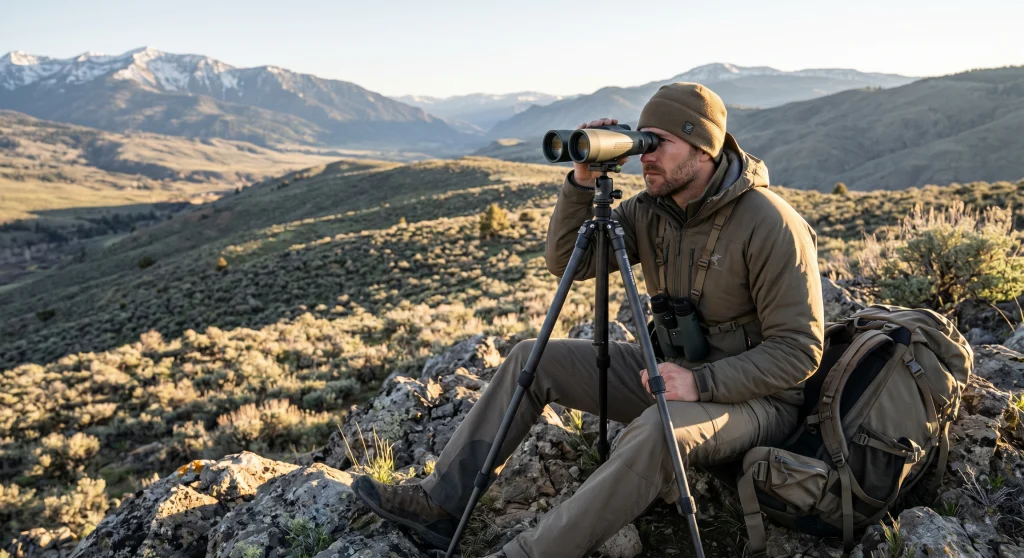
The Shift in Western Glassing
If you are looking for binoculars for elk hunting right now, you are probably noticing a shift in the conversation. For years, the default answer for anyone heading West was to buy a 10×42. It was the undisputed king of the mountain. But recently, the trend has been creeping upward.
More guys are coming to the optics counter asking about 12x50s and 15x56s. They assume bigger is automatically better. The reality is that western hunting binoculars are not one size fits all. The right choice depends entirely on your specific hunting style. Are you covering ten miles a day on foot, or are you sitting on a prominent ridge picking apart shadows for four hours at a time?
Every step up in magnification costs you something. You lose field of view, you add weight to your chest harness, and you make the image harder to hold steady without a physical support. Before you decide to jump up to a massive set of glass, it helps to understand exactly what you are gaining and what you are giving up.
The Traditional 10×42: Still the Most Versatile Option
Despite the trend toward bigger glass, the 10×42 remains the most versatile baseline for western hunting. If you need one piece of glass that can do a little bit of everything, this is still where you start.
The primary advantage of the 10×42 is that it sits right at the edge of what most people can hold steady by hand. If you bump a bull in the timber or need to quickly check a shape across a canyon without setting up a tripod, you can pull a 10×42 up to your eyes and get a usable image. The field of view is wide enough that you can quickly find your target, and the weight is manageable for all-day wear. A veteran hunter on the Hunt Talk forum summed this up perfectly, noting that 10x is fine and they have used it all over the West for pronghorn, mule deer, elk, mountain goat, bighorn sheep, and moose. It simply works in almost every environment.
Field Note: One of the most common mistakes I see is a guy buying a massive 15×56 setup for his first elk hunt, only to realize half his hunt takes place walking through dark timber. When he tries to pull those heavy binoculars up quickly, the image shakes so badly he cannot tell a stump from a cow elk. He usually comes back the next year asking for a 10×42.
For most users, the 10×42 is fully functional for glassing out to 400 or 800 yards. It is the best binoculars for elk hunting if your strategy involves moving frequently, hunting a mix of dark timber and open parks, or if you simply cannot afford the weight penalty of carrying a tripod everywhere you step.

About this item<br /> 10x magnification and 42mm objective lenses, these Diamondback binoculars are the workhorse of Vortex lineup; known for impressive optical quality and durability.<br /> Dielectric, fully multi-coated lenses transmit more light and clearer, brighter images. A field of view that is one of the largest in its class helps you efficiently glass your surroundings and identify your target.<br /> A sleek, short hinge design with rubber armor and thumb indents leaves more room for your hands creating an easier, secure, non-slip grip.<br /> Multi-position eyecups twist up for adjustable eye relief. A right eye diopter accomodates for focal differences in your eyes.<br /> Argon purging and rubber armor provide enhanced waterproof and fogproof performance in extreme weather conditions.
Check On AmazonIf you click this link and buy, we earn a commission at no additional cost to you.
The 12x Sweet Spot for Open Country
This brings us to the 12×50, which is rapidly becoming the favorite among dedicated western hunters. The argument for the 12x setup, effectively mapped out by an experienced field tester on the Rokslide hunting forums, is that it splits the difference between versatility and pure long-range performance.
When you step up to 12x magnification, you get noticeably more detail at a distance than you do with a 10x. This matters when you are trying to count points on an elk in the brush from a mile away. At the same time, a 12x typically offers a wider field of view than a 15x, making it easier to scan large swaths of a hillside without feeling like you are looking through a narrow pipe.
If you decide to step up to 12x, keep a close eye on your budget. A quality 12×50 where the glass actually resolves fine detail without causing eye strain typically starts in the $500 to $800 range. Buying a cheap 12x binocular is a massive mistake. Poor optical quality paired with increased image shake will give you a worse view than a budget 10×42.
Warning: A 12×50 is very difficult to hold perfectly still by hand. While you can use it for a quick glance offhand, you will only see the true benefit of that extra magnification if you rest your elbows on your knees or mount the binoculars to a tripod.

Select HD glass elements with fully multi-coated, dielectric-coated lenses deliver exceptional sharpness, color fidelity, and light transmission at 12x magnification, while Armortek coating protects exterior surfaces from scratches and oil. Argon-purged and O-ring sealed for waterproof, fog-proof performance in any conditions. Includes a GlassPak chest harness and backed by Vortex's unlimited, unconditional, fully transferable lifetime VIP Warranty.
Check On AmazonIf you click this link and buy, we earn a commission at no additional cost to you.
When 15×56 Actually Earns Its Keep
There is a specific type of hunting where the 15×56 absolutely dominates. If your strategy involves hiking to a prominent vantage point in the dark, setting up a tripod, and sitting in one spot for five hours picking apart opposite ridges, the 15×56 is the tool for the job.
These are exceptional mule deer binoculars because they allow you to find an antler tine poking out of the sagebrush in deep shadow. They resolve fine detail at distances where a 10x simply runs out of optical reach. Because you are using both eyes, it is much easier to glass for extended periods without the eye fatigue common with high-powered spotting scopes.
However, the 15×56 is a specialized tool. They are heavy, and they are bulky on your chest. If you buy a 15x, you are committing to a style of hunting that revolves around stationary, tripod-based observation.

Built for western hunters glassing big country, these high-powered 15x56 binoculars feature fully multi-coated, dielectric-coated lenses with Armortek exterior protection for exceptional clarity, color fidelity, and scratch resistance. Argon-purged and O-ring sealed for waterproof, fog-proof performance in any conditions. A tripod adapter is included for shake-free viewing at this magnification, along with a GlassPak chest harness, all backed by Vortex's unlimited, unconditional, fully transferable lifetime VIP Warranty.
Check On AmazonIf you click this link and buy, we earn a commission at no additional cost to you.
How the Big Three Compare
To make the decision easier, it helps to look at exactly how these three common setups handle different field conditions. The choice usually comes down to how much time you spend walking versus how much time you spend sitting.
| Configuration | Primary Use Case | Handheld Usability | Tripod Requirement |
|---|---|---|---|
| 10×42 | Walk and glass, mixed timber, stalking | Good to very good | Recommended for long sessions |
| 12×50 | Open country, weight-conscious backpack hunts | Poor to marginal | Essential for maximum detail |
| 15×56 | Dedicated vantage point glassing | Unusable | Absolutely non-negotiable |
The Spotting Scope Decision
Moving up in binocular magnification inevitably brings up the question of whether you still need to carry a spotting scope. For western hunters, the optics payload is a major weight consideration. How you answer this depends entirely on your base binocular choice.
If you carry a 10×42, a spotting scope is highly recommended. The 10x gets you on the animal, and the spotting scope lets you evaluate it at a distance before committing to a mile-long stalk. This is the classic two-optic system.
If you upgrade to a 12×50, you are often doing so to leave the spotting scope in the truck. Backpack hunters love the 12×50 because it provides enough detail to evaluate a bull without the two-pound penalty of a dedicated scope and a heavy fluid head. It is the ultimate compromise setup for weight-conscious hunters.
If you run a 15×56, you are essentially replacing your spotting scope with a two-eye viewing experience. Many hunters who strictly glass from vantage points prefer the 15x binoculars on a tripod because staring through them for hours is vastly more comfortable than squinting through a single eyepiece.
The Tripod Rule for Western Glassing
You cannot have a serious conversation about elk hunting binoculars without talking about stabilization. Magnification does not just enlarge the animal. It also enlarges your heartbeat, your breathing, and the wind blowing against your arms.
Putting any binocular on a tripod effectively buys you a free level of magnification because it eliminates the micro-jitters that blur fine details. Your eyes relax, your brain stops fighting the shake, and you suddenly notice an ear twitching in the brush that you would have completely missed handheld.
Pro Tips: If you are planning to use a tripod, make sure the binoculars you buy have a threaded socket for a tripod adapter. Most modern roof prism models do, but it is always worth verifying before you spend the money. You can learn more about the exact setup process in our guide on how to use binoculars on a tripod.

This simple, quick-attach adapter transfers the weight of your binoculars onto a tripod for fatigue-free extended glassing sessions, revealing fine details that handheld viewing would miss. Standard quarter-inch 20 threading on both the top and base fits virtually any tripod-adaptable binoculars and most tripods or car window mounts.
Check On AmazonIf you click this link and buy, we earn a commission at no additional cost to you.
Low Light and Objective Lens Size
Elk and mule deer are most active right at the edges of the day. First light and last light are when your optics matter the most. This brings us to the objective lens size, which is the second number in the configuration.
A 10×42 binocular has an exit pupil of 4.2mm. A 10×50 binocular has an exit pupil of 5.0mm. At high noon, your eye cannot tell the difference. But thirty minutes before sunrise, when the canyon is still wrapped in shadows, that larger 50mm objective lens delivers a noticeably brighter image to your dilated pupil.
The trade-off is always weight. A 50mm objective lens requires more glass and a larger chassis, which pulls heavier on your neck and sticks out farther on your chest. If you are specifically building a setup for dawn and dusk performance, the 50mm or 56mm models are worth the physical burden. If you want a deeper breakdown of how this math works in the field, check out our dedicated look at binoculars for hunting in low light.

Made from quiet, non-rip polyester with double-stitched straps, this breathable chest pack fits binoculars up to 10x50 and 12x50 in a main compartment measuring 7 by 6.5 by 3 inches. Detachable binocular straps loop through your bino's side enclosures for secure, quick-release access, while padded mesh backing and adjustable straps keep it snug and comfortable against your torso all day.
Check On AmazonIf you click this link and buy, we earn a commission at no additional cost to you.
Final Thoughts on Choosing Your Setup
There is no magic number that works perfectly for every mountain range and every hunting style. The push toward 12x and 15x binoculars makes sense for the guy sitting on an open glassing knob in Arizona or Nevada. It makes very little sense for the guy still-hunting through thick dark timber in Idaho or Montana.
To put this into practical terms, here is a quick map of how terrain typically dictates your setup:
- Idaho and Montana dark timber: 10×42. You need a wide field of view and quick offhand acquisition.
- Colorado mixed terrain (dark timber and timbered parks): 10×42. The most versatile option for moving between pines and open parks.
- Wyoming open sage: 12×50 or 15×56. When you can see for miles, you need optics that can reach out.
- Arizona and Nevada desert basins: 15×56 on a tripod. This is pure vantage point glassing territory.
Buying a 15×56 because you saw it on a hunting show, then leaving the tripod at home to save weight and trying to freehand them all week.
Being honest about how many miles you walk versus how many hours you sit, and choosing the magnification that matches your actual boots-on-the-ground reality.
If you have identified the magnification that matches your hunt, below are the setups that consistently perform well across different budget tiers. If you are still unsure where your specific hunt falls on the spectrum, you can find a broader breakdown of how to match your glass to your game in our main binoculars for hunting hub, or take a step back and read our complete binoculars buying guide to understand the fundamentals.
FAQs
🔭 What magnification is best for elk hunting?
A 10×42 is the best all-around choice for most elk hunters because it balances magnification with a manageable weight for walking. If you hunt extremely open country and use a tripod frequently, a 12×50 is an excellent upgrade.
⛰️ Can I handhold 12×50 binoculars?
You can hold them for a quick glance, but the image will shake noticeably. To get the actual benefit of 12x magnification, you need to rest your elbows on your knees, lean against a tree, or mount them to a tripod.
🎒 Do I need a spotting scope if I have 15x binoculars?
In most cases, no. Many western hunters use 15×56 binoculars on a tripod specifically to replace the need for a spotting scope, saving overall pack weight while enjoying the comfort of looking through two eyes instead of one.
🦅 Are 8×42 binoculars enough for western hunting?
They can work if you are hunting dense timber or taking close-range shots. However, for open-country glassing across canyons, 8x simply lacks the magnification needed to judge distant animals. You can read a full breakdown of this in our 8×42 vs 10×42 for hunting guide.