The Close Focus Problem Nobody Warns You About
Finding the right binoculars for backyard bird watching usually trips people up because they look at the wrong numbers on the box. At the optics counter, I saw countless people buy powerful, expensive optics for their deck or kitchen window, only to return them a week later complaining that the image was completely blurry. The problem was never the quality of the glass. The problem was the physical distance.
Standard binoculars are built for looking at things far away. Because of this, most general-purpose models have a minimum focus distance of fifteen to twenty feet. That is perfectly fine if you are hiking a trail or scanning a distant tree line. However, when a chickadee lands on a bird feeder just eight feet away from your window, it is physically inside the minimum focus distance of those standard optics. The result is a frustrating, unresolvable blur.
Field Note: One of the most common things I heard at the counter was a customer bringing back a beautiful, expensive pair of 10x50s. They would tell me the binoculars were defective because they could not see the hummingbirds at the feeder mounted to their porch railing. I would take the binoculars, step outside, focus on a building down the street, and hand them back. They worked perfectly. The customer just had no idea that binoculars have a blind spot up close.
This is why close focus is the single most important specification for bird feeder binoculars. You need an instrument designed to bend light sharply enough to focus on a target right in front of you. The experts at optics4birding point out a classic beginner mistake in the field: anyone who starts with an inadequate pair eventually finds themselves standing ten to fifteen feet behind the rest of their group, just trying to get a bird outside of their optic’s blind spot. That exact same principle applies when you are watching from your kitchen. Similarly, as AllAboutBirds notes, when birds get to within fifteen feet of you, close focus means the difference between an unforgettable full-frame view versus a disappointing blur.
If you plan to watch birds from your patio or window, you should look for a close focus specification of eight feet or less. The absolute best models designed for close-up birding can focus down to five or six feet. It sounds like a minor detail, but in practice, it is the difference between enjoying your hobby and returning your purchase.

Fully multi-coated lenses and phase-coated BaK-4 prisms deliver bright, crisp, color-accurate images across all lighting conditions, with a wide 7.4 degree field of view for easy tracking. The rubber-armored polycarbonate body is waterproof, nitrogen-purged, and tripod-adaptable for extended sessions. Backed by a Celestron Limited Lifetime Warranty and US-based support.
Check On AmazonIf you click this link and buy, we earn a commission at no additional cost to you.
The Magnification Trap at Close Range
It is human nature to assume that more power is always better. If 8x magnification brings a bird close, 10x must bring it even closer. While that logic holds up in wide open spaces, it completely falls apart in the confined space of a garden. In fact, for backyard birding binoculars, high magnification actively works against you.
When you increase magnification, you automatically shrink your field of view. At fifty yards, a narrow field of view is manageable. At ten feet, a narrow field of view feels like looking through a drinking straw. If a warbler is hopping erratically through the dense branches of a lilac bush right outside your window, trying to find it with a 10x binocular is an exercise in pure frustration. By the time you locate the right branch in your lenses, the bird has already moved.
Buying a 10x or 12x binocular for a small garden, assuming the extra power will let you see individual feathers on a sparrow sitting just twelve feet away. You will spend all your time trying to find the bird in the lenses, and the natural shake of your hands will be severely magnified.
Choosing an 8x or even a 7x binocular for backyard use. The wider field of view allows you to instantly locate a fast-moving bird, and the lower magnification keeps the image perfectly steady even if you are holding them with one hand while holding a coffee cup in the other.
Lower magnification also provides a much more forgiving depth of field. Depth of field is how much of the image stays sharp at one time. At very close distances, your depth of field compresses significantly. With a 10x optic at ten feet, only a fraction of an inch might be in focus. If the bird hops one branch backward, you have to spin the focus wheel again. An 8x binocular gives you a deeper pocket of focus, meaning you spend less time adjusting the wheel and more time actually watching the bird.
If you eventually take your hobby out into open marshes or vast wetlands, different rules apply. I cover those specific scenarios in my broader binoculars for bird watching hub. But within the confines of a residential property line, 8x is almost universally the better choice.

Phase-correction coated prisms and fully multi-coated 42mm lenses deliver sharp, bright HD images across an extra-wide 430 foot field of view. A 2 meter close focus distance lets you pick out fine feather details with stunning clarity, while 8x magnification keeps distant subjects steady up to 1,000 yards. Nitrogen-filled and fully sealed against water and fog, backed by a 12-month warranty and 30-day money-back guarantee.
Check On AmazonIf you click this link and buy, we earn a commission at no additional cost to you.
The Reality of Watching Through Kitchen Windows
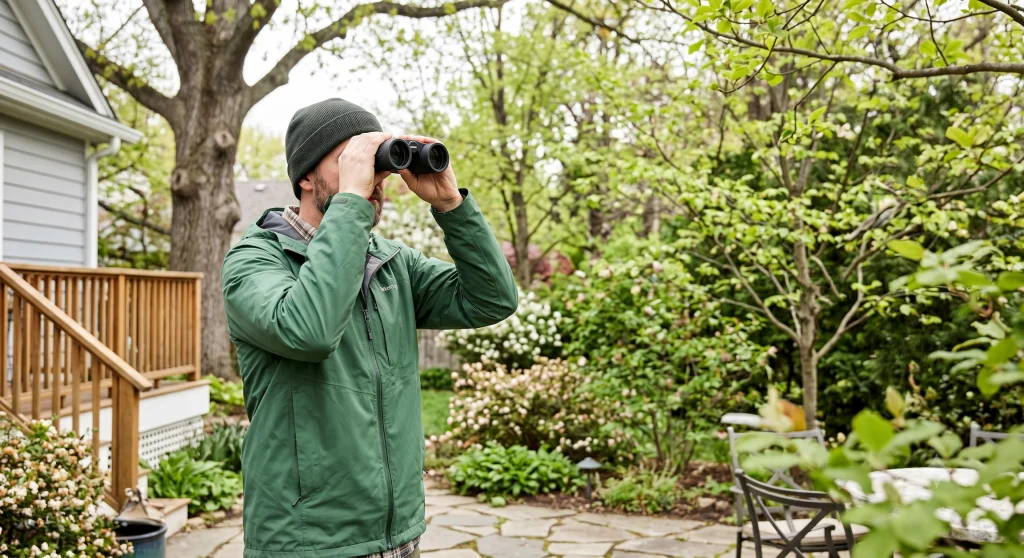
That close-range scenario, where a lower magnification and a wide field of view save the day, happens most often when you are birding from inside your house. A significant percentage of binoculars for garden bird watching never actually leave the property. They live on kitchen tables, next to coffee makers, or on living room windowsills. This means you will likely be doing a lot of birding through window glass, which introduces a specific set of optical challenges that you need to prepare for.
Household window glass is not optically pure. Double-pane insulated windows add multiple reflective surfaces between your eyes and the bird. When you point your binoculars through these layers, you can sometimes experience glare, ghost images, or a slight drop in contrast. This is where lens coatings become important. Binoculars with fully multi-coated lenses handle these scattered light reflections much better than cheap, uncoated alternatives.
Key point: Do not press the objective lenses of your binoculars directly against the window pane in an attempt to block glare. The metal or hard rubber edges can scratch your household glass, and the subtle vibrations from the house will transfer directly into the optic, creating a shaky image.
Another common issue with window watching at close range is the diopter adjustment. The diopter is the separate focus ring usually located on the right eyepiece, designed to compensate for the difference in vision between your two eyes. Binocular diopters are generally calibrated for distance viewing. When you focus on a finch sitting on a feeder just seven feet away through a pane of glass, you might notice that the image feels slightly unbalanced. You may need to tweak your diopter setting specifically for this close-range distance. Understanding how all these parts work together is crucial, which is why I mapped out the core mechanics in our main binoculars buying guide.

This pocket-sized cleaning tool combines a retractable natural hair brush for dust removal with a revolutionary non-liquid compound that safely eliminates smudges, fingerprints, and oily residue without spilling or drying out. Reduces static charge buildup and is safe for use on all lenses, all in a lightweight package small enough to carry anywhere.
Check On AmazonIf you click this link and buy, we earn a commission at no additional cost to you.
How Your Spec Priorities Change at Home
When you are out on a grueling five-mile hike, the physical weight of your optics is a massive concern. Every extra ounce pulls on your neck. In a backyard setting, weight simply does not matter as much. If you are standing at a window or sitting on a deck chair, you can easily support a heavier, full-size pair of binoculars without fatigue. This freedom allows you to prioritize optical quality over portability.
Because weight is less of an issue, I highly recommend sticking with a 42mm objective lens rather than downsizing to a compact 32mm or 25mm model. The reason for this comes down to the daily habits of birds. The highest volume of bird activity happens during the dawn chorus, right as the sun is coming up, and again at dusk before they roost. These are low-light conditions.
A full-size 8×42 binocular gathers significantly more light than a compact 8×25 model. During those dim morning hours when the cardinals and jays first hit your feeders, the 42mm objective lenses will give you a bright, crisp image with excellent color resolution. A compact binocular in the exact same early morning lighting will look dark, shadowy, and gray.
| Specification | Hiking / Field Use | Backyard / Garden Ideal |
|---|---|---|
| Close Focus | 15 to 20 feet is acceptable | Must be under 8 feet |
| Magnification | 8x or 10x depending on terrain | Strictly 8x (or 7x) |
| Weight | Crucial (under 22 ounces preferred) | Minimal concern (25+ ounces is fine) |
| Field of View | Important | Critical for tracking close targets |
Eye relief remains an important factor, especially if you wear eyeglasses. When you are looking out a window, you are often standing at an awkward angle or leaning over a piece of furniture. You want binoculars with at least 15mm of eye relief so you can quickly bring them up to your glasses and see the full picture without having to perfectly align your posture.

Select HD glass elements with fully multi-coated, dielectric-coated lenses deliver exceptional sharpness, color fidelity, and light transmission, while Armortek coating protects exterior surfaces from scratches and oil. Argon-purged and O-ring sealed for waterproof, fog-proof performance in any conditions. Includes a GlassPak chest harness and backed by Vortex's unlimited, unconditional, fully transferable lifetime VIP Warranty.
Check On AmazonIf you click this link and buy, we earn a commission at no additional cost to you.
Final Thoughts: Setting Up for Success
Buying optics for your property requires you to ignore a lot of the marketing hype surrounding extreme long-distance performance. You do not need the ability to count the points on a deer at six hundred yards. You need the ability to clearly see the textured feathers on a mourning dove sitting just out of arm’s reach.
Keep your checklist simple. Prioritize an 8x magnification to keep your field of view wide and your image steady. Ensure you have a 42mm objective lens to capture the morning light. Above all else, verify the close focus specification before you spend your money. If that number is under eight feet, you are going to have a fantastic time watching the daily visitors right outside your door.
FAQs
🔍 What does close focus mean on binoculars?
Close focus is the absolute shortest distance at which a pair of binoculars can produce a sharp, clear image. Anything closer than that distance will remain permanently blurry, no matter how much you turn the focus wheel.
🐦 Is 8x or 10x better for backyard birding?
8x is significantly better for backyard use. At close ranges, 10x magnification creates a very narrow field of view, making it hard to find fast-moving birds, and it heavily exaggerates normal hand shake.
🪟 Can I use binoculars through a closed window?
Yes, you can easily use them through a closed window. However, double-pane glass can sometimes cause mild reflections or glare, so having binoculars with fully multi-coated lenses helps maintain a clear image.
🦉 Do I need large objective lenses for feeder birds?
Large lenses are highly recommended because birds are most active at dawn and dusk when light is poor. A 42mm objective lens will give you a bright, colorful image during these dim hours, whereas smaller compact lenses will look dark.
📏 How close do birding binoculars need to focus?
For dedicated garden and feeder watching, you should look for binoculars that can focus at eight feet or less. The best models designed specifically for close observation can focus down to five feet.