The Astrophotography Illusion
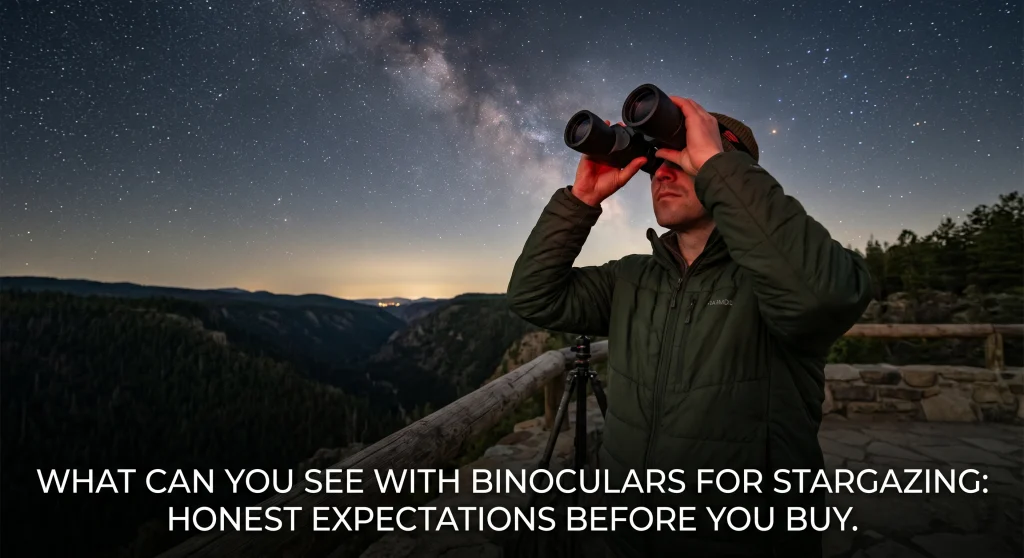
When people ask me exactly what can you see with binoculars stargazing, I usually start by telling them what they will not see. Most people walk outside on their first night expecting the night sky to look like a magazine cover. It is a completely natural expectation. We grow up seeing brilliant pink nebulae and crystal-clear spiral galaxies on screens.
Those photographs are created by cameras that accumulate light over thirty minutes, or sometimes multiple hours. Your eyes do not work that way. Human eyes integrate light over roughly one-tenth of a second in real time. We cannot store up light to build a brighter picture.
Field Note: Over my time at the optics counter, I handled dozens of returns from people who bought a nice pair of 10x50s, took them out once, and brought them back saying they were defective. They always said the same thing. “The galaxy just looks like a gray smudge.” The binoculars were working perfectly. Nobody had prepared them for what real-time astronomy actually looks like.
Furthermore, the brilliant reds, blues, and pinks you see in photos of the Orion Nebula are often processed from narrow-band exposures. Your eyes cannot perceive those colors in extreme low light. When you look through binoculars, nebulae will appear gray, or occasionally faintly greenish if you have very sensitive night vision. You are trading the colorful processing of a photograph for the raw reality of seeing photons that have traveled millions of years to hit your retina directly.
The Spectacular Targets
Once you clear away the false expectations of Hubble-style images, you can appreciate what binoculars do better than almost any other instrument. For certain targets, a good pair of binoculars actually provides a better viewing experience than a high-powered telescope.
The Moon and the Terminator Line
The Moon is spectacular through binoculars. A standard 10×50 configuration is enough to resolve major craters, mountain ranges, and the dark lunar maria. The secret is knowing when to look. A full moon is actually the worst time to view it. The light is flat and blinding.
You want to observe the Moon when it is in a crescent or quarter phase. Look specifically along the terminator. That is the boundary line between the light and dark sides of the lunar surface. Along this line, the Sun is hitting the lunar features at a low angle, casting long black shadows that make the craters pop out in sharp, three-dimensional relief.
Jupiter and the Galilean Moons
Jupiter is one of the most rewarding targets for beginners. When you locate it, Jupiter will not just be a bright star. It will appear as a distinct, tiny disk. But the real magic happens right next to it.
If you can hold your binoculars steady enough, you will see up to four tiny pinpricks of light arranged in a straight line on either side of the planet. These are the Galilean moons: Io, Europa, Ganymede, and Callisto. If you sketch their positions on a Tuesday, and go back out on a Wednesday, you will see they have moved. You are watching orbital mechanics happen in real time, exactly as Galileo saw them hundreds of years ago.
Open Star Clusters
This is where binoculars completely dominate telescopes. Open clusters like the Pleiades or the Hyades are groups of young stars born from the same nebula. They are often too wide to fit into the narrow field of view of a telescope.
Through binoculars, the Pleiades transforms from a tight blurry knot visible to the naked eye into dozens of brilliant, icy blue diamonds scattered across a rich, dark background. The wide field of view provided by binoculars frames these clusters perfectly.
Double Stars: The Easy Wins
If you want a target that looks great even in light-polluted suburbs, look for double stars. Mizar and Alcor form a famous pair in the handle of the Big Dipper. To the naked eye, it looks like one star (or two if you have excellent vision). Through binoculars, they split beautifully into two distinct points of light. Albireo, at the head of the Cygnus constellation, is another stunning pair that reveals a striking gold and blue color contrast when viewed through good glass.
Scanning the Milky Way Core
In the summer months, if you can get to a truly dark sky, simply lying back and scanning the core of the Milky Way around the constellation Sagittarius is an experience no telescope can match. Your binoculars will reveal dense clouds of unresolved stars, dark dust lanes, and glowing knots of star clusters. This wide-field sweeping is exactly what binoculars were built for.

Massive 70mm objective lenses paired with BaK-4 prisms maximize light throughput for bright, detailed views of the night sky at 15x magnification, making them a favorite for dawn, dusk, and astronomical observation. A built-in quarter-inch 20 tripod adapter attaches to most standard tripods in seconds, essential at this size and power. Water-resistant rubber armor provides durable protection in tough conditions, backed by a Celestron Limited Lifetime Warranty and US-based support.
Check On AmazonIf you click this link and buy, we earn a commission at no additional cost to you.
Targets That Require Managed Expectations
There is a second category of targets that are absolutely worth finding, as long as you know what to look for. These are the deep-sky objects. Finding them is a thrill of navigation, even if the visual result is subtle.
The Andromeda Galaxy
Andromeda is the closest major galaxy to our own Milky Way. Under dark skies in the autumn and winter, it is a fantastic binocular target. But it will not look like a swirling vortex of stars.
Through a 10×50 binocular, Andromeda appears as a small, faint, elongated smudge of light. It is slightly brighter in the center and fades out at the edges. It looks like a piece of glowing cotton. The thrill here is not visual spectacle. The thrill is the realization that the light hitting your eyes right now left that smudge 2.5 million years ago.
The Orion Nebula
Located in the sword hanging from Orion’s belt, this is a massive stellar nursery. It is one of the brightest nebulae in the sky. When you point your binoculars at the middle star of the sword, you will notice it is not a sharp point of light.
Instead, it will look like a soft, hazy gray glow surrounding the central stars. Depending on your sky darkness, you might see it taking on a fan or bat-wing shape. Again, there will be no brilliant pinks or reds, just a ghostly monochrome cloud of gas and dust where new stars are currently forming.
| Night Sky Target | What Beginners Expect | What You Actually See (10×50 Binoculars) |
|---|---|---|
| The Moon | Bright white circle | Sharp craters, mountains, extreme shadow detail on the terminator line |
| Jupiter | Swirling cloud bands and red spot | Bright solid disk with 4 tiny moons in a straight line |
| Double Stars (Mizar-Alcor) | A single bright star | Two distinct, separate points of light floating next to each other |
| Pleiades Cluster | Six faint stars | Dozens of brilliant blue stars filling the field of view |
| Milky Way Core | Vibrant glowing purple clouds | Dense rivers of stars interrupted by dark, dusty lanes |
| Andromeda Galaxy | Spiral arms and star dust | Faint, glowing gray oval smudge of light |
| Orion Nebula | Vibrant pink and red gas clouds | Soft, hazy gray mist surrounding a few central stars |
How Light Pollution Changes the View
Almost all astronomical targets are affected by your local sky conditions, but they do not all suffer equally. If you are observing from a bright suburban driveway, the Moon, Jupiter, and double stars will still look fantastic. They punch right through light pollution.
However, targets like the Andromeda Galaxy or the Orion Nebula require real darkness. In the suburbs, Andromeda might be completely invisible. Out in the country, it jumps out at you. Calibrate your expectations based on where you are standing.

This glow-in-the-dark planisphere lets you instantly identify visible constellations for any date and time, paired with seasonal star charts marking the best deep-sky objects across all four seasons. Printed on heavy card stock with a protective overcoat for years of durability, with spiral binding that lays completely flat for easy field use. Designed for use in the Northern Hemisphere only.
Check On AmazonIf you click this link and buy, we earn a commission at no additional cost to you.
What Requires a Telescope
There are hard physical limits to what standard binoculars can resolve. Knowing these limits prevents you from wasting hours staring at a dot trying to force details to appear.
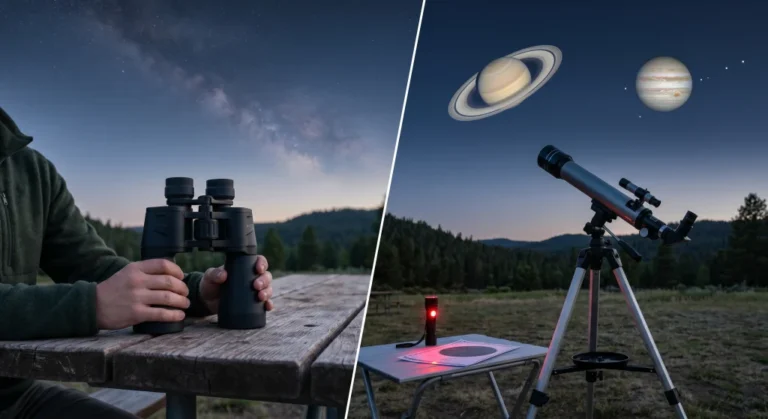
The most common disappointment is Saturn. Everyone wants to see the rings. Standard handheld binoculars simply lack the magnification. If you look at Saturn with a 10×50, it will look like a bright yellowish star. If you move up to a heavy, tripod-mounted 20×80 binocular, you will not see distinct rings. Instead, the planet will look like a tiny, elongated oval. To see the black gap of space between the planet and its rings, you absolutely need a telescope.
The same rule applies to most planetary surface details. You cannot see the cloud bands on Jupiter or the polar ice caps on Mars with standard binoculars. You can actually spot the crescent phase of Venus if you brace a 10×50 binocular perfectly still, but it will be remarkably tiny. However, true planetary surface detail is out of reach. Binoculars are low-magnification, wide-field instruments.
Warning: Never look at the Sun with binoculars. Even a fraction of a second will cause permanent, irreversible eye damage. Solar viewing requires specialized, certified solar filters attached to the front lenses.

Massive 80mm objective lenses paired with BaK-4 prisms maximize light throughput for bright, detailed views of the night sky at 20x magnification, making them ideal for dawn, dusk, and deep-sky astronomical observation. A built-in quarter-inch 20 tripod adapter attaches to most standard tripods in seconds, essential at this size and power. Water-resistant rubber armor provides durable protection in tough conditions, backed by a Celestron Limited Lifetime Warranty and US-based support.
Check On AmazonIf you click this link and buy, we earn a commission at no additional cost to you.
Your First Night Flight Plan
If you have not purchased your optics yet, you should read our comprehensive binoculars buying guide to understand how different specifications map to different hobbies. If you already know astronomy is your main goal, you can dive straight into our specific recommendations for binoculars for stargazing to find the right aperture size.
Once you have your glass, do not try to find everything on the first night. Start simple to build your navigation skills. I see the same mistake constantly. Beginners try to hunt down a faint galaxy before they even know how to focus their diopter properly in the dark.
Here is a realistic progression for your first few sessions. Start with the Moon. It is impossible to miss and provides instant gratification. Use it to dial in your focus perfectly. Next, pan over to Jupiter to spot its moons, or find a bright double star like Mizar and Alcor in the Big Dipper. Brace your elbows on a fence or the roof of your car to steady the image.
After you have mastered bright targets, give your eyes twenty minutes in complete darkness to adapt. No phone screens. Then, look for the Pleiades. Finally, once you are comfortable navigating star charts, try hunting down the Orion Nebula in winter, scanning the Milky Way core in summer, or tracking down the Andromeda Galaxy in autumn. Take your time, breathe, and let the faint light build on your retina.

This red-only LED headlamp preserves dark-adapted night vision while providing hands-free illumination for telescope setup, star chart reading, and nighttime navigation. Four light modes including high, low, blinking, and SOS cover a range of situations, with a 45 degree adjustable beam angle and up to 100 hours of runtime on standard AAA batteries. The ergonomic adjustable head strap ensures a comfortable fit for long nights under the stars, backed by a 2-year Celestron warranty.
Check On AmazonIf you click this link and buy, we earn a commission at no additional cost to you.
Final Thoughts: Enjoying the View
Binoculars are not stepping stones to a telescope. They are a dedicated astronomical instrument in their own right. They offer a comfortable, two-eyed view of the universe that no telescope can replicate. If you go outside knowing that you are hunting for subtle smudges of ancient light rather than glossy magazine photos, you will find that a simple pair of 10x50s can keep you busy for years. Learn the sky, manage your expectations, and enjoy the raw reality of the night sky.
FAQs
🔭 What can 10×50 binoculars see in the night sky?
You can clearly see lunar craters on the terminator line, Jupiter’s four largest moons, and dozens of stars inside open clusters like the Pleiades. Under dark skies, you can also spot the Andromeda Galaxy and the Orion Nebula as faint, glowing gray smudges.
🪐 Can you see Saturn’s rings with binoculars?
No, not with standard handheld binoculars. Even with heavy 20x magnification binoculars on a tripod, Saturn will only appear as an elongated oval. You need a telescope to see the actual gap between the rings and the planet.
🌌 Why do galaxies look gray instead of colorful?
Human eyes cannot detect color in extremely low light conditions. The vibrant colors you see in space photos are the result of cameras accumulating light over long exposures, often combined with false color processing. In real time, your eyes will only register these objects as gray or faintly green.
👀 Is 10x magnification enough for astronomy?
Yes, 10x is the sweet spot for beginners. It provides enough power to see Jupiter’s moons and lunar detail, while remaining low enough that you can hold the binoculars reasonably steady without needing to buy a heavy tripod right away.
✨ What are the easiest stargazing targets for beginners?
The Moon is the easiest and most rewarding first target. After that, Jupiter, bright double stars, and the Pleiades star cluster are excellent because they are easy to find and look noticeably different through binoculars than they do to the naked eye.