Before You Choose the Tech, Check the Law
People often walked up to the optics counter ready to spend a lot of money on the best night vision binoculars for hunting without knowing the laws in their own backyard. They had seen the videos online and wanted that exact capability. But when I asked them what they were hunting and where they planned to do it, the conversation usually came to a hard stop.
Here is the reality of hunting with night vision in the United States. For white-tailed deer, elk, turkey, and most traditional game animals, using night vision or thermal optics is illegal in almost every state. It does not matter if the technology is digital, image intensifier, or thermal. If you pull the trigger after dark using these devices on a protected game animal, you are poaching.
Field Note: I remember a customer coming into the shop ready to drop three grand on a premium thermal setup right before deer season. He was thrilled about the tech. I asked him where he hunted. When he told me, I had to gently explain that night hunting for deer was completely illegal in his state. He checked with a game warden friend and came back a week later just to thank me. He would have lost his truck, his rifle, and his hunting license if he had been caught in the field.
State wildlife agencies strictly regulate shooting hours. These usually span from 30 minutes before sunrise to 30 minutes after sunset. Anything outside that window for standard game is off-limits. If you buy a night vision device thinking it will help you harvest a buck at 10 PM, you are making a very expensive mistake.

A 256x192 thermal sensor with 12μm infrared detector delivers high-resolution thermal imaging in six color palette modes including White-Hot, Black-Hot, and Rainbow for fast, accurate target identification in any scenario. Four times zoom and 16GB onboard storage provide flexibility for capturing and saving critical images, while WiFi connectivity enables real-time viewing and sharing via a dedicated app. IP65 rated with replaceable batteries for over 6 hours of continuous use in rain, dust, and demanding field conditions.
Check On AmazonIf you click this link and buy, we earn a commission at no additional cost to you.
Where and When Hunting With Night Vision is Legal
If you cannot hunt deer with them, you might be wondering who actually buys these things for hunting. The answer mostly comes down to two categories: feral hogs and predators. Because these are largely considered invasive or nuisance species, many states have entirely different rulebooks for them.
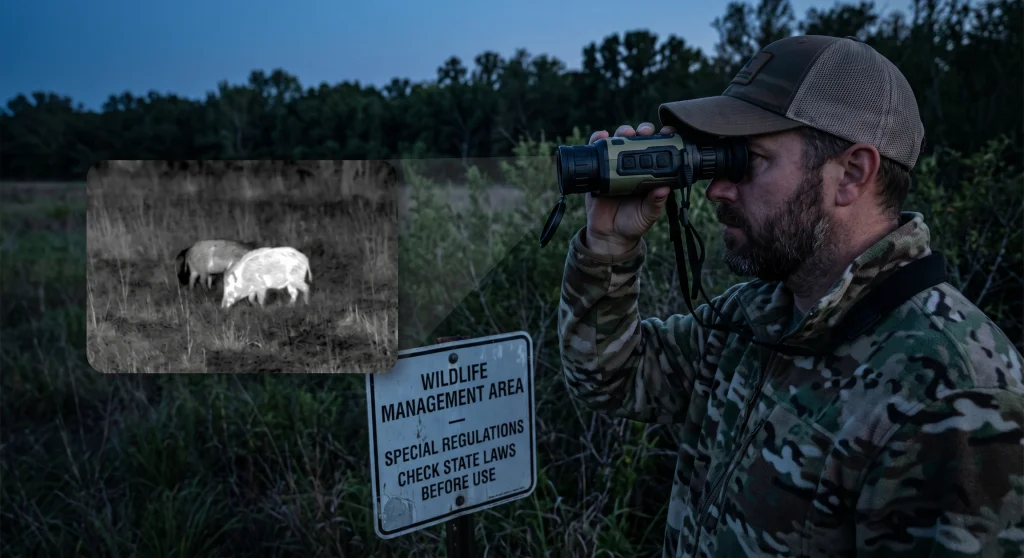
In states like Texas, Oklahoma, and across much of the South, feral hogs cause massive agricultural damage. To help control the population, wildlife agencies in these areas often allow hunters to use night vision and thermal optics to hunt hogs at night. The same applies to coyotes in a wide variety of states. Predator hunting after dark is a massive pursuit, and this is where night optics become a legal and highly effective tool.
Warning: This is not a gray area. It is a hard legal line. Never rely on what you read on a forum or what a buddy told you. Regulations change constantly, so always confirm local restrictions on your state wildlife agency website before taking night optics into the woods.
When you verify the rules for your area, here is what you need to look for specifically:
- The exact species allowed for nighttime harvesting.
- Whether artificial light or infrared illuminators are restricted.
- Differences between public land rules and private land rules.
- Specific seasons or dates when night hunting is permitted.
- Whether you need a special depredation permit to use night optics.

This smartphone-mounted thermal monocular uses InfiRay Core technology with 15x zoom and an adjustable focus lens to detect targets beyond 1,500 yards and identify objects clearly at 400 plus yards in any condition, day, night, or fog. High Definition and Highlight modes enhance image clarity and target visibility, while integrated hotspot tracking keeps fast-moving subjects locked in frame. A dual-function solution that turns your phone into both a thermal camera and night vision monocular trusted by over 100,000 hunters.
Check On AmazonIf you click this link and buy, we earn a commission at no additional cost to you.
The Scouting Exception: Observing Without a Weapon
There is one massive exception where hunters can legally use this technology even if they cannot shoot at night. In many jurisdictions, using night vision or thermal binoculars for scouting is perfectly legal. This is an incredibly powerful way to pattern deer or elk. If you want to know how a herd moves from their bedding area to a food source before the sun comes up, a thermal binocular will show you exactly what is happening in pitch blackness.
I have seen hunters use entry-level night vision from their trucks to scan fields hours before dawn. They map out where the animals are congregating. Then, when legal shooting light finally arrives, they already know exactly where to set up. It takes the guesswork out of the early morning sit.
The line that keeps this activity legal is the strict absence of a firearm or bow. If a warden catches you scanning a field with night vision at 4 AM and you have a loaded rifle next to you, you will have a very hard time explaining that you are just scouting. Keep the gear separated to stay out of trouble.
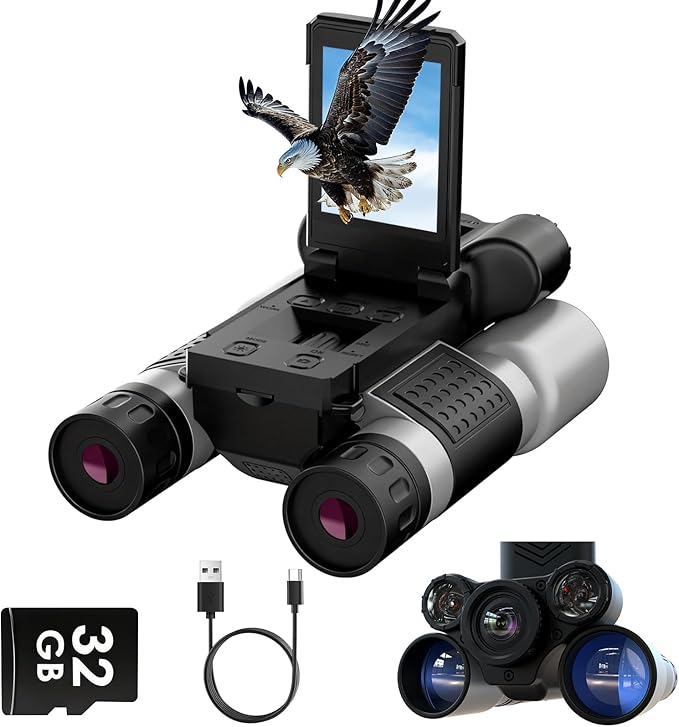
A BAK-4 prism with 12x magnification and 8x digital zoom delivers sharp, high-contrast daytime views, while a 7-level 850nm infrared system illuminates targets up to 300 meters in complete darkness. The built-in 8MP camera with a 2.4 inch IPS screen allows real-time viewing, photo capture, and video recording without a phone, and the included 32GB TF card stores everything on the go. USB-C charging and a durable all-in-one build make it ready for hunting, wildlife observation, and night exploration.
Check On AmazonIf you click this link and buy, we earn a commission at no additional cost to you.
Matching the Technology to Your Legal Game
Once you have confirmed that you can legally hunt your target species at night, you have to pick the right tool for the terrain. The commercial market offers three completely different technologies, and each one handles the dark differently.
If you are hunting coyotes in wide open fields where you can see for hundreds of yards, digital night vision or a Generation 1 image intensifier might do the job. Digital models are affordable and let you record video, but they rely heavily on an infrared illuminator. If you are in total darkness, that IR beam is the only way the sensor can see.
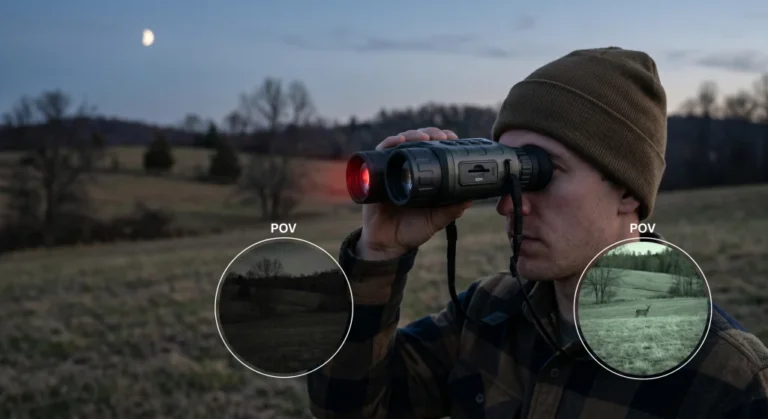
If you are hunting feral hogs in thick brush, digital night vision will only show you the leaves in front of you. This is where thermal imaging takes over. Thermal detects body heat. It does not care about ambient light or shadows. It sees right through light vegetation. If a hog is standing behind a bush, thermal will show a bright glowing shape, whereas traditional night vision will just show the bush.
For a complete breakdown of why heat detection beats light amplification in the woods, you will want to read our detailed comparison at https://binospecs.com/thermal-vs-night-vision-binoculars/ which explains the visual differences.
| Technology Type | How It Works | Best Hunting Environment | Typical Price Range |
|---|---|---|---|
| Digital Night Vision | Amplifies light via digital sensor, requires IR light in total dark | Open fields, bait stations at close range | $100 to $400 |
| Image Intensifier (Gen 1) | Magnifies ambient light particles for a green/white image | Open terrain where identifying specific details matters | $400 to $800 |
| Thermal Imaging | Detects body heat signatures regardless of lighting | Dense brush, tall grass, deep woods | $1,500+ |
What this looks like in practice is a matter of matching your budget to your environment. If you are setting up for casual predator hunting in open terrain, a digital night vision setup in the $100 to $400 range gets you in the game. If you want better image quality and faster target acquisition without the digital lag, a Gen 1 image intensifier in the $400 to $800 range is the traditional step up. The price gap between $800 and $1,500 is largely filled by Gen 2 or Gen 3 military-style intensifiers, which offer incredible clarity but stretch most budgets. However, if you are going after hogs in thick brush, light amplification will not help you see through the leaves. That is where you have to make the jump to a thermal unit starting around $1,500.

Four interchangeable LED modules in white, red, green, and IR850 swap quickly to adapt to any game or hunting environment, with a zoomable lens that transitions from wide flood to focused spotlight for long-range observation. Stepless pressure switch control allows smooth, continuous brightness adjustment for precise stealth or maximum illumination, while IPX6 waterproofing handles heavy rain and harsh conditions. Includes Picatinny and quick-release mounts plus a protective carry case for a complete hunting kit.
Check On AmazonIf you click this link and buy, we earn a commission at no additional cost to you.
Final Thoughts: Don’t Buy Until You Verify
The technology inside modern night optics is incredible. It completely changes what you can experience in the woods after dark. But the most critical step in the buying process happens before you ever look at a spec sheet.
By confirming exactly what your local regulations permit, you can pick the right tool for the job without risking your license. To see how these night devices fit into the bigger picture of outdoor optics, take a look at our complete framework at https://binospecs.com/types-of-binoculars/ or browse our dedicated hub for https://binospecs.com/night-vision-binoculars/ to explore the different setups in more detail.
FAQs
🦌 Are night vision binoculars legal for deer hunting?
In the vast majority of US states, using night vision or thermal equipment to hunt deer is strictly illegal. Deer are protected game animals with specific daytime shooting hours. Always check your state wildlife regulations to avoid severe poaching penalties.
🐗 Can I use thermal binoculars for hog hunting in Texas?
Yes. Texas, along with several other southern states, allows hunters to use thermal and night vision equipment to hunt feral hogs at night. Because hogs are considered an invasive and destructive species, regulations are much looser to encourage population control.
🔦 Do I need an IR illuminator for hunting coyotes at night?
If you are using digital night vision or a Generation 1 intensifier in complete darkness, you absolutely need an IR illuminator to see the coyote. Without ambient light like a full moon, those specific devices cannot produce a visible image.
🕵️♂️ Is scouting with night vision legal before the season starts?
In many states, using night vision just to observe and pattern wildlife is legal, provided you do not have a hunting weapon with you. However, you must check your state wildlife agency website and consult your local game warden if needed, as some areas restrict any use of night optics on public lands.