The Missing Numbers on the Waterproof Box
At the optics counter, I regularly watched customers pick up a box, see the word “waterproof” printed in bold letters, and immediately start searching for a number to back it up. They wanted to know the actual binoculars waterproof rating, but nine times out of ten, that number was completely missing from the packaging. This leaves buyers wondering if the binoculars can survive a drop in a puddle or if they will get ruined by a light mist. The confusion is completely understandable because the outdoor gear industry uses these terms very loosely.
To make things worse, a $50 pair of binoculars and a $500 pair might both claim to be waterproof on the side of the box. Without a standardized number, it feels impossible to compare them fairly or know what you are actually paying for. I have seen countless people buy budget optics thinking they were fully protected, only to bring them back a week later with water sloshing around inside the lenses. Getting your binoculars IPX rating explained properly is the only way to cut through the marketing noise and protect your investment.
Breaking Down the Binoculars Waterproof Standard
The IPX system stands for Ingress Protection, which is an international standard used to define exactly how well a device keeps out liquids and solids. The “IP” is the standard itself, the “X” means the product was not specifically tested for dust resistance, and the final number tells you the exact level of water protection. When we talk about an IPX rating binoculars actually use, we are mostly looking at numbers ranging from 4 up to 8. Anything below a 4 is essentially useless for outdoor gear, and anything above an 8 is usually reserved for deep-sea diving equipment.
Understanding these numbers helps you match the optic to the environment you plan to explore. If you are just birding from a covered porch, a low number might be perfectly fine. If you are paddling a kayak through choppy water, you need a completely different level of protection to ensure your glass survives the trip. Here is how the most common ratings translate into real-world field conditions.
| IPX Rating | What the Standard Means | Real-World Binocular Capability |
|---|---|---|
| IPX4 | Splash resistant from any direction | Can survive a light drizzle or wet grass, but will fail in heavy rain. Not fully sealed. |
| IPX5 | Resists low-pressure water jets | Handles steady rain without issue. Cannot survive being dropped in water. |
| IPX6 | Resists high-pressure water jets | Survives heavy storms and boat spray. Still not rated for full underwater submersion. |
| IPX7 | Submersion to 1 meter for 30 minutes | The gold standard for outdoor optics. Survives being dropped in a creek or flipped in a kayak. |
| IPX8 | Continuous submersion beyond 1 meter | Extreme marine use. Manufacturers specify the exact depth and time for this rating. |
What About MIL-STD Testing?
Occasionally, you will see tactical or rugged binoculars marketed with a MIL-STD-810 certification instead of an IPX number. This is a military testing protocol that goes beyond simple water submersion. It tests the optics against blowing rain, high humidity, and extreme altitude pressure changes. If a binocular genuinely passes MIL-STD water testing, its protection typically equals or exceeds the IPX7 standard, making it a highly reliable indicator of a fully sealed outdoor tool.
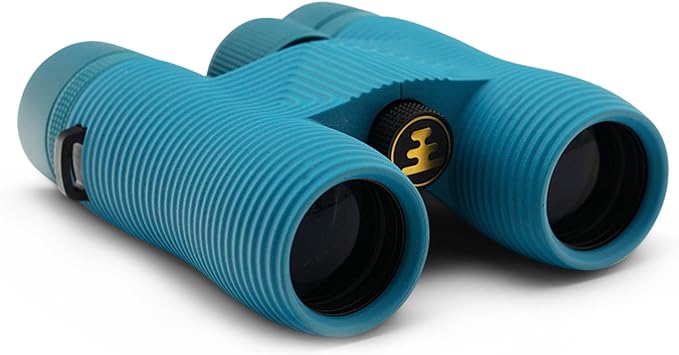
Weighing just 16.7 oz, these compact binoculars feature fully multi-coated optics and a Swiss-designed BaK-4 prism for bright, edge-to-edge clarity across a wide 387 foot field of view. IPX7 rated and nitrogen sealed, they handle submersion up to 3 feet for 30 minutes without compromising performance. A patented wave grip, three-position twist eyecups, and a no-matter-what lifetime warranty make them a confident choice for any adventure.
Check On AmazonIf you click this link and buy, we earn a commission at no additional cost to you.
Why IPX7 Binoculars Are the Outdoor Baseline
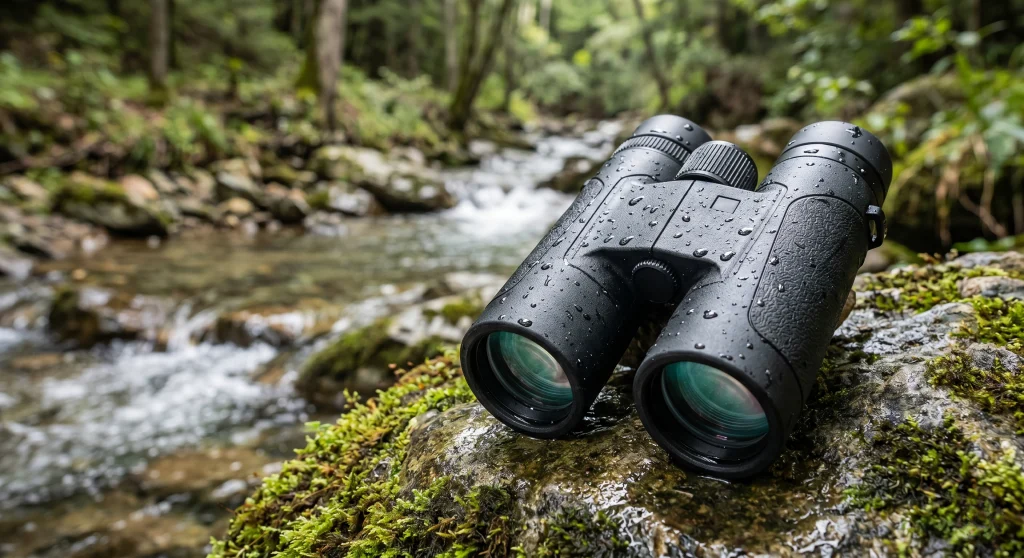
If you spend any serious time hiking, hunting, or boating, IPX7 binoculars are generally the baseline you want to aim for. This rating guarantees that the optic can survive being submerged in one meter of water for up to thirty minutes without any liquid breaching the internal lenses. This specific threshold is critical because it covers the most common catastrophic accidents that happen outdoors. Slipping while crossing a shallow stream or knocking your gear off a boat deck are real scenarios that IPX7 is designed to forgive.
Field Note: I once talked to a customer who slipped on a wet riverbank and dropped his binoculars right into the mud and water. Because they were rated to IPX7, he just picked them up, rinsed them off under a camp faucet, and kept using them. If they had been a standard IPX4 model, that slip would have been the end of those optics.
Even if you never plan to drop your gear in a lake, the IPX7 standard provides a massive secondary benefit related to atmospheric pressure. The same seals that keep out a meter of water also keep out microscopic water vapor during extreme temperature changes. This is why high-end sealed models rarely develop internal fungus, as the tight seals prevent the humid air that feeds mold from ever getting inside the barrel.

An upgrade to Bushnell's best-selling H2O series, these compact roof-prism binoculars feature fully multi-coated lenses and BaK-4 prisms for maximum clarity and light transmission. O-ring sealed and nitrogen-purged for 100 percent waterproof, fog-proof performance in any conditions. Rugged rubber armor with soft grip handles wet conditions with ease, and the package includes a strap, case, and lens covers. Backed by over 70 years of Bushnell optics expertise.
Check On AmazonIf you click this link and buy, we earn a commission at no additional cost to you.
The Reason Most Brands Do Not List an IPX Number
You would think that if a manufacturer builds a tough product, they would proudly stamp the rating right on the front of the box. The reality is that official IPX certification requires independent laboratory testing, and that testing costs a significant amount of money. Many optics manufacturers, especially those producing mid-tier models, choose to skip the official certification process to keep their retail prices competitive. Instead, they just print the word “waterproof” on the packaging and rely on their own internal quality control checks.
This lack of transparency creates a lot of justified skepticism among experienced outdoor users. A user on a popular birding forum perfectly captured this feeling when they noted that extreme weather in places like the Scottish Highlands tests gear to the absolute limit, making them wary of any brand that avoids publishing official ratings. When a brand refuses to list the number, it forces the buyer to guess whether the term “waterproof” means a light mist or a full dunk in a river. Thankfully, there is a mechanical workaround you can use to bypass this marketing problem entirely.

A 42mm objective lens with superior light transmission delivers vivid, high-definition views across a wide 241 foot field of view from dawn to dusk. The rugged magnesium-aluminum alloy chassis with shock-absorbing rubber armor is true IPX7 rated for rain, snow, and humid conditions. At 2.2 lbs, the included chest harness redistributes weight from neck to shoulders, while 16.5mm eye relief, twist-up eyecups, and a smooth center focus wheel ensure comfortable viewing with or without glasses.
Check On AmazonIf you click this link and buy, we earn a commission at no additional cost to you.
Two Things to Look For When the Rating Is Missing
If the box does not list a specific number, you can still determine the true capability of the optic by looking at the construction materials. The first thing you must verify is O-ring sealing. O-rings are physical rubber gaskets placed at every joint, dial, and lens mount to create a physical barrier against moisture. Any binocular that lacks O-ring seals is, by definition, only weather-resistant and will eventually let water inside if pushed too hard.
The second mandatory feature to check for is nitrogen or argon purging. This is a process where the manufacturer vacuums out the regular, moisture-rich air from inside the barrel and replaces it with a completely dry, inert gas. While both gases work exceptionally well, argon has a larger molecule size and higher density than nitrogen. This means argon is theoretically less likely to leak out of microscopic gaps over a decade of heavy use. Regardless of which gas is used, this purging process is what makes the optic truly fogproof.
The Reality of Seal Degradation
There is one detail about waterproofing that spec sheets rarely mention: rubber seals do not last forever. O-rings degrade over time, especially when repeatedly exposed to UV light, sunscreen, or the extreme heat of a car trunk. If you notice a foggy patch forming inside the lens that you cannot wipe away, or if you see internal condensation after a sudden temperature drop, the seal has failed. Checking your older optics for these signs before a trip is a habit that saves a lot of frustration in the field.
Regardless of the types of binoculars you are evaluating, finding a model that clearly advertises both O-ring sealing and gas purging gives you a reliable shortcut when the IPX number is missing. These two features together essentially guarantee that the optic performs at an IPX7 equivalent, even without the expensive laboratory certificate.
Trusting a product page that highlights words like “weatherproof” or “rain-ready” without listing the actual internal construction details. These terms are marketing fluff and offer no real protection guarantees.
Ignoring the marketing headlines and scrolling straight to the technical specifications. If you see “O-ring sealed” and “nitrogen purged” listed together, you have a genuinely protected optic.
I always tell people that the most reliable waterproof binoculars on the market rarely need to rely on flashy marketing terms. The specs speak for themselves. If a company goes through the trouble and expense of installing O-rings and purging the chassis with gas, they have built a tool meant for serious outdoor use. You can confidently take that gear into heavy rain or onto a boat without worrying about the missing IPX label.

This compact field kit covers every step of lens care, with a retractable ultra-soft brush for safe particle removal, a lens cleaner solution that cleans and protects against fogging without affecting optical properties, and a Vor-Tek microfiber cloth for wiping away fingerprints and smudges. Compatible with riflescopes, binoculars, monoculars, and spotting scopes.
Check On AmazonIf you click this link and buy, we earn a commission at no additional cost to you.
Final: Do Not Let Missing Ratings Stop Your Purchase
The absence of an IPX rating on a box is frustrating, but it should not automatically disqualify a pair of binoculars from your list. The optics industry has a long history of leaning on buzzwords, but the physical construction of the tool never lies. Focus your attention on the mechanical seals and the gas purging rather than hunting for a specific certification number.
Once you understand how to read a specification sheet, you take the power back from the marketing departments. You will know exactly what a binocular can survive before you ever take it out into the field. Stick to O-ring sealed and nitrogen-purged models for any serious outdoor activity, and your optics will easily outlast the worst weather you encounter.
FAQs
💧 What does IPX7 mean for binoculars?
An IPX7 rating means the binoculars can survive being submerged in up to one meter of water for thirty minutes. This is considered the standard for true waterproofing and will protect your gear during heavy rain, stream drops, or kayak capsizes.
🌧️ Is IPX4 waterproof enough for heavy rain?
No, IPX4 is only rated for light splashes from any direction. While it can handle a brief, light drizzle, sustained heavy rain will eventually push moisture past the basic seals and ruin the internal optics.
🛁 Can I wash my binoculars in the sink if they are dirty?
If your binoculars are confirmed to be IPX7 or have O-ring seals with nitrogen purging, you can safely rinse them under a low-pressure tap. You should never do this with IPX4 or unrated optics, as the water pressure will force moisture inside.
🌫️ Does an IPX rating mean the binoculars are fogproof?
Not always. An IPX rating only measures water resistance from the outside. To be truly fogproof, the binoculars must also be purged with nitrogen or argon gas to remove all internal moisture, preventing condensation when temperatures change.