Image Stabilized Binoculars: When Stabilization Actually Changes What You Can See
I have watched countless buyers at the optics counter debate whether to spend three times their budget on image stabilized binoculars. Often, they assume that spending more automatically means they will see a sharper and brighter image in every situation. The reality is much more specific than that. These tools are an absolute game changer when you cross certain thresholds of magnification or environmental movement. Below those thresholds, you are paying a massive premium for a feature that sits idle.
The trick is knowing exactly where your personal use case falls. If you are standing on solid ground looking at a bird twenty yards away, standard glass will serve you perfectly well. If you are trying to count points on a buck from a mile away in the wind, everything changes. When we step back to look at the different types of binoculars on the market, stabilization sits in a category of its own because it solves a physical problem rather than just an optical one.
We are going to look at exactly how this technology works in the field, where it justifies the cost, and where it becomes an unnecessary burden. Knowing these boundaries is the only way to ensure your investment actually improves your time outdoors.
How Image Stabilization Binoculars Work in the Field
To understand why these optics cost so much, it helps to look at what is happening inside the chassis. If you are wondering about image stabilization binoculars how it works, the concept relies on gyroscopic or electronic sensors that constantly detect your hand movement and compensate for that motion. However, not all brands use the same mechanism, and the difference is noticeable in the field.
Systems like Canon’s optical IS and Nikon’s optical IS physically shift internal lenses or prisms to keep the image steady. This mechanical approach usually provides a very smooth, natural feel when panning across a landscape. On the other hand, Sig Sauer’s electronic IS relies on digital correction. While they process the image differently, both methods are incredibly effective at neutralizing aggressive, rapid vibrations.
Regardless of the mechanism, this stabilization requires power to function. This introduces a variable you do not have to think about with standard optics. You will need to carry spare batteries, and you have to account for the environment. Cold weather saps these batteries quickly. If you are hunting in freezing temperatures, that electronic advantage can die in hours. When the battery dies, the stabilization feature shuts off entirely, leaving you carrying a heavier pair of standard binoculars.
Field Note: One of the most common surprises I saw from new buyers was the realization that engaging the stabilization often requires holding down a button continuously. Some modern models feature a toggle switch that stays on, but many legacy or budget options require active pressure from your finger. If you are glassing for twenty minutes straight, holding that button down introduces its own kind of hand fatigue.
The Magnification Threshold: When You Need It on Solid Ground
Whether this technology is worth the investment depends heavily on the magnification level and how long you plan to look through them. At lower magnifications like 8x, most people with a reasonably steady stance can hold binoculars stable enough that stabilization adds minimal visible improvement. The natural tremor of your hands is simply not amplified enough to destroy the image detail.
The threshold where things change dramatically is above 10x handheld. When you step up to 12x, 14x, or 16x models, every heartbeat and micro-vibration in your hands is magnified right along with the image. Engaging the stabilizer at these higher powers feels like putting the optics on an invisible tripod. A user on the Rokslide forum perfectly captured this realization after testing a stabilized pair: “Hand held, these things are game changers and outclassed everything. Taking out all those micro vibrations make such a huge difference in my ability to resolve detail.”
Even at exactly 10x magnification, long-duration glassing introduces a different problem. If you are staring at a hillside for two hours looking for movement, your arms get tired, and your shake increases over time due to accumulated fatigue. In these endurance situations, stabilization resets that fatigue clock, allowing you to maintain a perfectly still image long after your shoulders have started to burn.
Hand tremor and fatigue are internal variables. But the equation completely changes when the movement is external, which brings us to the next major threshold.

Canon's EF lens image stabilization technology eliminates shake at 10x magnification for steady, sharp views in hand. Porro II prisms and a doublet field-flattener deliver clear, distortion-free images edge to edge, while 14.5mm eye relief ensures comfortable use with or without glasses. Improved power efficiency extends battery life for longer sessions in a compact, portable package.
Check On AmazonIf you click this link and buy, we earn a commission at no additional cost to you.
The Moving Platform Rule: Boats, Vehicles, and Aircraft
If you are on a boat, in a truck, or flying in a helicopter, the external movement is constant and entirely out of your control. In these situations, the magnification threshold disappears. IS binoculars vs regular models is not even a fair contest here. A stabilized binocular on a rocking boat will drastically outperform a standard pair of the exact same power in choppy conditions.
I used to explain to boaters that trying to track a channel marker with standard glass in rough water is an exercise in pure frustration. The ocean adds its own unpredictable sway to your natural hand shake. By turning on the stabilization, the horizon line flattens out and the channel marker stays centered in your view. This is exactly why marine professionals and pelagic birders are often the most enthusiastic adopters of this technology.
This dynamic also applies to safari trips or wildlife tours where you are glassing from the back of an idling vehicle. The engine vibration travels straight up through the floorboards into your arms. Standard optics will transfer every bit of that vibration into the image. A good stabilized unit will absorb it, allowing you to comfortably watch wildlife without needing the driver to shut off the engine.

A gyro sensor-based image stabilization system with a plus or minus 6 degree correction angle eliminates vibration at 14x magnification, while 40mm objectives with Fujinon's EBC Multi-Coating maximize light transmission and control flare for exceptional low-light and astronomical performance. Four objective elements in three groups and six ocular elements in four groups deliver edge-to-edge sharpness with minimal chromatic aberration. Nitrogen-purged, O-ring sealed, and rubber-armored for reliable all-weather use.
Check On AmazonIf you click this link and buy, we earn a commission at no additional cost to you.
The Genuine Trade-Offs: Weight, Bulk, and Field of View
All of this technological advantage comes with physical costs that you need to be prepared to carry. The most obvious trade-off is the physical footprint. The internal gyroscopes, motors, and battery compartments add significant weight and bulk to the chassis. A stabilized model will almost always be heavier and wider than a standard pair of the same magnification. Over a long day of hiking with the strap around your neck, those extra ounces become very noticeable.
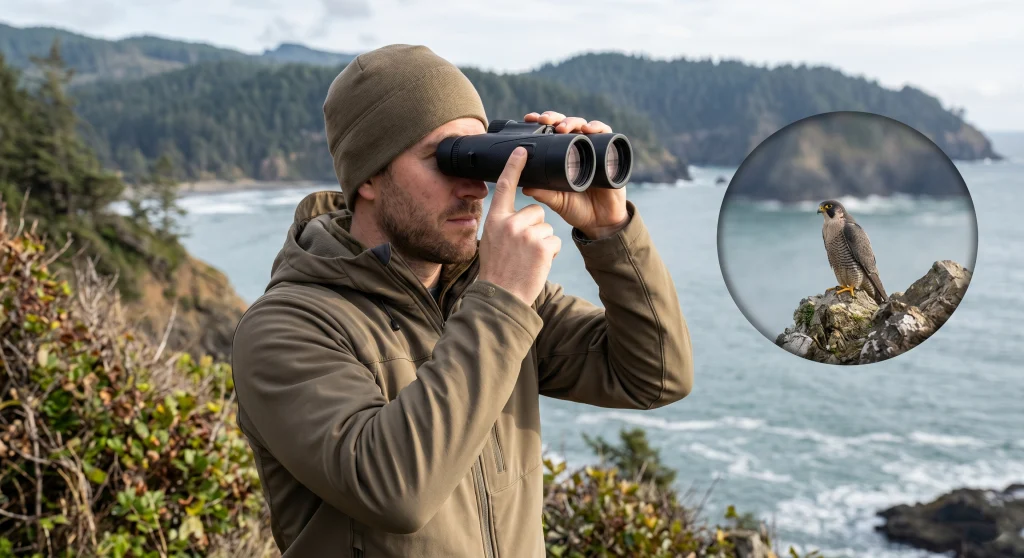
The optical trade-off that catches many people by surprise is the field of view. Stabilized models often have a narrower field of view than their non-stabilized counterparts. A common observation from discussions on BirdForum highlights this exact issue. Users trying to track fast targets in woodland areas report they have difficulty finding the bird due to that narrow viewing window. This restricted field defeats the fast target acquisition that woodland observation requires. It is a classic case of gaining stability but losing situational awareness.
Warning: Always check the field of view specifications before buying stabilized models for fast-action viewing. The restricted viewing window can make acquiring a moving target surprisingly difficult in enclosed environments.
You also have to accept that you are paying a premium for the electronics, not just the glass. A stabilized binocular that costs a thousand dollars will not have the same edge-to-edge optical clarity as a standard thousand-dollar binocular. The standard model puts all of that budget into premium prisms and advanced lens coatings, while the stabilized model diverts a huge chunk of that budget into the complex electronic mechanisms.

Canon's EF lens image stabilization technology delivers rock-steady views at 12x magnification, while Porro II prisms and a doublet field-flattener produce sharp, distortion-free images edge to edge. The 36mm objective lens provides clear, bright, high-resolution images with improved power efficiency for extended battery life in a compact, portable package ideal for birdwatching and hunting.
Check On AmazonIf you click this link and buy, we earn a commission at no additional cost to you.
Are Image Stabilized Binoculars Worth It for Hunting?
Hunters face a unique set of challenges that make the stabilization question particularly tricky. If you are asking are image stabilized binoculars worth it for hunting, the answer depends heavily on your terrain and how you glass. If you hunt from a fixed blind where you can easily rest your elbows on a window ledge, the stabilization feature is likely unnecessary. Your setup already provides the physical stability you need to resolve detail.
However, if you spot and stalk in open terrain, the calculation changes. Glassing offhand in heavy wind creates a situation where even lower magnifications become difficult to hold steady. I have talked to western hunters who note that even when glassing off a tripod, heavy winds introduce a small amount of vibration into the system. In these specific, high-wind environments, turning on electronic stabilization smooths out the environmental shake perfectly.
This brings up a common debate about carrying a traditional support system versus relying on internal electronics. A tripod solves most of the same stability problems without requiring batteries. For stationary glassing on land, a tripod paired with standard binoculars is usually the smarter play. But for hunters who need to move quickly, scan on the go, and eliminate setup time, stabilization offers a clear tactical advantage.

This slim, lightweight quick-release adapter mounts your binoculars to any tripod or car window mount for steady extended glassing sessions, then stays attached when you switch to handheld use without getting in the way. A simple, no-fuss solution designed to stay on your binoculars full time.
Check On AmazonIf you click this link and buy, we earn a commission at no additional cost to you.
Final Thoughts: Making the Right Investment
At the end of the day, stabilization is just another tool to solve a specific physical problem. Hand shake ruins optical resolution, and eliminating that shake reveals details you simply cannot see otherwise. But it is crucial to remember that you are buying a specialized instrument designed to overcome environmental challenges.
If your primary activities involve viewing from a boat, riding in a vehicle, or scanning distant ridges at high magnification without a tripod, this technology will change the way you see the outdoors. If you prefer peaceful, stationary wildlife watching at standard magnifications, your money is almost always better spent on traditional, high-quality optical glass.
FAQs
🔭 How do image stabilized binoculars work?
They use gyroscopic or electronic sensors to detect hand tremor and movement. The system then instantly shifts internal prisms or applies digital correction to counter the shake, resulting in a perfectly steady image even at high magnifications.
🔋 Do image stabilized binoculars need batteries?
Yes, the stabilization system requires battery power to operate. If the batteries die, the binoculars will still function as standard optics, but you will lose all stabilization capabilities until you replace them.
🦅 Are image stabilized binoculars good for bird watching?
They are excellent for hawk watching at high magnification or pelagic birding from a moving boat. However, their narrower field of view can make them frustrating for tracking fast-moving birds in dense forest environments.
🌧️ Are image stabilized binoculars waterproof?
Many premium models are fully waterproof, but budget or older models may only be water-resistant due to the complex electronic components inside. Always check the specific IPX rating if you plan to use them in harsh weather.