
Why the 10mm Difference Is Not What Most People Expect
When you hold two pairs of binoculars that both say 8x on the chassis, it is easy to assume they will give you the same viewing experience. However, comparing 8×32 vs 8×42 binoculars is not just about choosing a slightly smaller or larger body. The ten-millimeter difference in the front objective lenses represents a fundamental fork in design philosophy. While one is built to be a nimble, go-anywhere companion, the other is designed to maximize raw light intake.
At the retail optics counter, I often watched people reach immediately for the larger size because they figured more glass was always better. That is a classic mistake because they do not think about how those extra ounces feel around their neck after a long day of walking. In my experience, the best binocular is always the one you actually want to carry with you, not the one left behind in your vehicle because it felt too heavy. Understanding where that extra glass helps and where it hurts is the key to making a smart investment.
The Physical Reality: Weight, Size, and Field Ergonomics
The most immediate difference you will notice when comparing these two configurations is how they feel in your hands. An 8×32 binocular is typically twenty to twenty-five percent lighter than its 8×42 counterpart, which translates to a physical savings of about five to six ounces. It is also about ten to fifteen percent shorter, making it much easier to slip into a coat pocket or a small backpack. While a few ounces might not sound like a lot when you are standing in a store, it makes a massive difference over a six-hour trek.
Beyond pure weight, the geometry of the barrel length changes how you hold the instrument. The shorter chassis of an 8×32 can feel slightly cramped for users with very large hands, leaving less surface area for a firm grip. Conversely, the longer 8×42 body provides more room to wrap your fingers and brace the optic solidly against your cheekbones for a steady view. It is a practical trade-off where physical comfort directly influences how easily you can glass for extended periods.
I have watched hikers and travelers express immediate relief when they swap a heavy full-size model for a mid-compact option. By choosing a lighter frame, you gain a level of mobility that completely transforms how you move through the woods. However, physical comfort is only half the equation. The size of those front lenses ultimately dictates what your eyes can extract from the shadows.
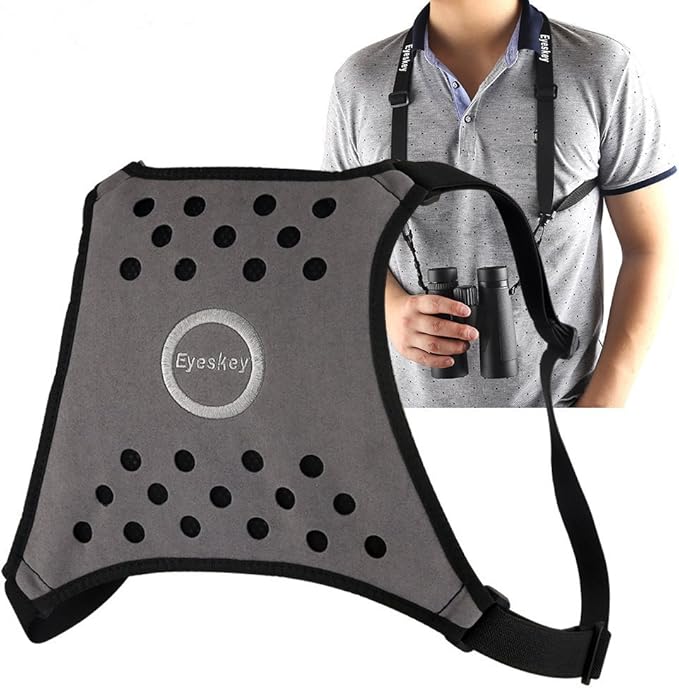
This nylon shoulder harness distributes the weight of your binoculars, rangefinder, or camera across both shoulders for fatigue-free all-day carry. The self-adjustable design fits a wide range of body types and keeps your gear snug against your chest, eliminating jostle while freeing up your hands. Durable straps allow smooth, quick sliding into viewing position whenever you need it.
Check On AmazonIf you click this link and buy, we earn a commission at no additional cost to you.
The Optical Breakdown: Exit Pupil and Low-Light Performance
The core optical difference between these two sizes comes down to the exit pupil, which is the diameter of the light beam that reaches your eye. You can find this number by dividing the objective lens size by the magnification, which gives us four millimeters for the 8×32 and five and a quarter millimeters for the 8×42. During the bright hours of midday, your physical pupils shrink to about two or three millimeters. Because both light beams are wider than your eye’s pupil in full sun, the daytime performance of these two models is virtually identical.
Everything changes when the ambient light drops and your eyes naturally dilate to five millimeters or wider. In these lower light conditions, the larger front lens of the 8×42 gathers seventy-three percent more light by surface area than the smaller model. The smaller four-millimeter beam of the 8×32 will now act as a bottleneck, making the image appear measurably dimmer. If you are trying to spot wildlife in fading light, this difference is not marginal; it is the difference between identifying a subject and seeing a dark blur.
| Specification / Feature | 8×32 Mid-Compact | 8×42 Full-Size |
|---|---|---|
| Objective Lens Diameter | 32 mm | 42 mm |
| Exit Pupil Diameter | 4.0 mm | 5.25 mm |
| Average Weight | 16 to 20 ounces | 22 to 28 ounces |
| Daylight Performance | Excellent (Equal to full-size) | Excellent |
| Low-Light Performance | Moderate (Dimmer under heavy canopy) | Superb (73% more light gathering) |
| Eye Placement Forgiveness | Tighter, requires precise alignment | Generous and highly forgiving |
Looking at the raw numbers helps illustrate why so many people get confused by these two configurations. When I was discussing the wider landscape of compact binoculars with customers, I always emphasized looking at the exit pupil first. It is the single metric that explains why a smaller lens works beautifully in the desert sun but struggles under a heavy forest canopy. Understanding this physical limit helps you avoid paying for size you do not need, or conversely, buying an optic that leaves you in the dark when you need it most.

Fully multi-coated lenses and phase-coated BaK-4 prisms deliver bright, crisp, color-accurate images across all lighting conditions, with a wide 7.4 degree field of view for easy tracking. The rubber-armored polycarbonate body is waterproof, nitrogen-purged, and tripod-adaptable for extended sessions. Backed by a Celestron Limited Lifetime Warranty and US-based support.
Check On AmazonIf you click this link and buy, we earn a commission at no additional cost to you.
The Counterintuitive Field of View Advantage
It seems logical to assume that a larger front lens would act like a wider window to the world. In optical design, however, the opposite is often true. The smaller objective lens allows engineers to create wider apparent viewing angles within the internal prism configuration. This counterintuitive design quirk means that an 8×32 model will often let you see a wider slice of the horizon than an 8×42 from the exact same product line.
A wider field of view is incredibly valuable when you are trying to track fast-moving targets. If you are comparing 8×42 vs 8×32 binoculars for birding, being able to sweep a wide area of the canopy quickly can make a massive difference. It helps you locate a hopping warbler or a flying raptor before it darts behind a branch. While the full-size model excels at raw brightness, the mid-compact often wins when it comes to scanning wide open landscapes during the daytime. But there is one more difference that spec sheets will never show you, and it is the one most likely to make you return a binocular.

Extra-Low Dispersion glass eliminates color fringing for razor-sharp, true-to-life images, while phase-coated BaK-4 prisms maximize light transmission even at dawn or dusk. The rubber-armored polycarbonate body is fully waterproof, nitrogen-purged, and features built-in tripod adapter threads for shake-free extended viewing. Backed by a Celestron Limited Lifetime Warranty and US-based support.
Check On AmazonIf you click this link and buy, we earn a commission at no additional cost to you.
The Hidden Comfort Issue: Eye Box and Shadowing Blackouts
While spec sheets are great for comparing weight and light transmission, they completely hide the physical relationship between the optic and your face. The exit pupil does not just dictate brightness, it also creates the eye box, which is the three-dimensional space where you must position your eyes to see a clear image. Because the 8×32 has a smaller four-millimeter exit pupil, the eye box is much tighter and less forgiving than the generous sweet spot of an 8×42. If your eyes are even slightly off-center, you will experience sudden dark shadows or complete blackouts.
This tight alignment requirement can be incredibly frustrating for people with unique facial structures or wide-set eyes. If the distance between your eyes does not align perfectly with the barrels, you will find yourself constantly fighting to get both eyes aligned without annoying edge shadows. It is a highly subjective fit issue that you cannot diagnose by reading a description online. For some people, a mid-compact model feels perfectly natural, while for others, it feels like peering through a pair of narrow straws.
Field Note: I once had a customer come back to the counter to return a beautiful, highly expensive European 8×32 model. He was incredibly frustrated because he kept experiencing sudden blackouts every time he brought the optics to his eyes quickly. There was absolutely nothing wrong with the glass itself, but his wider facial structure made it nearly impossible for him to stay perfectly aligned with the tight four-millimeter exit pupil. We swapped him into a standard 8×42 from the exact same line, and his eyes instantly relaxed into the larger, more forgiving image circle.
This specific counter interaction was a pattern I watched repeat itself several times over the years. Many people assume that a high price tag guarantees a perfect viewing experience, but price cannot override the basic laws of physical alignment. If your facial shape requires a wider interpupillary distance, the larger objective size provides a crucial cushion of comfort. It is always wise to test how easily your eyes find the center of the image before committing to a smaller, less forgiving frame.

Fully multi-coated lenses and phase-coated BaK-4 prisms deliver sharp, color-accurate images across a wide 7.4 degree field of view in a compact, lightweight frame. The rubber-armored polycarbonate body is waterproof, nitrogen-purged, and tripod-adaptable for steady extended sessions. Backed by a Celestron Limited Lifetime Warranty and US-based support.
Check On AmazonIf you click this link and buy, we earn a commission at no additional cost to you.
Making the Choice: The New Generation Parity
It is also worth noting how modern optical engineering has changed this calculation. Historically, mid-compact binoculars were a noticeable compromise. Today, if you look at the middle to premium price tiers, the gap has narrowed considerably. Thanks to advanced phase-correction coatings and high-density ED glass, a modern 8×32 can stand on an even footing with a similarly priced full-size model during daylight hours. At these price points, you are no longer sacrificing daytime image quality for portability.
Deciding between 8×32 binoculars vs 8×42 ultimately comes down to an honest assessment of your primary outdoor activities. If you are looking for a nimble, lightweight companion for long mountain hikes, backpacking trips, or international travel, the weight savings make the smaller size incredibly appealing. In these scenarios, a high-quality mid-compact option is highly practical because it reduces fatigue without sacrificing daytime clarity. When you are traveling light, keeping your gear compact ensures you actually carry it instead of leaving it packed away.
On the other hand, if you are selecting 8×32 or 8×42 binoculars for serious wildlife observation, hunting, or early birding, the larger lens is almost always the superior choice. Those quiet hours before full sun are when animal activity peaks, and that is exactly where the 8×42 provides the insurance you need to resolve fine details. Furthermore, the wider, more forgiving eye box is far more comfortable during hours of continuous glassing from a fixed position.
- Choose the 8×32 if you prioritize physical comfort, walk long distances, travel frequently, or primarily use your optics in bright daylight.
- Choose the 8×42 if you regularly watch wildlife in poor lighting, need maximum eye-comfort, or plan to use your binoculars as your primary, all-purpose glassing tool.
- Choose the 8×32 if you already own a heavy, full-size pair of binoculars and want a secondary, highly portable set for casual outings.
Asking yourself whether a mid-compact size is actually suitable for your needs is a crucial step. For casual users, the weight savings alone make 8×32 binoculars worth it because they are simply more fun to carry. However, if you are willing to pack extra weight in exchange for a brighter, more relaxed view, the classic full-size frame remains the gold standard. Selecting the right frame size is a core decision when reviewing the primary types of binoculars that suit different environments.

Select HD glass elements with fully multi-coated, dielectric-coated lenses deliver exceptional sharpness, color fidelity, and light transmission, while Armortek coating protects exterior surfaces from scratches and oil. Argon-purged and O-ring sealed for waterproof, fog-proof performance in any conditions. Includes a glass pak harness and is backed by Vortex's unlimited, unconditional, fully transferable lifetime VIP Warranty.
Check On AmazonIf you click this link and buy, we earn a commission at no additional cost to you.
Final Thoughts: A Long-Term Investment in Your Vision
Optics are a long-term investment. Unlike digital technology that becomes obsolete in a few years, a well-chosen binocular will serve you for decades if cared for properly. Instead of agonizing over which spec sheet looks more impressive on paper, think about the environments you actually spend the most time in. A phenomenal pair of heavy binoculars is useless if it sits in your closet because you dread carrying it up a trail.
Buy the optic that fits your hands comfortably, aligns effortlessly with your eyes, and enhances the specific activities you love. Whether that ends up being the nimble agility of an 8×32 or the raw optical horsepower of an 8×42, the right choice is simply the one that makes you want to stay outside just a little bit longer.
FAQs
🔍 What does the 10mm difference actually mean in field use?
The ten-millimeter difference represents the diameter of the front objective lenses. In practice, the larger 42mm lens gathers substantially more light than the 32mm lens. While this difference is invisible during bright daylight, it makes the 42mm model noticeably brighter and clearer in low-light conditions or fading evening light.
🦉 Is 8×32 or 8×42 binoculars better for birding?
For most dedicated birders, the 8×42 is the superior all-around choice because bird activity often peaks when lighting is poor. However, many daytime birders prefer the 8×32 for its lighter weight and wider field of view. If you rarely bird in heavy shadows, the mid-compact is an excellent, fatigue-reducing alternative.
🎒 Are 8×32 binoculars worth it for long hiking trips?
Yes, they are highly worth it because they typically save you five to six ounces of neck weight. Over several miles of walking, a lighter optic prevents muscle fatigue and bouncing. They also pack down much smaller, making them easier to store in a compact hiking daypack.
🕶️ Can I use 8×32 binoculars comfortably if I wear glasses?
Yes, but you must check the eye relief specification carefully before buying. Mid-compact binoculars often have shorter eye relief than full-size models, which can cause shadowing for glasses wearers. Look for an 8×32 model with at least fourteen to sixteen millimeters of eye relief to ensure a full, unclipped view.