The Numbers That Matter at Legal Shooting Light
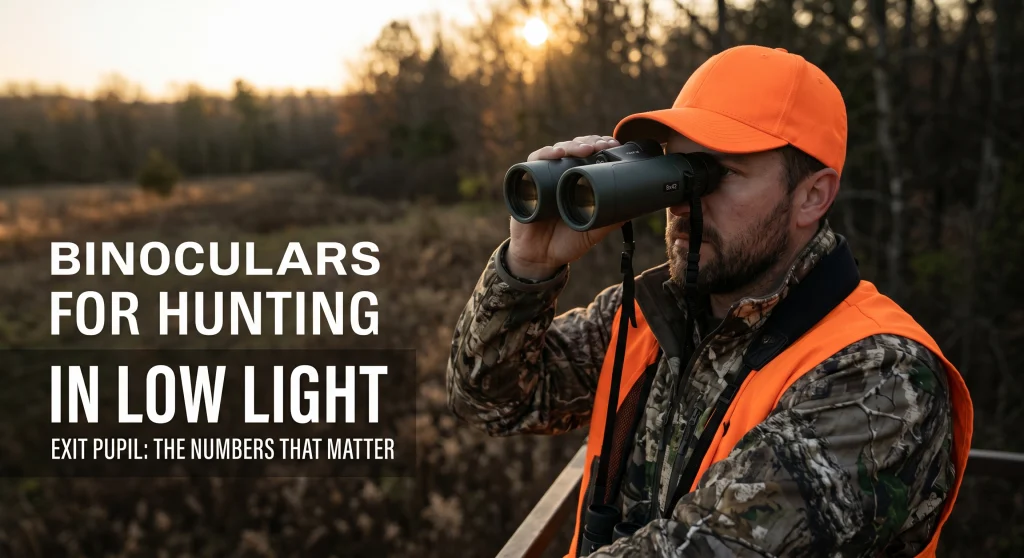
Legal shooting light happens at the very edges of the day, whenever that falls in your state and season. If you are relying on standard optics, you are going to miss game. When selecting binoculars for hunting in low light, the rules of the game change completely. You stop worrying about maximum magnification and start fighting for every photon of light you can pull to your eye.
I have watched this play out more times than I can count at the optics counter. A hunter comes in wanting a 12×42 because they want to count tines at 400 yards. I take them outside at dusk, hand them the 12×42 and a standard 8×42, and let them look into the tree line. The 12×42 is dark, muddy, and shaking. The 8×42 is bright and clear.
The answer is basic math. It comes down to the relationship between your physical eye and the binocular’s objective lens. We are going to look at the real specs that matter for pre-dawn and dusk hunting, and we are going to ignore the marketing numbers that do not help you in the field.
The Exit Pupil Calculation and Your Eye
The most important number for any dawn or dusk hunting scenario is rarely printed on the box in big letters. It is the exit pupil, and you have to calculate it yourself. The math is simple. You just divide the objective lens diameter by the magnification.
For a standard 10×42 binocular, 42 divided by 10 gives you an exit pupil of 4.2mm. For a 10×50, the exit pupil is 5.0mm. For an 8×42, it is 5.25mm. This number represents the physical shaft of light leaving the eyepiece and hitting your eye.
To understand why this matters, you have to look at how the human pupil reacts to ambient light. In bright daylight, your pupil contracts to about 2mm or 3mm. Any of those binoculars will provide a shaft of light larger than your pupil can accept. In broad daylight, a 10×42 and a 10×50 will look virtually identical in terms of brightness.
At dawn, your pupil dilates to let in more light, typically opening to between 5mm and 7mm. This is where the physics catch up with you. If your pupil is dilated to 6mm, but your 10×42 binocular is only delivering a 4.2mm shaft of light, the image will look dim. You are physically starving your eye of light. An 8×42, delivering a 5.25mm exit pupil, fills much more of that dilated window. This is exactly why 8×42 is consistently recommended by experienced hunters for timber and early morning setups.
| Binocular Configuration | Exit Pupil Size | Low Light Performance |
|---|---|---|
| 8×42 | 5.25mm | Excellent. Fills the dilated eye well. |
| 10×42 | 4.2mm | Adequate. Noticeably darker at extreme dawn. |
| 10×50 | 5.0mm | Very good. Balances 10x reach with decent light. |
| 12×50 | 4.17mm | Poor. Too dark for serious pre-dawn hunting. |

Select HD glass elements with fully multi-coated, dielectric-coated lenses deliver exceptional sharpness, color fidelity, and light transmission, while Armortek coating protects exterior surfaces from scratches and oil. Argon-purged and O-ring sealed for waterproof, fog-proof performance in any conditions. Includes a GlassPak chest harness and backed by Vortex's unlimited, unconditional, fully transferable lifetime VIP Warranty.
Check On AmazonIf you click this link and buy, we earn a commission at no additional cost to you.
The Age Factor in Exit Pupil
There is a biological variable that most spec sheets ignore entirely. The 5mm to 7mm pupil dilation we talk about applies to younger eyes. As we get older, our maximum pupil dilation decreases. For a hunter over fifty, maximum dilation in the dark is often closer to 4mm or 5mm.
This changes the field math. If your eye can only dilate to 5mm, the massive 7mm exit pupil of an 8×56 binocular is partially wasted. Your eye physically cannot take in that extra light. However, it also means a 10×50 binocular, which produces a 5.0mm exit pupil, perfectly matches your eye’s maximum capacity. You get to keep the higher 10x magnification without sacrificing any brightness your eye is actually capable of processing.
The 10×42 vs 10×50 Decision for Dawn Hunting
If you hunt western terrain or open clearcuts where you genuinely need 10x magnification to resolve antler detail, but you also hunt early and late, you hit a crossroads. The standard 10×42 gives you that 4.2mm exit pupil. That size is often right on the edge of being too dark at the extremes of legal light.
This is where the 10×50 comes into the conversation. Bumping the objective lens up to 50mm pushes your exit pupil to 5.0mm. In practical field terms, head-to-head comparisons consistently show that a 10×50 provides about 5 to 10 minutes more viewable light in evening conditions than a 10×42 of the exact same glass quality.
Field Note: I used to tell guys at the counter that five minutes does not sound like much until it is November, you are freezing, and the buck you have been waiting for all season finally steps out of the brush right at the edge of legal light. Those five minutes are the whole season.
However, that 50mm objective comes with a cost. You are adding significant glass weight to your chest harness. A 10×50 is noticeably heavier and bulkier than a 10×42. If you are sitting in a stand or glassing from a fixed ridge, the weight penalty is absolutely worth the light gathering. If you are still-hunting or covering miles of steep elevation all day, you might curse that extra half-pound by noon.

Select HD glass elements with fully multi-coated lenses deliver exceptional edge-to-edge sharpness, color fidelity, and light transmission across the larger 50mm objectives in a compact roof prism design. Nitrogen-purged and O-ring sealed for waterproof, fog-proof performance in any conditions, with rubber armor for shock resistance and a secure grip. Tripod-adaptable and backed by Vortex's unlimited, unconditional, fully transferable lifetime VIP Warranty.
Check On AmazonIf you click this link and buy, we earn a commission at no additional cost to you.
The Twilight Factor Myth
If you spend enough time reading product specs online, you will run into a metric called “twilight factor.” Manufacturers love this number because it sounds incredibly scientific and gives them a way to market high-magnification binoculars to hunters.
Twilight factor is calculated by multiplying the magnification by the objective diameter, and finding the square root of that number. Under this formula, a 12×50 has a higher twilight factor than an 8×56. The marketing implication is that the higher the number, the better the binocular performs in low light.
In practice, this metric is worse than useless. It is actively misleading. Twilight factor assumes that all glass is created equal and that magnification somehow creates light. It does not account for the quality of the lens coatings, the grade of the prisms, or the actual light transmission of the instrument.
I have seen cheap 12×50 binoculars with a massive twilight factor completely fall apart at dusk, while a premium 8×42 with a mathematically lower twilight factor cuts through the shadows with perfect clarity. Do not use twilight factor as a buying criterion. It is a math trick, not a performance indicator.
Buying a cheap 12×50 binocular because it has a high “twilight factor” on the spec sheet, assuming it will perform well at dusk.
Ignoring twilight factor entirely and choosing an 8×42 or 10×50 with a large exit pupil and fully multi-coated lenses.

Fully multi-coated 42mm objective lenses deliver bright, crisp images across a wide 307 foot field of view, while shock-absorbing rubber armor provides durable protection in tough weather conditions. Includes a smartphone mount, carrying case, lens covers, cleaning cloth, and neck strap right out of the box.
Check On AmazonIf you click this link and buy, we earn a commission at no additional cost to you.
What Actually Determines Low-Light Clarity
If twilight factor is a myth, what should you actually look for? The formula for genuine low-light performance combines adequate exit pupil size with high optical transmission. Optical transmission is the percentage of light entering the objective lenses that actually makes it through the prisms and into your eyes.
If you read through a general binoculars buying guide, you will learn a harsh truth about optical construction: cheap glass reflects and scatters light internally, while quality glass transmits it. For hunting at dawn and dusk, you need specific optical features to maximize that transmission.
- Fully Multi-Coated (FMC) lenses: This means every air-to-glass surface has multiple layers of anti-reflective coatings. This is non-negotiable for low-light hunting.
- Phase-corrected roof prisms: This coating keeps light waves perfectly in sync as they bounce through the straight barrels, ensuring sharp contrast in dim timber.
- BAK-4 prism glass: This is superior to standard BK-7 glass, ensuring a perfectly round exit pupil with no edge shadowing.
Matching your specs to your terrain is the foundation of any good hunting binoculars guide. But regardless of whether you hunt eastern timber or western mountains, if you are out at the edges of daylight, optical quality dictates what you see. Prioritize transmission, and you will extend your hunt.

This compact field kit covers every step of lens care, with a retractable ultra-soft brush for safe particle removal, a lens cleaner solution that cleans and protects against fogging without affecting optical properties, and a Vor-Tek microfiber cloth for wiping away fingerprints and smudges. Compatible with riflescopes, binoculars, monoculars, and spotting scopes.
Check On AmazonIf you click this link and buy, we earn a commission at no additional cost to you.
Final Thoughts: Balancing Weight and Light
Choosing binoculars for dawn and dusk hunting is an exercise in managing tradeoffs. You cannot cheat physics. To get more light, you need bigger objective lenses, which means carrying more weight. To get a brighter image without adding weight, you have to lower your magnification to increase the exit pupil.
For the majority of hunters, an 8×42 offers the best compromise of a bright 5.25mm exit pupil, manageable weight, and a wide field of view. If you need the reach of 10x and hunt primarily at dawn and dusk from a stationary position, step up to a 10×50 and accept the weight. Trust the exit pupil math, prioritize fully multi-coated glass, and you will not be left guessing when the light starts to fade.
FAQs
🦌 What is the best binocular configuration for dawn deer hunting?
An 8×42 is generally the best choice for dawn deer hunting. It provides a large 5.25mm exit pupil that perfectly matches the dilation of the human eye in low light, while keeping the weight manageable for all-day carrying.
🌅 Are 8x or 10x binoculars better for low light?
If the objective lens size is the same, the 8x will always be brighter in low light than the 10x. The lower magnification creates a larger exit pupil, delivering a wider shaft of light to your eye.
🦉 Why do my binoculars look dark at dusk?
Your binoculars likely look dark because the exit pupil is too small for your dilated eyes, or the lenses lack quality anti-reflective coatings. Budget binoculars often scatter light internally, significantly reducing brightness when the sun goes down.
🔭 Do I really need a 50mm objective lens for hunting?
You only need a 50mm objective if you regularly hunt at the very edges of legal shooting light and prefer 10x magnification. The 50mm objective offsets the darkening effect of high magnification, but it adds noticeable weight to your chest.