The Real Difference Between Stand and Still Hunting Specs
One of the most common mistakes I see at the optics counter is a hunter grabbing a 10×42 simply because it sounds powerful. They walk in with a budget, look at the numbers, and assume more magnification is always better without thinking about how their environment dictates what they actually need to see. The truth is that deer hunting with binoculars is not a single, unified activity. The glass you need for sitting quietly in a tree is not the same glass you want for tracking miles on foot.
If you hunt eastern whitetail, your requirements are fundamentally different from someone glassing western mule deer. Your shots are closer, your cover is thicker, and your time window to identify a moving target is significantly shorter. That changes the math on everything from magnification to objective lens size. Instead of starting with the price tag, we need to start with your terrain and your hunting style. Once you nail that down, the specs you actually need become very obvious.
Stand Hunting Requirements: Why Field of View Wins
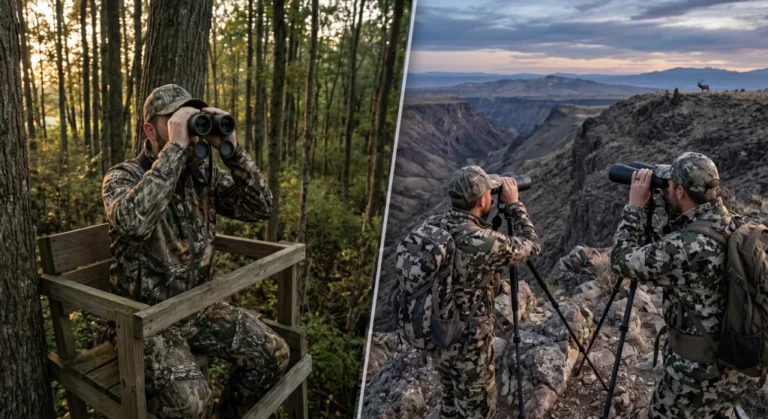
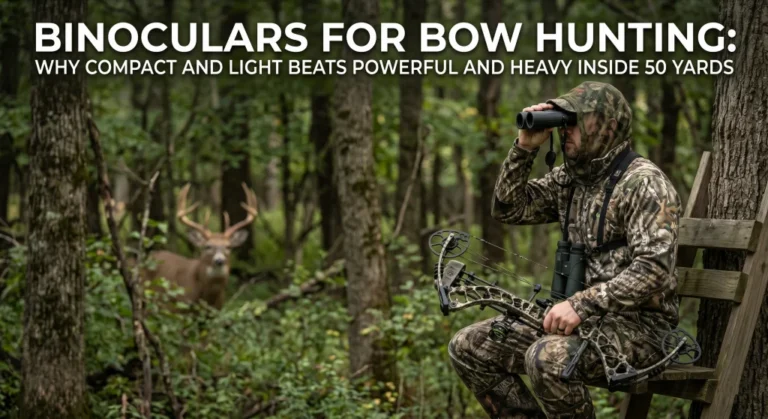
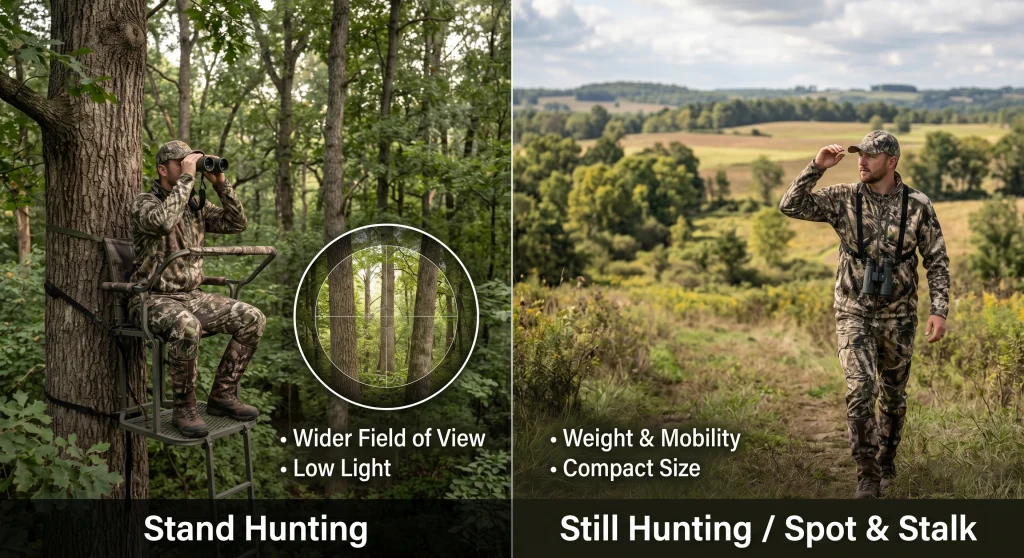
When you are hunting from an elevated position in the woods, the distances are usually short. Deer typically appear at anywhere from 20 to 150 yards, often stepping out of thick brush and moving steadily. In this scenario, field of view and target acquisition speed matter significantly more than raw magnification. You need to be able to pull the glass to your eyes and instantly find the animal in your sight picture before it steps behind another cluster of oaks.
This is exactly why 8×42 is the standard recommendation for most whitetail stand hunters. When reviewing hunting optics, the team at MeatEater pointed to the 8×42 configuration as the ideal middle ground for whitetail hunters. It is wide enough to track movement in the timber, yet it still pulls in enough light for those crucial pre-dawn shadows. This magnification provides a wide enough field of view to catch movement in dense cover, and it is incredibly forgiving when you are twisting around in a tree stand trying to get a look behind you. The practical benefits in the field usually look like this:
- Wider Field of View: Easily catch a buck sneaking through the periphery of your vision without sweeping the glass back and forth.
- Faster Target Acquisition: Bringing the binoculars to your eyes instantly frames the animal, which is critical when you only have seconds to evaluate.
- Forgiving Eye Box: When leaning awkwardly over a stand rail, an 8x optical system is much easier to align with your eyes than a highly sensitive 10x system.
Field Note: One of the most common complaints I heard from guys who bought 10x42s for deep timber hunting was that they kept losing the deer when they brought the binoculars up. By the time they found the animal in the glass, the shot opportunity was gone. Switching them to an 8x setup solved the problem immediately.
There is also the specific reality of tree stand ergonomics, which most generic buying guides completely ignore. When you are 20 feet up a tree, your glassing angle is pitched downward, often through a chaotic canopy of branches. You are usually resting your elbows on a shooting rail or trying to brace against your knees in a confined, awkward space. An 8x binocular is naturally easier to hold steady in these positions than a 10x, especially when your heart rate spikes or you are shivering in the November cold. If your stand does not have a rail, the wider field of view of the 8x becomes even more critical because unsupported glassing amplifies every tiny movement of your hands.
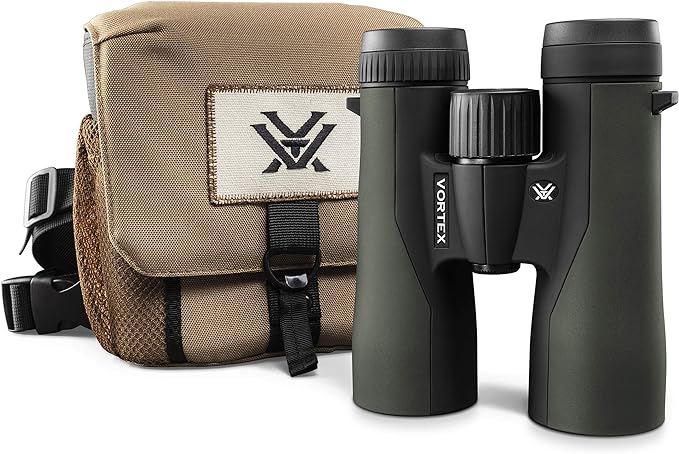
Select HD glass elements with fully multi-coated lenses deliver exceptional edge-to-edge sharpness, color fidelity, and light transmission in a compact roof prism design. Nitrogen-purged and O-ring sealed for waterproof, fog-proof performance in any conditions, with rubber armor for shock resistance and a secure grip. Tripod-adaptable and backed by Vortex's unlimited, unconditional, fully transferable lifetime VIP Warranty.
Check On AmazonIf you click this link and buy, we earn a commission at no additional cost to you.
Still Hunting and Spot-and-Stalk: The Weight Reality
If you are still hunting, tracking, or conducting spot-and-stalk maneuvers, your primary consideration shifts to weight and mobility. All-day carry means every ounce on your chest harness starts to drag on your neck and shoulders by the late afternoon. For this style of hunting, the decision often comes down to balancing optical performance with physical comfort over miles of uneven terrain.
This is where the debate between an 8×42 and a more compact 8×32 becomes relevant. An 8×32 setup saves you a meaningful amount of weight, typically 5 to 7 ounces compared to the full-size equivalent. That sounds like a trivial amount on paper, but after six hours of pushing through thick brush, you will absolutely feel the difference. The smaller physical profile also means the binoculars stay tighter to your chest. When paired with a proper bino harness rather than a standard neck strap, a compact unit bounces far less when you have to move quickly, climb over deadfalls, or crawl under fences.
| Hunting Style | Primary Priority | Recommended Spec | Main Trade-off |
|---|---|---|---|
| Tree Stand Hunting | Field of view & low light | 8×42 | Heavier around the neck |
| Still Hunting / Spot-and-Stalk | Weight & mobility | 8×32 | Reduced brightness at dusk |
| Open Field / Agriculture | Long-range detail | 10×42 | Narrow view at close range |
Buying heavy, high-magnification binoculars for tracking in thick woods, assuming more power will help you see through the brush. You end up with neck fatigue and a frustratingly narrow view.
Prioritizing a lightweight, wide-field optical setup that you barely notice carrying, which allows you to scan your immediate surroundings quickly and quietly.
The trade-off, of course, is low-light performance. Dropping from a 42mm objective lens to a 32mm lens reduces the exit pupil, which means the image will dim slightly earlier in the evening. For many mobile hunters, giving up 10 minutes of visibility at the very end of the day is a fair price to pay for a rig they can comfortably carry for ten miles. It depends entirely on whether your priority is the hike or the final few minutes of legal shooting light. However, all of this assumes you are staying in the woods. The moment you step out of the timber, the optical math changes again.

Built from durable 1000D treated nylon with YKK zippers and Duraflex hardware, this lightweight pack measures 7.08 by 3.54 by 8.66 inches and weighs 1.24 lbs. A 4-point harness system distributes weight evenly across the shoulders, while a magnetic lid closure and thick rain cover keep contents protected in wet conditions. Compact enough for both binoculars and a rangefinder without taking up excess space.
Check On AmazonIf you click this link and buy, we earn a commission at no additional cost to you.
The Eastern Timber vs. Open Field Distinction
While 8×42 is the default for most deer hunting binoculars in wooded areas, there is a distinct scenario where bumping up the magnification makes perfect sense. If you hunt the edges of large agricultural fields, powerline clearings, or open food plots, your sightlines expand dramatically. In these environments, you might be evaluating an animal at 200 to 400 yards, trying to count tines or assess body size before making a decision.
This is exactly where a 10×42 setup earns its keep. The extra magnification allows you to resolve finer details at longer distances, and since the animal is in the open, the narrower field of view is less of a hindrance. You don’t have to worry about the deer vanishing behind a thicket of pine trees quite as fast. When you have the time and the open space to brace yourself and glass a distant tree line, the 10x power becomes a genuine asset rather than a liability.
The trick is matching your primary hunting location to the glass. If you spend 90 percent of your season in the deep hardwoods and only 10 percent watching a bean field, stick with the 8x. The versatility of the wider view in the woods far outweighs the occasional need for more reach. As I always suggest in our broader binoculars buying guide, let the terrain you hunt most often dictate your purchase.

Steiner's proprietary Color Adjusted Transmission technology enhances contrast in foliage and shaded areas, making it easier to spot game hiding in natural cover. Crystal-clear optics deliver bright, three-dimensional depth and sharp detail at any distance, in a lightweight waterproof and fog-proof body built for demanding field conditions. Backed by Steiner's lifetime heritage warranty covering repair or replacement of any defective product at no charge.
Check On AmazonIf you click this link and buy, we earn a commission at no additional cost to you.
Low Light is Universal: The 42mm Minimum
Regardless of whether you sit in a stand or track through the timber, one truth remains constant in deer hunting. The most critical moments happen at dawn and dusk. Whitetail movement peaks during the first 30 minutes of light and the last 30 minutes of legal shooting time. This means your hunting binoculars for deer must perform when the sun is barely over the horizon.
This requirement dictates your objective lens size. To pull in enough ambient light for a clear, identifiable image in the shadows, a 42mm objective is the practical minimum for a primary hunting optic. The math behind this is tied to the exit pupil, the shaft of light hitting your eye. An 8×42 configuration delivers a 5.25mm exit pupil, which closely matches how wide your own pupils dilate in low light. This ensures the image stays bright enough to confirm your target long after the naked eye starts seeing only silhouettes.
Key point: If you find yourself consistently frustrated by not being able to identify deer in the last 15 minutes of legal light, you might need to read up on how to select binoculars for hunting in low light, where larger 50mm objective lenses start to dominate the conversation.
You can certainly find cheaper binoculars with large objective lenses, but cheap glass coatings will kill the light transmission before it ever reaches your eye. When shopping for the best binoculars for deer hunting, prioritize fully multi-coated lenses. Good glass coatings will often outperform a physically larger lens that uses cheap materials, especially when you are staring into the deep shadows of an eastern forest.
Weatherproofing: The Non-Negotiable Hunting Spec
Beyond magnification and light transmission, deer hunters face environmental conditions that make durability non-negotiable. You will be sitting in autumn rain, pushing through wet brush, and dealing with massive temperature swings from the heated cab of your truck to the freezing woods. Because of this, reliable weatherproofing cannot be an afterthought.
Look specifically for binoculars that are nitrogen-purged or argon-purged and tightly O-ring sealed. This ensures they are fully waterproof and, more importantly, internally fog-proof. A binocular that fogs up on the inside the moment you bring it to your warm face on a freezing November morning is entirely useless, no matter how good the glass quality might be. Make sure this spec is explicitly listed before you buy.
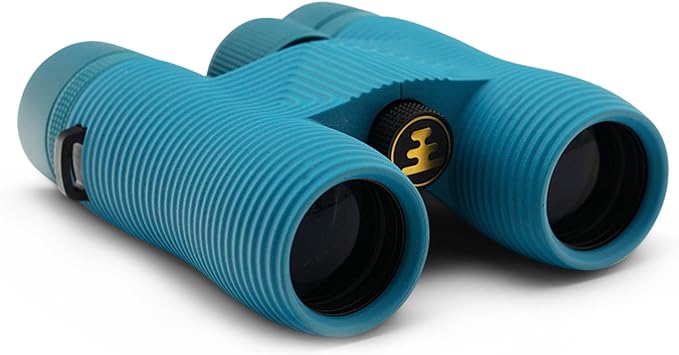
Weighing just 16.7 oz, these compact binoculars feature fully multi-coated optics and a Swiss-designed BaK-4 prism for bright, edge-to-edge clarity across a wide 387 foot field of view. IPX7 rated and nitrogen sealed, they handle submersion up to 3 feet for 30 minutes without compromising performance. A patented wave grip, three-position twist eyecups, and a no-matter-what lifetime warranty make them a confident choice for any adventure.
Check On AmazonIf you click this link and buy, we earn a commission at no additional cost to you.
Final Thoughts: Matching the Tool to the Hunt
Choosing binoculars for whitetail deer isn’t about finding the most powerful optic on the shelf. It is about finding the most efficient tool for your specific environment. A stand hunter in dense woods needs a wide, bright view to catch quick movement. A still hunter needs a lightweight rig that won’t cause fatigue over a long day. An open-field hunter needs the magnification to evaluate distant targets across agricultural land.
Before you make a purchase, honestly assess where you spend the majority of your season. If you are still unsure where to begin, looking at our broader hub on binoculars for hunting can help you frame the decision. In my experience, most hunters who start with a quality 8×42 find that it covers almost every scenario they encounter in the whitetail woods, providing the perfect balance of field of view, low-light performance, and manageable weight. If you are stuck between magnifications, diving into the 8×42 vs 10×42 debate for hunting is a solid next step.
Get the magnification right, insist on fully multi-coated lenses for those crucial low-light minutes, and ensure the build quality can handle the unpredictable autumn weather. Set your gear up to match your hunting reality, and the optics will do exactly what you need them to do.
FAQs
🦌 Are 10×42 binoculars too much for deer hunting?
For dense woods and timber, yes, 10×42 can often be too much. The narrower field of view makes it hard to find moving deer at close range. They work best if you primarily hunt open fields or clearcuts.
🌲 What is the best binocular size for a tree stand?
An 8×42 is generally the best size for a tree stand. It provides a wide field of view for scanning the woods around you and gathers plenty of light for dawn and dusk observation.
⚖️ Do I need compact binoculars for still hunting?
You don’t absolutely need them, but an 8×32 compact setup saves weight and reduces bulk on your chest. This makes moving quietly through thick brush much easier over a long day.
🌙 Will 8×32 binoculars work in low light?
They will work, but they won’t be as bright as an 8×42 setup. The smaller objective lens means the image will dim noticeably earlier during the critical last minutes of legal shooting light.