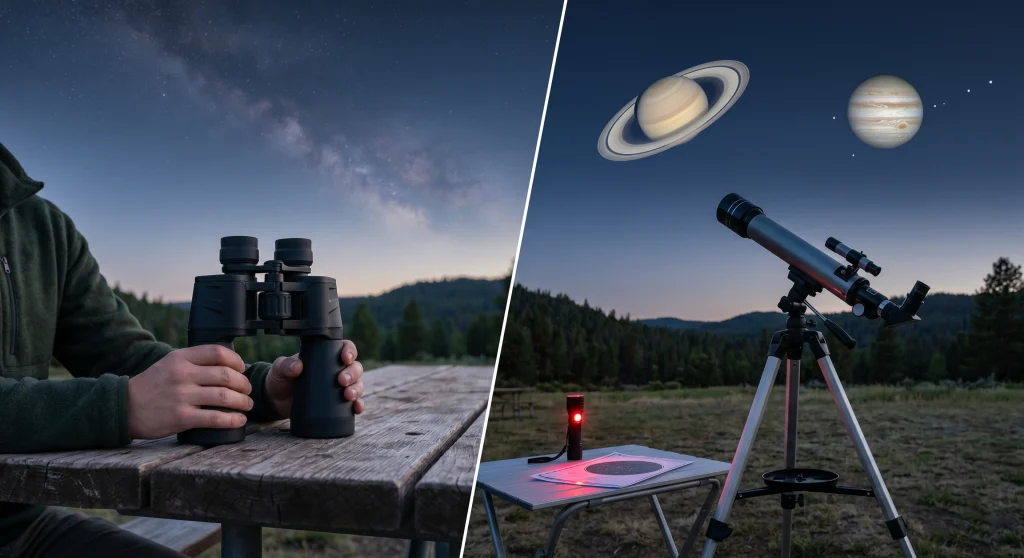
The Honest Answer Most Beginners Don’t Get
When someone asks me about binoculars vs telescope for stargazing, the first thing I ask is what they actually expect to see on their first night out. Over my years at the optics counter, I watched countless beginners walk in assuming that a telescope was the only “real” way to look at the night sky, and that binoculars were just a compromise for people who couldn’t afford a telescope. It simply doesn’t work that way.
The reality is that binoculars and telescopes are built for entirely different jobs. A telescope is a high-magnification, narrow-field instrument designed to look at very specific, tiny points of light in extreme detail. Binoculars are low-magnification, wide-field instruments designed to take in vast sweeps of the sky at once. Choosing between them isn’t a matter of which one is “better,” but rather which one fits your budget, your patience level, and the specific celestial objects you want to track down.
Field Note: The most common mistake I see is someone buying a $100 department store telescope for their family. They take it out, spend thirty minutes trying to align it, finally find the moon, and then spend the rest of the night frustrated because the mount is so wobbly they can’t keep anything in view. In almost every case, a $150 pair of 10×50 binoculars would have given them a drastically better first experience.
If you are standing at these crossroads, you need to understand where the performance lines are actually drawn. Once you know what each optic is actually capable of, the decision usually makes itself.
Where Binoculars Actually Beat Cheap Telescopes
There is a persistent myth that to see anything interesting in space, you need massive magnification. In practice, many of the most spectacular objects in the night sky are simply too large to fit into the eyepiece of a standard telescope. This is where binoculars hold a massive advantage.
Wide-field targets are where binocular optics shine. If you want to scan the dense star fields of the Milky Way core in the summer, or look at the Pleiades star cluster, binoculars will give you a breathtaking view that a telescope physically cannot replicate. The field of view (FOV) on a standard pair of 10×50 stargazing binoculars is typically around 5 to 6 degrees. Most telescopes struggle to give you a 1-degree field of view. When you are looking at the Andromeda Galaxy, which is roughly six times the width of the full moon in the sky, a telescope will only show you a tiny, zoomed-in fraction of the center. Binoculars let you see it in its wider context.
Beyond the field of view, there is the massive physical advantage of using two eyes. Your brain is hardwired to process visual information binocularly. When you use both eyes, you get an effect called binocular summation, which essentially improves contrast and makes faint objects appear brighter and easier to resolve than if you were squinting through a single telescope eyepiece.
If you want to know exactly what targets are best suited for this wide-field approach, you can read my full breakdown on what you can actually see with stargazing binoculars to set your expectations before you head outside.

Multi-coated BK-7 prism glass delivers bright, sharp, high-contrast images at 10x magnification in a rubber-covered aluminum body with ergonomic thumb indents and finger ridges for a secure, comfortable grip. Water-resistant construction handles outdoor conditions reliably, and the package includes a carrying case, lens covers, and cleaning cloth. Backed by a Celestron Limited Lifetime Warranty and US-based support from a California optics brand with over 60 years of experience.
Check On AmazonIf you click this link and buy, we earn a commission at no additional cost to you.
The Hard Truth About Planetary Detail
I cannot tell you that binoculars can do everything, because they can’t. If your primary goal is to look at the planets, the conversation ends here: you need a telescope. Binoculars simply do not possess the magnification required to resolve fine planetary details.
Through a good pair of 10×50 binoculars, Jupiter will appear as a bright, distinct disk, and you will easily see its four largest Galilean moons lined up beside it. It is a fantastic sight. But you will not see Jupiter’s cloud bands or the Great Red Spot. Saturn is the ultimate dealbreaker for many beginners. In standard handheld binoculars, Saturn looks slightly elongated, like a tiny glowing oval. You cannot resolve the distinct gap between the planet and its rings. To see Saturn’s rings clearly, you need magnification levels that only a telescope (or massive, tripod-mounted specialty binoculars) can provide.
Key point: Telescopes are built for high magnification and resolving tight details on small targets (planets, tight double stars, small planetary nebulae). Binoculars are built for low magnification and resolving large, faint structures (open star clusters, large galaxies, sweeping the lunar surface).

This 2.89 lb aluminum tripod extends from 18.5 to 68 inches with three-section leg locks and supports up to 8.8 lbs of equipment, accommodating DSLRs, telescopes, and more. The fluid head delivers smooth 360 degree pan and plus 90 to minus 55 degree tilt with hydraulic damping, dual bubble levels, and a reversible center column for low-angle macro shooting. Includes a phone mount, travel bag, and quick-release plate, backed by a 2-year warranty.<br />
Check On AmazonIf you click this link and buy, we earn a commission at no additional cost to you.
The $300 Price Threshold
The single biggest factor that should drive your decision is your budget, because the entry price for quality gear is very different for these two instruments. There is a specific price threshold where the math flips from favoring binoculars to favoring a telescope.
Below $200 to $300, binoculars almost always provide a vastly superior experience. A $150 pair of Porro prism binoculars is a legitimate, precision optical instrument that will last for years. A $150 telescope is, in most cases, a toy. Cheap telescopes suffer from poor optical quality, narrow plastic eyepieces, and, most fatally, flimsy mounts that vibrate for five seconds every time you touch the focus knob. The frustration of trying to track a moving object with a cheap, shaky telescope mount kills the astronomy hobby for most beginners before it even starts.
| Budget Tier | Binoculars Reality | Telescope Reality |
|---|---|---|
| Under $150 | Excellent entry-level 10×50 optics, great for learning the sky. | Usually frustrating, wobbly mounts, poor eyepieces. Not recommended. |
| $150 to $300 | Premium handheld optics or entry-level giant tripod-mounted models. | Borderline. Some small tabletop models work, but tripod models are still shaky. |
| $300 to $500+ | High-end specialized astronomy glass (tripod mandatory). | The sweet spot for a quality 6-inch or 8-inch Dobsonian telescope. |
Once your budget crosses the $300 to $500 mark, the dynamic changes. At this price point, you can purchase a quality Dobsonian telescope. These use simple, rock-solid wooden bases instead of cheap metal tripods, putting all your money into a large mirror that gathers massive amounts of light. The Dobsonian design is often recommended for beginners because the alt-azimuth mount is intuitive to point, requires no complex polar alignment, and offers the best aperture per dollar of any telescope type. If you have $400 to spend and want to see deep sky objects, a Dobsonian telescope will out-resolve binoculars. If you want a deeper dive into how budget shapes your entire optical setup, check our overarching binoculars buying guide.

A 6 inch f/8 parabolic mirror delivers stunning views of the Moon, planets, nebulas, galaxies, and star clusters with enough light grasp for serious deep-sky exploration. The simple Dobsonian alt-azimuth base requires no polar alignment, making it effortless for the whole family to use, while the stable mount provides vibration-free tracking even at high magnifications. A lifetime telescope that far outlasts beginner refractors at a surprisingly accessible price.
Check On AmazonIf you click this link and buy, we earn a commission at no additional cost to you.
The Setup Time and Practicality Reality Check
Optical capability is only half the equation. The other half is human nature. The best optical instrument in the world is completely useless if it stays packed in your closet because it’s too much of a hassle to take out.
Telescopes require commitment. Even a simple setup often requires carrying a heavy base outside, letting the mirrors cool down to ambient temperature to prevent thermal distortion, aligning the finder scope, and sometimes collimating (aligning) the mirrors. That is a 20 to 30-minute process before you even look at a star. Because of this, telescope owners usually only observe on nights when they have hours of free time.
Binoculars offer zero friction. The process of using them is entirely different, which I detail thoroughly in our guide on how to use stargazing binoculars properly. You can grab them, walk out onto your deck in your slippers, and instantly start observing.
When you compare those two setups side by side, the practical advantages of starting with binoculars become clear:
- Portability: Binoculars can be thrown into a backpack for a camping trip to dark skies. A telescope usually takes up the entire backseat of a car.
- Learning curve: Binoculars point exactly where you look, right side up. Telescopes often invert the image or mirror it, which makes navigating the sky incredibly confusing for a first-timer.
- Comfort: Looking straight up with binoculars can strain your neck, but you can easily solve this by lying back in a zero-gravity lawn chair. Telescopes require standing or crouching at awkward angles depending on where the eyepiece ends up.

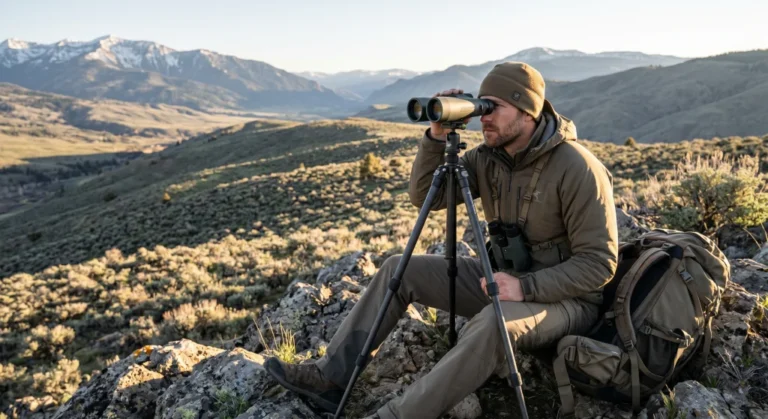
Massive 70mm objective lenses paired with BaK-4 prisms maximize light throughput for bright, detailed views of the night sky at 15x magnification, making them a favorite for dawn, dusk, and astronomical observation. A built-in quarter-inch 20 tripod adapter attaches to most standard tripods in seconds, essential at this size and power. Water-resistant rubber armor provides durable protection in tough conditions, backed by a Celestron Limited Lifetime Warranty and US-based support.<br />
Check On AmazonIf you click this link and buy, we earn a commission at no additional cost to you.
Final Thoughts: Making the Call
If you are still on the fence, the safest path forward is almost always to start with binoculars. They force you to learn the constellations, they teach you how to navigate the sky, and they build the foundational skills you will eventually need if you decide to buy a telescope later.
If you buy binoculars now and upgrade to a telescope in two years, the binoculars do not become obsolete. Every serious amateur astronomer I know owns a telescope, but they also bring a pair of binoculars to every single observing session to scan the sky and find targets. If you are ready to begin, a 10×50 configuration is the almost universal starting point for good reason. For a complete breakdown of specific models across different price tiers, head over to our main hub covering everything you need to know about binoculars for stargazing. Start small, learn the sky, and let your curiosity dictate where you invest next.

This powder-coated steel frame chair features a double-bungee support system with weather-resistant Textilene fabric and a padded headrest for a weightless, stress-free recline. The locking reclining mechanism transitions smoothly from upright to fully reclined with legs raised, supporting up to 300 lbs across a 35.4 by 26 by 43.3 inch footprint. Lightweight and folds flat for easy transport to the beach, campsite, or backyard.
Check On AmazonIf you click this link and buy, we earn a commission at no additional cost to you.
FAQs
🔭 Should I buy binoculars or a telescope first?
If your budget is under $300, you should almost always start with binoculars. They provide better optical quality for the price and teach you how to navigate the sky without the frustration of a cheap, wobbly telescope mount.
🪐 Can I see Saturn’s rings with binoculars?
No, not with standard handheld binoculars. Saturn will appear as a slightly elongated oval. To clearly resolve the gap between the planet and its rings, you need the higher magnification that a telescope provides.
🌌 Are 10×50 binoculars good for astronomy?
Yes, 10×50 is universally considered the sweet spot for beginner astronomy. The 50mm objective lenses let in plenty of light, and the 10x magnification is right at the limit of what most people can hold reasonably steady without a tripod.
👓 Do I need a tripod for stargazing binoculars?
For 10×50 models, no, though a tripod or reclining chair helps immensely with stability. If you buy larger binoculars, like 15×70 or 20×80 models, a heavy-duty tripod is absolutely mandatory to get a usable image.
💰 How much do I need to spend for beginner astronomy binoculars?
You can get a highly capable pair of entry-level 10×50 Porro prism binoculars for between $100 and $150. Spending more will get you better edge-to-edge sharpness and durability, but this price point is enough to see the moons of Jupiter and the Orion Nebula clearly.