Image Stabilized Binoculars for Bird Watching: The Great Divide
The topic of image stabilized binoculars for bird watching creates intense debates among serious optics users. Browse the equipment threads on BirdForum, and you will see this divide play out daily. Half the threads are titled with warnings like “don’t waste your money,” while the other half feature birders swearing they will never go back to standard optics.
I have seen this same split firsthand with customers at the counter. The reason for the disagreement has nothing to do with whether the stabilization actually works. It works brilliantly. When you press the button, gyroscopes or electronic sensors instantly compensate for the micro-movements of your hands, freezing the image completely. A distant bird that was bouncing around in your lenses suddenly becomes a crisp, stationary subject.
The debate exists because building that stabilizing mechanism into the chassis forces manufacturers to make compromises in other areas of the optical design. Understanding what you are giving up is the only way to know if the investment makes sense for your specific style of observation.
When Image Stabilized Binoculars Make Sense for Birding
There are specific environments where image stabilization is genuinely transformative. In these situations, standard binoculars simply cannot compete, regardless of how much money you spend on premium glass.
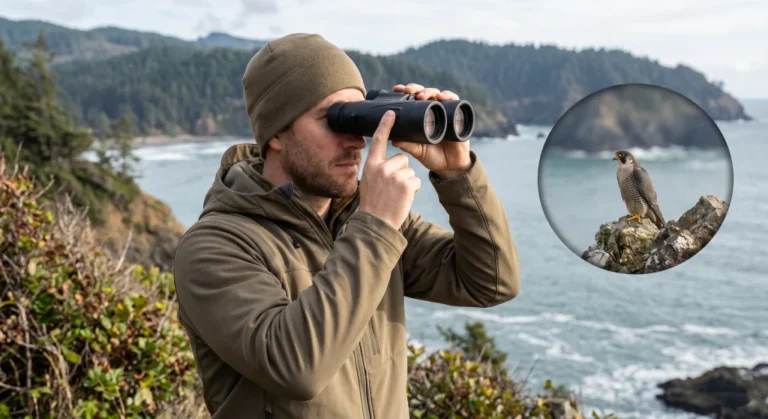
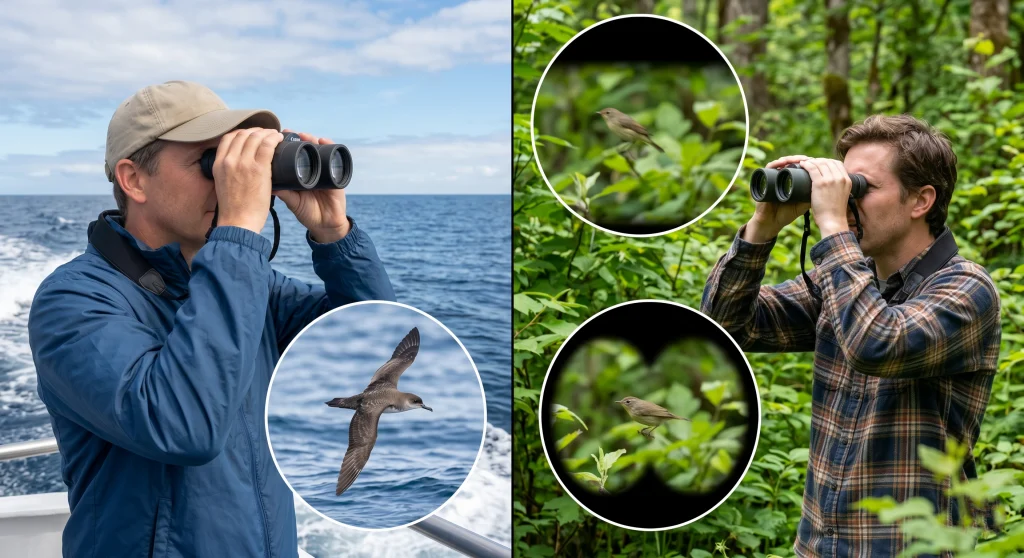
The most obvious example is pelagic birding. If you are on a boat looking for seabirds, the movement of the deck makes traditional high-magnification viewing nearly impossible. The boat pitches, your hands compensate, and the bird is lost in a blur of sky and water. When you engage the stabilization on a moving platform, a blurry shape suddenly becomes a clearly identifiable shearwater.
Field Note: I once watched a customer try to track seabirds with a standard 12×50 from a rocking charter boat. He was miserable and slightly seasick from the bouncing image. He swapped to a stabilized pair, and his whole posture relaxed. Suddenly he could actually count wing beats. Any time you are on a moving platform, stabilization solves the biggest optical problem you face.
Hawk watching is the other scenario where stabilization shines. When you are staring up at a featureless sky trying to identify a raptor riding a thermal thousands of feet above you, you need high magnification. Most hawk watchers use 12x, 14x, or even 16x optics. At those magnifications, normal hand tremor is amplified severely. A stabilized binocular allows you to study the wing shape and tail banding of a distant hawk with tripod-like stability, but with the freedom to scan the sky rapidly.
You will also find them incredibly useful if you bird from a kayak or canoe. When setting down a tripod is physically impossible, stabilization lets you scan vast shorelines for wading birds without fighting the constant rocking of the water.

Canon's EF lens image stabilization technology delivers rock-steady views at 12x magnification, while Porro II prisms and a doublet field-flattener produce sharp, distortion-free images edge to edge. The 36mm objective lens provides clear, bright, high-resolution images with improved power efficiency for extended battery life in a compact, portable package ideal for birdwatching and hunting.
Check On AmazonIf you click this link and buy, we earn a commission at no additional cost to you.
The Forest Birding Problem: The Field of View Trade-Off
Here is where the problems start for a lot of birders, and why those negative forum threads exist. Forest and woodland birding require you to find small, fast-moving birds in dense cover. To do that successfully, you need a wide field of view. Image stabilized models typically have a noticeably narrower window than standard binoculars of the same magnification.
A classic example popped up recently on BirdForum from a user who bought a Sig Sauer 16×42 IS for woodland birding. Their verdict captured the core issue perfectly: “I had difficulty finding the bird.” By the time they located the correct branch in that narrow visual window, the fast-moving songbird had already flown away.
Taking a stabilized 14x or 16x into a dense forest to look for warblers. The narrow window makes it incredibly difficult to acquire the target in the first place.
Using a standard 8×32 or 8×42 for woodland birding. The wider field of view allows you to catch movement on the edges of your vision and follow erratic birds through heavy brush easily.
If your daily birding involves chasing erratic songbirds through the woods, the stabilization feature will likely irritate you. It is perfectly stable once you find the bird, but actually finding the bird in the first place becomes an exhausting chore.

Select HD glass elements with fully multi-coated, dielectric-coated lenses deliver exceptional sharpness, color fidelity, and light transmission, while Armortek coating protects exterior surfaces from scratches and oil. Argon-purged and O-ring sealed for waterproof, fog-proof performance in any conditions. Includes a GlassPak chest harness and backed by Vortex's unlimited, unconditional, fully transferable lifetime VIP Warranty.
Check On AmazonIf you click this link and buy, we earn a commission at no additional cost to you.
The Hybrid Birder Problem
What if you are a hybrid birder? Many people spend most of their weekends in local woodlands but book one or two pelagic trips a year, or spend a few weeks each fall at a hawk watch site. Choosing one primary optic for these entirely different environments is tricky.
If you fit this profile, you have to buy for the activity you do 80 percent of the time. Buying a heavy, narrow-view stabilized binocular for a single annual boat trip will make your regular weekend forest birding miserable. The most practical solution for the hybrid birder is to own a high-quality standard 8×42 as a primary tool, and rent or borrow a stabilized pair specifically for the boat trips. However, if those pelagic trips or hawk watching sessions happen more than once or twice a year, owning a dedicated stabilized pair quickly pays for itself.
Are Canon Image Stabilized Binoculars Viable for Birding?
If there is one stabilized option that transcends the usual debate in serious birding circles, it is the Canon 10×42 L series. On BirdForum, experienced reviewers consistently note that its optical quality is “very close if not equal to the alpha” European brands. Canon put their best luxury-grade glass into this specific model.
BirdForum reviewers note that pushing the stabilization button on these binoculars yields about 50 percent more readable resolution on distant subjects simply because the micro-vibrations are eliminated. You can read band numbers on shorebirds that would be a vibrating blur in standard 10x optics. If you are a dedicated pelagic birder, shorebird watcher, or someone who observes from windy, exposed coastlines, this specific model is the definitive tool for the job.
However, you still have to accept the physical realities of the technology. A premium standard 10×42 weighs about 24 to 28 ounces. The Canon 10×42 L IS weighs nearly 40 ounces. Holding that extra weight to your eyes for six hours of continuous hawk watching takes a real physical toll on your neck and shoulders.
Key point: Stabilized binoculars require batteries. If the battery dies in the field, you are left holding a very heavy, slightly clunky standard binocular. You must carry spares on every trip.

Canon's first waterproof binocular with built-in Image Stabilizer technology delivers rock-steady, shake-free views at 10x magnification. Two Ultra-low Dispersion lens elements per side provide outstanding chromatic aberration correction, while the large 42mm objectives and 4.2mm exit pupil ensure an exceptionally bright view even in low-light conditions. Fully waterproof and ideal for marine use, stargazing, and wildlife observation.
Check On AmazonIf you click this link and buy, we earn a commission at no additional cost to you.
Image Stabilized Binoculars for Bird Watching: The Verdict
Before you spend the money, you have to be honest about where you spend your time outdoors. For general backyard, woodland, or open-field birding, a standard 8×42 or 10×42 is almost always the better investment. The money you save by skipping the electronics can go directly into better glass quality and a lighter body that will not strain your neck.
You might also wonder if an 8x stabilized binocular is a good compromise. In practice, it rarely is. At 8x magnification, natural human hand tremor is minimal enough that standard optics provide a perfectly fine image for most users. The stabilization technology simply does not create enough of a visible difference at 8x to justify the added weight and the massive price premium.
If you are trying to understand the broader categories of outdoor optics, looking at the different types of binoculars is a good place to start your research. And if you are still wondering if the technology makes sense for your hands and your budget, read more about whether image stabilized binoculars are worth the cost.
| Birding Environment | Is Stabilization Recommended? |
|---|---|
| Pelagic / Boat Trips | Highly Recommended. Transforms the experience. |
| Hawk Watching (Distant) | Highly Recommended. Fixes shake at 12x and 14x. |
| Shorebirds / Mudflats | Very Good. Replaces the need for a spotting scope. |
| Dense Forest / Woodlands | Not Recommended. Tracking small birds is too difficult. |
| Backyard Feeders | Not Recommended. Added weight provides no real benefit. |

A gyro sensor-based image stabilization system with a plus or minus 6 degree correction angle eliminates vibration at 14x magnification, while 40mm objectives with Fujinon's EBC Multi-Coating maximize light transmission and control flare for exceptional low-light and astronomical performance. Four objective elements in three groups and six ocular elements in four groups deliver edge-to-edge sharpness with minimal chromatic aberration. Nitrogen-purged, O-ring sealed, and rubber-armored for reliable all-weather use.
Check On AmazonIf you click this link and buy, we earn a commission at no additional cost to you.
Final Thoughts: Making the Call
Image stabilized binoculars are highly specialized tools. When you put them in the right environment, they feel like magic. If your birding life revolves around hawk migration counts, pelagic boat trips, or scanning vast marshes from a kayak, you should seriously consider the investment. A high-end model like the Canon 10×42 L IS will reveal feather details you have been missing for years.
But if you spend your weekends chasing warblers through thick brush, stick to standard binoculars. Buy the brightest, widest glass you can afford, practice a steady stance, and enjoy the lighter weight around your neck.
FAQs
🦅 Is image stabilization good for birding?
It is excellent for distant, stationary birds, hawk watching, or birding from a moving boat. It is generally poor for fast-moving birds in dense forests because the visual window is too narrow to easily track them.
🌲 Why do some birders dislike stabilized binoculars?
Many birders dislike them because they are noticeably heavier than standard binoculars and have a tighter field of view. Finding a small bird darting through branches is much harder when your vision is restricted.
📸 Are Canon Image Stabilized Binoculars good for bird watching?
Yes, particularly the Canon 10×42 L series, which offers optical quality that rivals premium European brands. It is the top recommendation for serious pelagic and shorebird watchers, despite its heavy weight.
🔋 Do image stabilized binoculars work if the battery dies?
Yes, they still function as normal binoculars when the battery dies. You just lose the stabilization feature, meaning you will have to deal with normal hand shake while carrying the extra weight of the dead electronics.
🔭 What magnification is best for stabilized birding?
Most birders who buy stabilized optics choose 10x, 12x, or 14x. At 8x, natural hand shake is usually minimal, so the expensive stabilization technology does not provide enough of a visible upgrade to justify the cost.