The Reality of Optics on a Paddle Craft
Finding the right waterproof binoculars for kayaking requires looking past the marketing text printed on the side of the box. During my years behind the optics counter, I used to keep a plastic bin in the back room specifically for customer returns that did not survive a weekend on the river. In almost every single case, the frustrated owner pointed to the word “waterproof” printed on the rubber armor and asked what went wrong.
The problem is that the optics industry uses that word very loosely. If you are standing on a hiking trail and it starts to rain, your equipment gets wet from the top down. The physical water pressure pushing against the seams is essentially zero. If you flip a kayak in a shallow river or get hit by a wave launching through the surf, your equipment goes completely underwater. It might stay there for ten to thirty seconds while you recover your paddle and right the boat. That scenario involves physical water pressure actively pushing against the seals of the lenses and the focus wheel.
Regular outdoor optics are built for rain. Finding true kayaking binoculars means finding an optical tool built for full submersion. If you cannot verify these specs before you buy, you are essentially gambling with your gear every time you leave the launch ramp. Understanding the different types of binoculars and their specific environmental limits is the only way to protect your investment over the long haul.
Why Splash Resistance Will Cost You
When manufacturers rate their equipment for water exposure, they usually rely on the IPX rating system. This is an official scale that measures exactly how much moisture an enclosure can block. The mistake most paddlers make is assuming any IPX rating is good enough for a boat. It is not.
Many affordable models carry an IPX4 or IPX5 rating. These are officially considered water-resistant. They will handle a sudden downpour, heavy mist from a waterfall, or sweat from your brow. What they will not handle is being dropped in a lake. If an IPX4 binocular goes underwater, the water pressure instantly forces moisture past the center focus mechanism and into the optical tubes. The focus wheel actually acts like a tiny pump if it is not fully sealed. Once water gets inside, the binocular is ruined. You cannot dry it out with rice, and you cannot clean the internal lenses.
Field Note: I once talked with a customer who ruined a beautiful pair of 10x42s on a perfectly calm lake. He never capsized. He just set them on the floor of his sit-in kayak, where a puddle of water had collected from his paddle drips. The binoculars sat in two inches of water for three hours. The bottom lenses flooded completely because they were only splash-proof. He thought he was safe because it wasn’t raining.
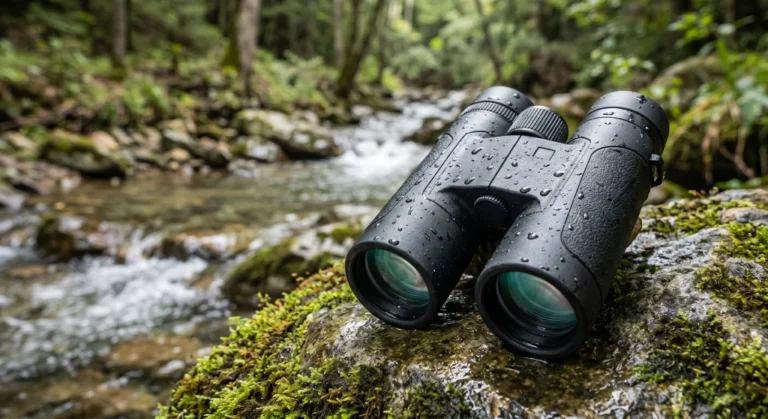
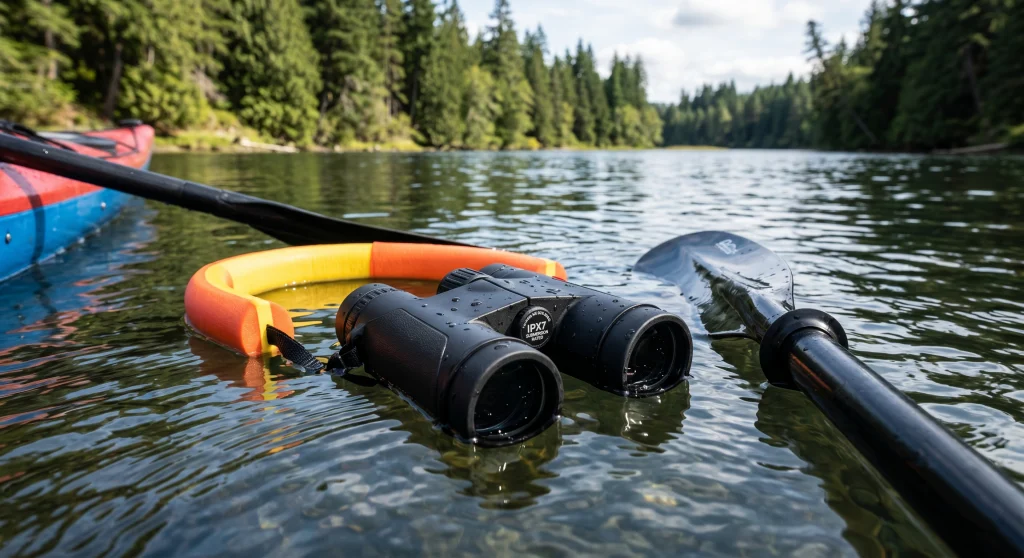
For any watercraft use, you need an IPX7 rating. This specific number means the manufacturer tested the equipment by submerging it in one meter of water for thirty minutes. If you flip your boat, an IPX7 binocular will survive the dunking without letting a single drop of moisture inside. If you want a deep dive into how these tests work and why they matter, you can review how the binoculars IPX rating explained system applies to outdoor gear.
Buying optics labeled “weatherproof” and assuming they are safe for a river trip because you are an experienced paddler who rarely flips the boat.
Checking the spec sheet specifically for an IPX7 rating or explicit language stating the unit survives submersion to at least one meter.
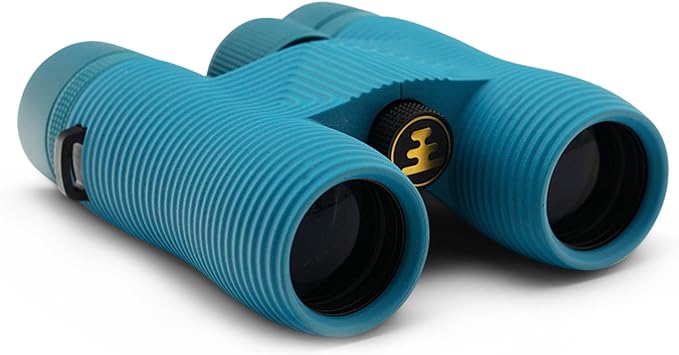
Weighing just 16.7 oz, these compact binoculars feature fully multi-coated optics and a Swiss-designed BaK-4 prism for bright, edge-to-edge clarity across a wide 387 foot field of view. IPX7 rated and nitrogen sealed, they handle submersion up to 3 feet for 30 minutes without compromising performance. A patented wave grip, three-position twist eyecups, and a no-matter-what lifetime warranty make them a confident choice for any adventure.
Check On AmazonIf you click this link and buy, we earn a commission at no additional cost to you.
How to Verify the Specs When IPX Is Missing
Not every optics company pays for official IPX certification, which can make shopping incredibly frustrating. Sometimes you will find excellent waterproof binoculars for water sports that have no official IPX number listed anywhere on the product page or the box. When that happens, you have to act like a detective and look for two specific manufacturing details.
First, look for the phrase “O-ring sealed.” An O-ring is a physical rubber gasket placed at every vulnerable point on the chassis, including under the objective lenses, around the eyepieces, and deep inside the focus assembly. Second, look for “nitrogen-purged” or “argon-purged.” This means the factory pumped out all the normal, moisture-laden air and replaced it with a dry, inert gas before sealing the unit. This gas prevents internal fogging when temperatures change rapidly, such as moving from a hot car interior to a cold river.
If a product description explicitly claims both O-ring sealing and nitrogen purging, you are generally safe to treat it as a fully sealed unit capable of surviving a quick dunk. If it only mentions a rubberized grip or weather resistance, leave it on the shelf. You can explore this baseline requirement further in the waterproof binoculars hub.
The Flotation Problem Nobody Mentions
There is a harsh reality about IPX7 equipment that I always made sure to point out at the counter. Surviving submersion only matters if you can get the binoculars back. Standard binoculars are dense blocks of optical glass and metal chassis. If you drop them in deep water, they sink straight to the bottom like a stone.
You have a few ways to solve this for kayaking. The easiest and most affordable method is buying a floating neck strap. These are bright, foam-filled straps that replace the thin nylon cord that comes in the box. If the binoculars go overboard, the strap keeps them bobbing at the surface so you can grab them. They are highly effective, but you have to check the weight rating.
Pro Tips: If you use a floating strap, test it in a sink or bathtub before your trip. Some heavy 8×42 models weigh too much for a standard foam strap to support. You need to verify the buoyancy actually matches the weight of your specific optics before trusting it on the river.
For touring or white water situations where a floating strap might get ripped away in the current, using a short retainer lanyard clipped directly to a carabiner on your life jacket is the safest secondary backup.
The alternative is buying dedicated marine binoculars. Some marine models are specifically designed to float, often utilizing lighter polycarbonate frames or coming with highly buoyant straps out of the box. While these are well-suited for offshore sailing, they tend to be quite bulky. And keeping your gear afloat is only half the battle, as you also have to actually hold and use them while paddling.

This handcrafted, high-visibility orange strap is designed to keep marine binoculars afloat if dropped overboard, compatible with most major brand 7x50 and smaller models. Generously sized for larger binoculars with 0.4 inch wide strap loop ends for a secure fit.
Check On AmazonIf you click this link and buy, we earn a commission at no additional cost to you.
Choosing the Right Size and Power for a Kayak
Space and stability are your two biggest constraints on any paddle craft. You do not have the luxury of planting your feet shoulder-width apart on solid ground to steady your arms. Every ripple on the water, every shift in your weight, and every breath of wind transfers directly into your upper body.
Because of this constant motion, magnification limits are strict. Anything over 8x power is incredibly difficult to use on a small boat. If you try to use 10x magnification while bobbing on a lake swell, the image will shake so violently you will likely get a headache within five minutes. Stick to 7x or 8x magnification for a stable image. A wider field of view is much more valuable than raw power when you are trying to find a heron along the shoreline from a moving platform.
Physical size matters just as much. Full-size 42mm objective lenses gather beautiful light, but they are heavy around the neck and take up a lot of room in a dry bag. For the vast majority of people looking for waterproof binoculars paddling, an 8×32 configuration is the perfect compromise. It gives you the stability of 8x power, the optical quality needed for daylight viewing, and a footprint small enough to tuck into a pocket.
Speaking of pockets, how you carry them matters. Avoid traditional chest harnesses, as they interfere with your life jacket and get in the way during a self-rescue. Instead, keep a compact pair tucked directly inside a dedicated personal flotation device (PFD) pocket. These same size, power, and carrying rules apply to stand-up paddleboarding (SUP), where a wet launch or choppy conditions create identical viewing challenges and submersion risks for water sports.
| Configuration | Paddling Performance |
|---|---|
| 10×42 | Poor. Too much image shake on moving water. Heavy around the neck. |
| 8×42 | Good. Stable image, excellent light, but slightly bulky for small kayaks. |
| 8×32 | Excellent. Very stable, lightweight, easy to stow in a small dry bag. |
| 8×25 | Fair. Highly portable, but the smaller exit pupil makes them harder to align quickly. |
When selecting binoculars for kayaking, pay attention to the eyecups. Twist-up eyecups that hold their position securely are vital. When you are rushing to pull the optics out of a bag to catch a glimpse of wildlife, you do not want to be fumbling with flimsy rubber folds that collapse against your face.

This rugged Pelican hard case offers highly waterproof, impact-resistant protection for phones and small electronics in a compact footprint. Interior dimensions measure 10.6 by 6.0 by 3.1 inches with foam padding included, while the overall case weighs approximately 33.4 oz. Built to Pelican's trusted standards for dependable gear protection in the field.
Check On AmazonIf you click this link and buy, we earn a commission at no additional cost to you.
Storage on the Water
When you are not actively glassing the shoreline, where you put the binoculars matters just as much as their waterproof rating. Tossing them loosely in the bottom of the hull exposes them to bilge water, sand, and accidental kicks.
A standard dry bag rolled down tight is the bare minimum for storage. It keeps them completely dry and adds a layer of buoyancy. However, for multi-day touring kayakers, a small hardshell Pelican-style case lashed securely to the deck provides crush protection that a soft dry bag simply cannot offer.

Built from heavy-duty 500D PVC with fully welded seams and a roll-top closure, this dry bag delivers reliable waterproof, dustproof, and scratch-resistant protection for all your essentials. Available in 7 colors across 5 sizes from 5L to 40L, with smaller sizes including a single detachable shoulder strap and the 30L and 40L converting to a backpack with double straps. Perfect for kayaking, paddleboarding, beach trips, hiking, and multi-day outdoor adventures.
Check On AmazonIf you click this link and buy, we earn a commission at no additional cost to you.
A Mandatory Note on Saltwater Paddling
River kayaking usually involves a quick capsize in fresh water. Sea kayaking is a completely different risk profile. If your idea of kayaking includes coastal bays, estuaries, or ocean swells, you have to account for salt. Saltwater is highly corrosive to optical coatings, hinge grease, and rubber armor. Even if your equipment is rated IPX7 and built like a tank, letting saltwater dry on the lenses will leave abrasive salt crystals behind. If you wipe those crystals with a dry microfiber cloth, you will permanently scratch the glass.
The solution requires strict discipline after your trip:
- Keep the lens caps on while paddling unless you are actively looking through the glass.
- When you get off the water, rinse the entire binocular under a gentle stream of fresh tap water. Do not use high pressure.
- Let the chassis air dry completely in a room-temperature space before putting it back in its case.
- Never wipe a saltwater-sprayed lens while you are still on the water. Blot it gently if absolutely necessary, but wait for a fresh water rinse if you can.

Select HD glass elements with fully multi-coated, dielectric-coated lenses deliver exceptional sharpness, color fidelity, and light transmission, while Armortek coating protects exterior surfaces from scratches and oil. Argon-purged and O-ring sealed for waterproof, fog-proof performance in any conditions. Includes a GlassPak chest harness and backed by Vortex's unlimited, unconditional, fully transferable lifetime VIP Warranty.
Check On AmazonIf you click this link and buy, we earn a commission at no additional cost to you.
Final Thoughts: Protecting Your View
Taking optics on the water vastly improves the paddling experience. It allows you to read distant navigational markers, spot wildlife hiding in the reeds before you spook it, and chart a safe course through shallows. But the river environment is unforgiving to gear that is only built for a light drizzle.
Prioritize an IPX7 rating above all other specifications. Accept the fact that you need 8x magnification or lower for a stable image. And always plan for the moment the equipment goes overboard, either by using a floating strap or keeping it secured to your vest. Buying the right tool up front is an investment. If you respect the limits of the environment and match your specs to the reality of the water, you will buy a tool that lasts for years of river trips instead of becoming another casualty in a plastic bin at the optics counter.
FAQs
🛶 Do I need marine binoculars for kayaking?
You do not strictly need traditional marine binoculars, which are often large and bulky. A standard outdoor binocular is perfectly fine as long as it has a verified IPX7 submersion rating to survive a capsize.
💦 What happens if my water-resistant binoculars fall in the lake?
If they only have an IPX4 or IPX5 rating, water will likely breach the seals immediately. The internal lenses will flood, the view will become cloudy, and the binoculars will be permanently damaged.
👀 Is 10x magnification good for a kayak?
No, 10x is generally too powerful for small watercraft. The constant movement of the boat amplifies hand shake, making the image highly unstable. Stick to 8x or 7x magnification for a clearer view.
🦺 How should I carry binoculars while paddling?
Avoid traditional chest harnesses, as they interfere with your life jacket. The best method is using a short floating neck strap or keeping a compact pair tucked directly inside a dedicated pocket on your PFD.