Thermal vs Night Vision Binoculars: The Thicket Test
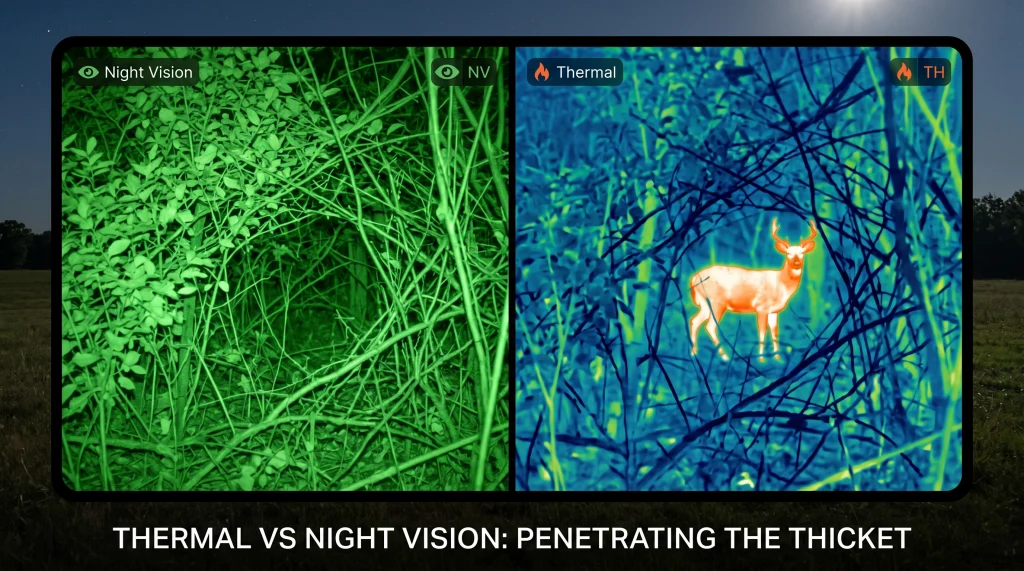
When people come to the optics counter asking about thermal vs night vision binoculars, they usually expect a conversation about specs, sensor resolutions, and battery life. I always stop them and present a specific scenario instead. Imagine a deer standing quietly twenty yards deep inside a dense brush patch at midnight. You are standing in an open field looking at that brush patch.
If you look through night vision binoculars, you will see a highly detailed, bright green image of the brush patch. You will see every leaf and every twig facing you. But you will not see the deer. The deer is physically blocked by the vegetation, and night vision only amplifies the light reflecting off the first surface it hits.
If you look through thermal binoculars, you will see a bright, glowing white or orange silhouette shining straight through the gaps in the leaves. You might not see the texture of the leaves at all, but the body heat of the animal makes it physically impossible to hide. This is the fundamental difference that should drive your entire purchasing decision.
Before you even look at price tags, you have to decide what your primary goal is. If you need to know exactly what an object is, night vision gives you the optical detail to figure it out. If you only need to know that a warm body is present in the area, thermal is completely unmatched.
Key point: Night vision relies on available light and is easily defeated by physical camouflage or dense vegetation. Thermal imaging relies on body heat, making it almost impossible for living creatures to hide in typical outdoor environments.
How Each Technology Actually Sees the Dark
To understand why these devices perform so differently in the field, you have to look at what they are actually capturing. They are not doing the same job in different ways. They are reading entirely different parts of the physical world.
Night vision technology works by gathering tiny amounts of existing ambient light from stars, the moon, or distant streetlights. The objective lens pulls this faint light in, and an internal image intensifier tube amplifies it thousands of times before projecting it to your eye. When there is absolutely zero ambient light, night vision becomes completely useless unless you turn on an infrared illuminator. An infrared illuminator acts like a flashlight that only your binoculars can see. For a deeper look at how the entry-level versions handle this, you can read my breakdown on digital night vision binoculars.
Thermal imaging does not care about light at all. It does not amplify moonlight, and it does not need an infrared flashlight. Thermal sensors read heat signatures. Every object on earth emits some level of heat energy. A thermal sensor reads the temperature differences between a living animal, the cold ground, and the surrounding trees, and then creates an electronic display based purely on those temperature contrasts.
Field Note: One of the most common complaints I heard from new night vision buyers was that their device was broken because it looked completely black inside a windowless room or a dense basement. I had to explain that night vision amplifies light. If you give it zero light, it amplifies zero. Thermal, on the other hand, works perfectly in a sealed, pitch-black cave.
The Weather Variable: Fog, Smoke, and Thermal Washout
Because night vision relies on light particles, it fails under the exact same weather conditions that defeat standard vision. If you try to use an infrared illuminator in heavy fog, rain, or smoke, the light reflects directly back off the water droplets into the lens, exactly like turning on your car’s high beams in a fog bank. You effectively blind yourself.
Thermal radiation cuts straight through smoke and light fog. This is why firefighters and search-and-rescue teams rely almost exclusively on thermal. However, thermal has its own environmental weakness: “thermal washout.” On a freezing winter night, a 98°F animal contrasts violently against a 30°F background, making thermal spectacular. But on a sweltering 95°F summer evening in the South, rocks, trees, and ground dirt absorb and retain the sun’s heat. When the background temperature nearly matches the animal’s body temperature, the thermal contrast vanishes, and everything blends into a washed-out, glowing gray screen.

A 35mm large-diameter lens with advanced CMOS sensor delivers vivid full-color images in low light and clear infrared vision up to 300 meters in complete darkness. Eight levels of digital zoom and a 3 inch display provide an immersive viewing experience, while a screen-off function with 5 brightness levels keeps you concealed during hunting or wildlife observation. A 5,200mAh rechargeable battery provides up to 6 hours of infrared use or 12 hours in daylight mode.
Check On AmazonIf you click this link and buy, we earn a commission at no additional cost to you.
Identification vs Detection: The Benchmark Reality
The ability to see through light brush and fog sounds like thermal is the obvious winner, but there is a massive trade-off that buyers often overlook until they look through the eyepiece. That trade-off is image detail and positive identification.
Thermal imaging is exceptional at detection over vast distances. A mid-tier thermal unit with a 384×288 resolution sensor can easily detect the heat signature of a human-sized object at 1,000 yards. It will show you a glowing pixel. However, you might not be able to confidently identify whether that glowing blob is a person, a small cow, or a large deer until it closes the distance to within 150 yards. Thermal displays struggle to show fine textures, facial features, or anything that lacks a distinct temperature difference.
Night vision excels at identification. Because it amplifies actual light reflecting off surfaces, it shows you the physical texture of the world. With a quality Gen 2 night vision device (offering 45-50 lp/mm resolution), you can count the points on a buck’s antlers at 100 yards. You can read the lettering on a license plate. You can recognize facial features. If your task requires you to know exactly who or what you are looking at, night vision is the mandatory choice.
Buying thermal binoculars to evaluate the antler size of deer at night on your property. The antlers are bone, they lack significant blood flow, and they often blend completely into the background temperature. You will see a glowing body and an invisible head.
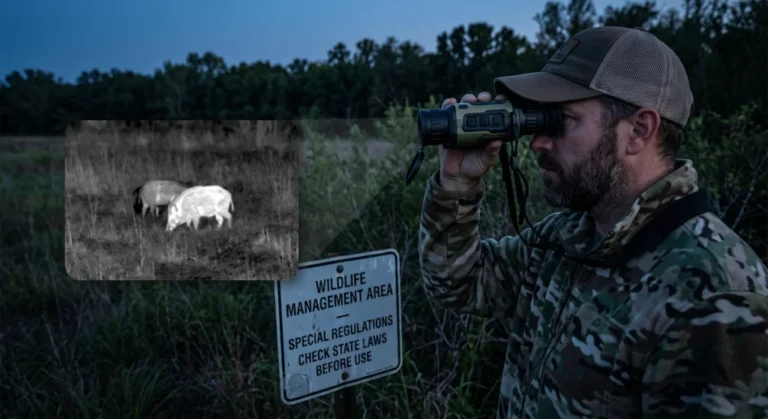
Buying thermal binoculars to locate feral hogs rooting in tall agricultural fields. You do not need to identify facial features. You just need to find the heat sources hidden in the crops quickly before moving in.
Beyond Hunting: Security, Astronomy, and Navigation
The thermal vs night vision debate extends well beyond the hunting context. For property security, thermal holds one critical tactical advantage over night vision: absolute stealth. In total darkness, night vision requires you to turn on an IR illuminator. To anyone else wearing night vision gear, your IR illuminator looks like a massive spotlight pointing right at them. Thermal imaging is 100% passive. You emit zero light, visible or infrared, making you completely undetectable while scanning your property.
If you are looking upward, the technologies split radically. If you point thermal binoculars at the night sky, you see absolutely nothing, because stars are too distant to register as heat signatures. If you point night vision binoculars at the sky, the light amplification reveals thousands of stars and satellites completely invisible to the naked eye. For amateur astronomers, night vision is a revelation.
A similar split applies to marine navigation. Night vision shows you the physical waves, the shoreline, and the buoys. Thermal imaging reads a large body of water as a flat, featureless sheet, making navigation extremely disorienting.
Thermal vs Night Vision for Hunting
This stark difference between merely detecting a shape and positively identifying a species is exactly why hunters must choose their optics based on their specific target. For hunters managing invasive species like feral hogs, the environment dictates the gear. If you are hunting hogs in the dense brush of Texas, thermal is widely considered the superior tool. It allows you to scan a massive tree line and instantly pick up the heat signatures of a group of pigs that would otherwise be completely hidden.
Conversely, if you are calling coyotes across wide, open plains under moonlight, a high-quality night vision setup gives you the clarity to positively identify the animal before taking any action. Night vision allows you to see the terrain clearly, judge distances more accurately, and spot obstacles that might be the exact same temperature as the ground.
There is a massive legal barrier here that you cannot ignore. Using either of these technologies for hunting is strictly regulated. I have seen guys spend thousands of dollars only to realize their state completely bans nighttime electronic optics for the game they want to pursue. Before making any decisions based on optical performance, I highly recommend checking out my specific breakdown on night vision binoculars for hunting to understand the regulatory realities first.

A 25mm multi-coated objective lens with 5x digital zoom and a 3 inch HD display delivers natural-color viewing in low light and sharp 4K video capture in complete darkness. A 5,000mAh rechargeable battery powers extended overnight sessions, and the included 32GB TF card stores photos and video without interruption. Lightweight and tripod-compatible via a standard quarter-inch mount, with an adjustable neck strap for comfortable all-night carry.<br />
Check On AmazonIf you click this link and buy, we earn a commission at no additional cost to you.
The Price Reality: When Is Thermal Worth the Premium?
You cannot have a realistic conversation about which is better, thermal or night vision binoculars, without talking about the financial gap between them. It is not a small jump. It is a completely different budget bracket.
You can buy a functional, entry-level digital night vision binocular for casual property scanning for a few hundred dollars. If you step up to traditional Gen 1 or Gen 2 image intensifier tubes for better clarity, you are looking at five hundred to over a thousand dollars. For most people needing basic security or wildlife observation on an open property, this budget solves their problem entirely.
Quality thermal binoculars start around fifteen hundred dollars, and that is just the entry point. Premium thermal units easily reach three to five thousand dollars. The thermal sensors require exotic materials for the lenses, usually germanium, because standard glass actually blocks thermal radiation. You are paying for highly specialized industrial technology.
In my experience, buying a high-end thermal unit just to casually watch raccoons in a backyard leads to immediate buyer’s remorse. Buying a premium night vision unit to find lost cattle in a dense forest leads to frustration because you still cannot see through the leaves. Paying for specs you cannot fully utilize in your specific terrain is the fastest way to waste money in outdoor optics.

A 256x192 resolution thermal sensor with a smooth 50Hz refresh rate and 13mm lens delivers vivid thermal imaging with detection up to 410 meters, cutting through fog and dense vegetation with ease. IP67 rated and encased in durable silicone, it withstands drops up to 2 meters and runs up to 11 hours on a 5,000mAh battery. The TopInfrared app enables wireless live monitoring, image capture, and video recording directly from your phone.
Check On AmazonIf you click this link and buy, we earn a commission at no additional cost to you.
Which Is Better: Thermal or Night Vision Binoculars?
If you are still on the fence about which category to pursue, reviewing the core strengths side by side usually clears things up. Neither is universally better. They are specialized tools built to solve different problems in the dark.
Consider night vision if you fit into these categories:
- You need to positively identify species, read text, or recognize faces in low light.
- Your use case is primarily in wide open fields, navigating on the water, or looking at the stars.
- You want to walk through your property while seeing the physical details and depth of the terrain.
- You are working with a budget under one thousand dollars.
Consider thermal imaging if you fit into these categories:
- You need to detect living things hidden inside tall grass, deep brush, or forest cover.
- You frequently operate in heavy fog or smoke, which completely blinds night vision.
- You need to track wounded game or locate missing animals based on body heat.
- Your priority is stealth security where emitting an IR beam is an unacceptable risk.
| Capability | Night Vision | Thermal Imaging |
|---|---|---|
| How it sees | Amplifies available ambient light | Detects radiated body heat |
| Sees through brush/fog? | No, blocked by physical obstacles | Yes, heat signatures penetrate light cover |
| Image detail | High (can see faces, antlers, textures) | Low (shows glowing silhouettes and blobs) |
| Needs IR illuminator? | Yes, in complete total darkness | No, works perfectly in total darkness |
| Starting price tier | Accessible ($100 – $500 for entry level) | Expensive ($1,500+ for usable quality) |

This iF Design Gold Award-winning power bank features a vintage fuel bottle aesthetic with fast-charging USB-C Power Delivery, smart device detection for automatic power allocation, and a standard quarter-inch tripod mount for compatibility with NESTOUT accessories like the LAMP-1 lantern and FLASH-1 LED panel. IP67 rated for submersion up to 1 meter and MIL-STD 810G drop tested, with a shockproof silicone-cushioned hard shell built for extreme outdoor conditions. Backed by a 1-year warranty.
Check On AmazonIf you click this link and buy, we earn a commission at no additional cost to you.
Final Thoughts: The Landscape vs. The Heartbeat
The easiest way to make a mistake in the outdoor optics market is to buy technology because it sounds advanced, rather than because it solves your specific problem. Ultimately, you are choosing between buying the ability to see the world, or the ability to find a heartbeat.
If you need to navigate a trail, read the landscape, or look up at the stars, you need to see the world. Stick to the established night vision binoculars market. If you need to find an animal hidden in the brush before it finds you, or track movement through heavy morning fog, you need to find the heartbeat. That is where thermal justifies every dollar of its premium price tag. Match the technology to the problem, and you will never regret the purchase.
FAQs
🦌 Can thermal binoculars see through walls?
No. Thermal imaging cannot see through walls, glass, or solid wood. It only detects the temperature of the surface it is looking directly at. If an animal is standing behind a glass window, the thermal sensor will read the temperature of the glass, not the animal inside.
🌧️ Does rain affect night vision or thermal binoculars?
Heavy rain severely degrades both technologies, but for different reasons. Rain scatters ambient light, making night vision grainy and reducing the effectiveness of IR illuminators. For thermal, heavy rain cools everything down to a uniform temperature, which destroys the heat contrast needed to generate a clear image.
🔋 Which drains batteries faster, night vision or thermal?
Thermal binoculars generally consume battery power much faster than standard image intensifier night vision. Thermal devices rely heavily on internal digital processors and screens to render the heat map, meaning you need to carry spare batteries or external power banks for long nights in the field.
🔦 Do thermal binoculars emit a visible light?
The device itself does not emit light into the environment, meaning you remain completely stealthy. However, the digital display screen inside the eyepiece glows brightly. If you pull the binoculars away from your face quickly, that back-glow can illuminate your face in the dark.