The Two Factors That Actually Matter
People standing at the optics counter often ask me if the premium price tag for IS binoculars is actually justified. If you find yourself wondering are image stabilized binoculars worth it, the honest answer depends almost entirely on two specific details about your intended use. The first detail is the level of magnification you plan to look through. The second detail is whether the surface you are standing on is moving or perfectly still. I have taken these units out on choppy boat decks and windy ridges, and the difference they make is undeniable, provided you are using them in the right situation.
Image stabilization technology exists to solve a very specific problem that regular optics cannot fix. Every human hand has a natural tremor that transfers directly into the lenses of whatever you are holding. At low magnifications on solid ground, your brain easily filters out this slight movement so you barely notice it. However, if you change the environment or increase the power of the lenses, that tiny tremor becomes a massive viewing obstacle.
Before you spend the premium for stabilization, you need to evaluate exactly where you will be standing when you glass. If your use case falls into one of the categories where stabilization shines, the technology will completely change what you are able to see. If you fall outside those specific categories, you will end up spending a lot of money on a feature that adds weight but no visible value to your experience.
The Magnification Threshold and Hand Tremor
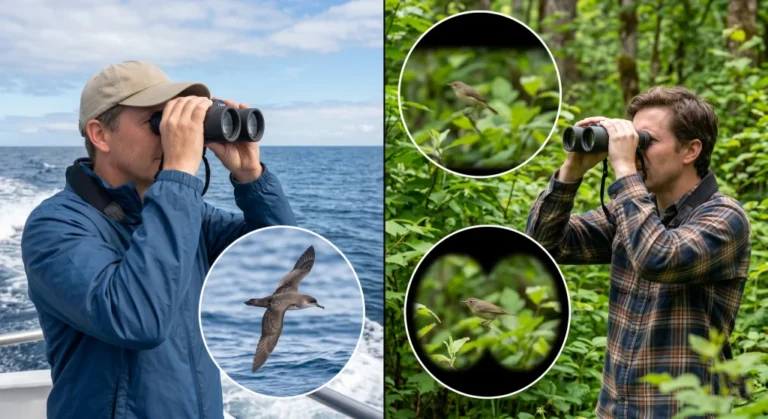
The most reliable test for whether you need stabilization is looking at the numbers printed on the barrel. For standard 8x and 10x models, most adults with a reasonably steady stance can hold the optic still enough to get a perfectly clear image. At 8x or 10x, turning on the stabilization adds virtually nothing to your ability to identify a target. For standard ground use, you simply do not need the electronics at these magnifications.
The math changes completely once you step up to 12x, 14x, or 16x magnification. At these higher powers, every tiny pulse in your fingertips or slight shift in your breathing is amplified dramatically through the lenses. An image that should be large and detailed instead becomes a bouncing, blurry mess that causes severe eye strain after just a few minutes. I regularly read discussions where hunters compare their experiences, and one Rokslide forum user summed up the high-magnification experience perfectly by stating that handheld, these things are game changers.
Field Note: One of the most common mistakes I see first-time buyers make is assuming they can handhold a 15x binocular simply because they have steady hands. They walk out of the store confident, but they come back two days later complaining that the image bounces around too much to see any detail. Human hands simply cannot hold that much magnification perfectly still, which is exactly where stabilization technology goes from a luxury to an absolute necessity.
If you absolutely need the reach of 12x or 15x power to identify distant birds or spot game on a ridge, you have to stabilize the optic somehow. You either need to mount the unit to a sturdy mechanical base, or you need internal electronics to do the work for you. If you want to dive deeper into the mechanical side, my guide covering image stabilized binoculars vs tripod setups breaks down how to choose between the two solutions.

Canon's EF lens image stabilization technology delivers rock-steady views at 12x magnification, while Porro II prisms and a doublet field-flattener produce sharp, distortion-free images edge to edge. The 36mm objective lens provides clear, bright, high-resolution images with improved power efficiency for extended battery life in a compact, portable package ideal for birdwatching and hunting.
Check On AmazonIf you click this link and buy, we earn a commission at no additional cost to you.
The Exception for Aging Hands
There is one important exception to the magnification rule: age. As we get older, our natural resting hand tremor noticeably increases. A birder in their sixties or seventies might find that the 10x binoculars they held perfectly still a decade ago now bounce just enough to cause eye strain.
In this specific case, an image-stabilized model at 10x or even 8x becomes an incredible tool. It allows older users to continue enjoying the outdoors and spotting wildlife comfortably without being forced to step down in magnification. For senior birders or hunters, stabilization at standard powers is often worth every penny.
The Moving Platform Rule
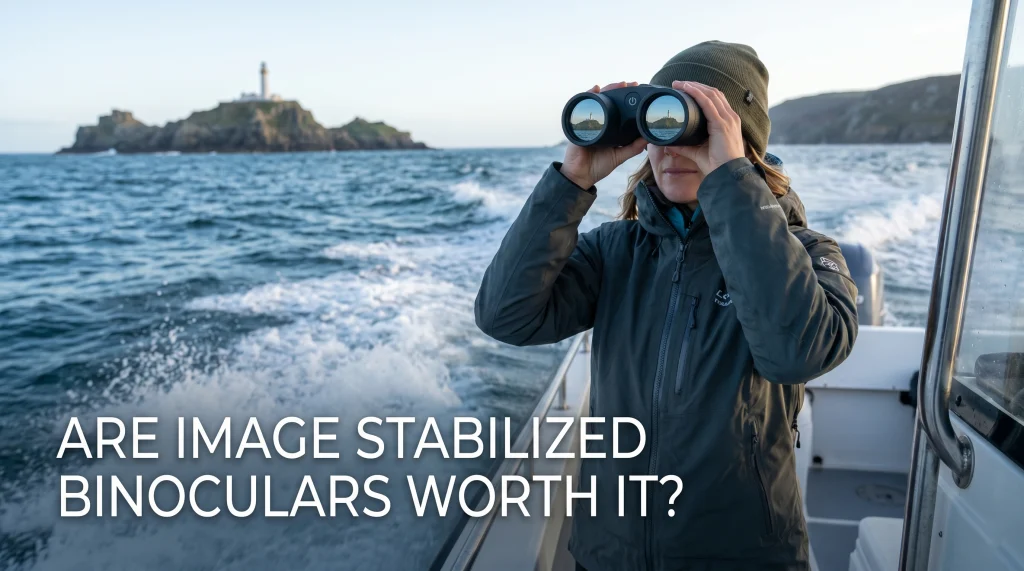
The second major factor that tips the scale in favor of image stabilization is the environment beneath your feet. If you are standing on solid ground, you only have to worry about your own internal hand tremor. If you are standing on the deck of a boat, riding in a truck, or sitting in a helicopter, external movement is constantly throwing your optics out of alignment. In these environments, stabilization technology is genuinely transformative.
How do they actually freeze the view? Inside the housing, IS binoculars use either a gyroscopic mechanism or electronic sensors that detect movement and instantly shift the internal prisms to compensate. This internal machinery is exactly why they require batteries and weigh significantly more than traditional designs. That trade-off becomes irrelevant the moment the platform starts moving. On a rocking boat, even a low-power 7x or 8x binocular can be difficult to look through. The sensors instantly detect the roll of the waves and adjust to keep the horizon flat.
A 7x stabilized binocular on a choppy bay will consistently outperform a standard 7x model because it allows you to maintain focus on your target instead of fighting the ocean. This is why marine biologists and offshore fishermen are some of the most dedicated users of this technology.
The same principle applies to observing wildlife from a safari vehicle or scanning from the bed of a pickup truck. The engine vibration and suspension movement make standard handheld glassing incredibly frustrating. Engaging the stabilization button instantly removes the vehicle vibration from your view. If your primary outdoor activities happen in motion, the high cost of stabilization pays for itself on the very first trip.

A gyro sensor-based image stabilization system with a plus or minus 6 degree correction angle eliminates vibration at 14x magnification, while 40mm objectives with Fujinon's EBC Multi-Coating maximize light transmission and control flare for exceptional low-light and astronomical performance. Four objective elements in three groups and six ocular elements in four groups deliver edge-to-edge sharpness with minimal chromatic aberration. Nitrogen-purged, O-ring sealed, and rubber-armored for reliable all-weather use.
Check On AmazonIf you click this link and buy, we earn a commission at no additional cost to you.
The Financial Trade-Off Between Glass and Electronics
When you look at the price tag of an IS binocular, you need to understand exactly what your money is buying. Image-stabilized binoculars typically cost two to four times as much as comparable standard models. If you spend eight hundred dollars on a standard optical instrument, nearly all of that money goes into premium glass, advanced prism coatings, and rugged mechanical build quality. The result is a stunningly bright and crisp image, especially in low light.
If you spend that same eight hundred dollars on an image-stabilized model, a large portion of your budget goes toward the gyroscopes and sensors. The IS premium buys you stabilization, not top-tier glass. The image will be perfectly still, but the actual glass quality and light transmission are typically lower than a standard pair at the same price point.
| Feature | $800 Standard Binocular | $800 Stabilized Binocular |
|---|---|---|
| Optical Quality | Premium HD glass with advanced coatings | Glass quality typically lower than a standard pair at the same price point |
| Low Light Performance | Excellent brightness at dawn and dusk | Average brightness, noticeable drop-off |
| Weight and Size | Typically 22 to 28 ounces, streamlined | Usually 30+ ounces, bulky battery housing |
There is also the very real issue of battery dependency to consider in the field. Stabilized models only provide their perfectly still image as long as the batteries have power. Once the batteries die, you are left holding a heavy optical instrument. If you are planning an extended backcountry trip where replacing batteries is impossible, standard mechanical optics are always the safer and more reliable choice.
Because of this undeniable trade-off between optical purity and stabilization hardware, identifying your exact use case is critical before making a purchase.

Canon's EF lens image stabilization technology eliminates shake at 10x magnification for steady, sharp views in hand. Porro II prisms and a doublet field-flattener deliver clear, distortion-free images edge to edge, while 14.5mm eye relief ensures comfortable use with or without glasses. Improved power efficiency extends battery life for longer sessions in a compact, portable package.
Check On AmazonIf you click this link and buy, we earn a commission at no additional cost to you.
When Standard Optics Provide Better Value
If you do most of your glassing from a stationary position on solid ground, standard binoculars are almost always the smarter purchase. You get significantly better glass for your money, a wider field of view for tracking moving subjects, and a lighter unit hanging around your neck.
Standard optics are particularly superior for activities that require fast target acquisition. A common complaint with stabilized models is that they often feature a narrower field of view due to their complex internal lens construction. If you are tracking a fast-moving warbler through a dense forest canopy, a standard 8×42 will give you a wider, brighter picture that makes finding the bird much easier. Before making a final choice, it helps to understand how they fit into the broader landscape of different types of binoculars available today.
If you are unsure where you stand, sticking to standard optics is usually the right choice when:
- You are glassing entirely from solid ground with a stable stance.
- You prefer an 8x or 10x magnification level for general purpose use, and do not suffer from age-related hand tremor.
- Your budget requires you to maximize glass quality and low light performance.
- You are doing woodland birding where a wide field of view is critical.
- You want to avoid carrying spare batteries and heavy equipment on long hikes.

Fully multi-coated lenses and phase-coated BaK-4 prisms deliver sharp, color-accurate images across a wide 7.4 degree field of view in a compact, lightweight frame. The rubber-armored polycarbonate body is waterproof, nitrogen-purged, and tripod-adaptable for steady extended sessions. Backed by a Celestron Limited Lifetime Warranty and US-based support.
Check On AmazonIf you click this link and buy, we earn a commission at no additional cost to you.
The Short Version: When IS Is Worth It and When It Isn’t
Choosing to buy an image-stabilized binocular should never be about wanting the fanciest technology in the store. It should be a practical solution to a specific environmental problem. If you spend time on boats, off-road vehicles, or regularly need 12x magnification or higher without carrying a tripod, these instruments are absolutely worth the high cost. They will allow you to see things you would otherwise miss entirely.
However, if you are a casual hiker or a backyard bird watcher using a 10x magnification, your money is much better spent on premium traditional glass. A high-quality standard binocular will give you a brighter, wider, and more colorful image that delivers maximum optical clarity for your money.
If your use falls into any of those moving or high-magnification categories, the next step is understanding what to look for when shopping. My full guide to image stabilized binoculars explains exactly what specs to consider.
FAQs
🔋 Do image stabilized binoculars work without batteries?
Yes, they still function as regular optical instruments when the batteries die or are removed. However, you will lose the stabilization feature and be left with a standard binocular until you replace the power source.
🔭 Is image stabilization worth it binoculars for stargazing?
It can be very helpful for astronomy because holding high magnification steady on a tiny point of light is difficult. Removing the hand tremor makes viewing craters on the moon much clearer, though a dedicated tripod setup is often cheaper and equally effective.
🦌 Are image stabilized binoculars vs regular better for hunting?
It depends entirely on your hunting style and terrain. For hunters glassing from a moving vehicle or using 15x power from a quick seated position, they are excellent. For hunters hiking miles into the backcountry where weight and battery life are concerns, regular models are superior.
🚙 Should I buy image stabilized binoculars for a safari?
They are fantastic for safaris if you are observing from inside a moving or vibrating Land Cruiser. The stabilization completely negates the engine shake, allowing you to clearly identify wildlife while the vehicle is idling.