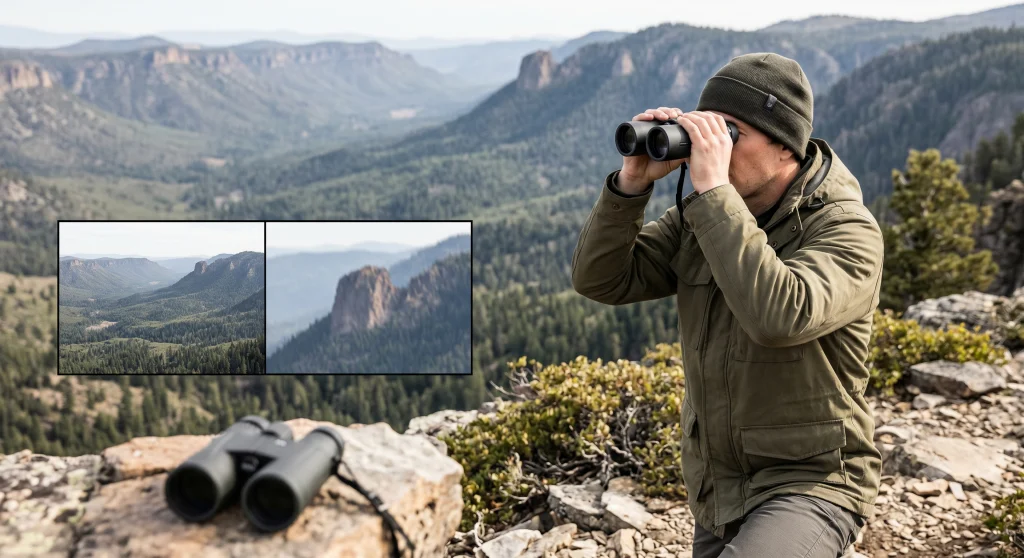
Binoculars Magnification Explained: The Obvious and the Hidden
Getting binoculars magnification explained to you usually stops at the literal definition. Everyone knows that the first number on the box tells you how much closer the target will appear. If you are looking at an object 400 yards away with an 8x binocular, the optics make it appear as if it were only 50 yards away. This basic math is exactly where most buying decisions start and end.
The problem is that magnification is not a free optical upgrade. Every time you increase the power to get a closer look at a bird or a distant ridgeline, you are triggering a cascade of secondary optical effects. These effects change the entire viewing experience in ways that manufacturers rarely print on the packaging. Understanding how binoculars magnification works in the real world means looking closely at the hidden costs of that extra power.
Amplifying Your Hands: The Stability Tax
The most immediate thing you will notice when stepping up in power is what happens to your hands. Magnification does not just enlarge the deer or the boat you are looking at. A slight hand shake that is completely unnoticeable to the naked eye becomes a highly distracting blur when viewed through high-powered glass.
Field Note: Moving from an 8x to a 10x binocular increases your visible hand tremor by exactly 25 percent. I have watched this play out countless times at the optics counter when someone insists they need maximum power. They will brace their elbows firmly on the glass display case and think a 12x model looks absolutely perfect indoors. Then they step outside unsupported and quickly realize the image is jumping around so much that they actually see less detail than they would have with a lower power model.

Fully multi-coated lenses and phase-coated BaK-4 prisms deliver bright, crisp, color-accurate images across all lighting conditions, with a wide 7.4 degree field of view for easy tracking. The rubber-armored polycarbonate body is waterproof, nitrogen-purged, and tripod-adaptable for extended sessions. Backed by a Celestron Limited Lifetime Warranty and US-based support.
Check On AmazonIf you click this link and buy, we earn a commission at no additional cost to you.
Shrinking the Window: Field of View Reduction
Another universal rule of optical physics is that every additional power jump significantly narrows your viewing angle. You are essentially trading visual width for visual proximity. If you look through a standard 8×42 binocular, you get a wide window that makes it very easy to locate a moving target in dense brush. If you step up to a 10x model in that exact same product line, your overall field of view will typically drop by 15 to 25 percent.
You might also notice two different field of view terms on the spec sheet: actual and apparent. Actual field of view is the physical width of the image at 1,000 yards. Apparent field of view is just the actual angle multiplied by the magnification, which describes how wide the image feels against your eye. They are not the same thing. To compare how much physical ground you will see, always look at the actual field of view.
This reduction in width sounds minor when you read it on paper, but it is a massive difference when you are actually in the field. A wider field of view provides a highly forgiving window when you first raise the optics to your eyes. Even if your aim is slightly off center, that wider view still captures your intended target. In dense cover or fast moving situations, the wider window will beat the higher magnification almost every single time.
The Focus Treadmill: Why Depth of Field Shrinks
Depth of field is arguably the least understood secondary effect of stepping up your optics power. This term refers to how much of the image stays in sharp focus from front to back without you having to touch the focus wheel. As you increase your magnification, your depth of field shrinks dramatically. In fact, it reduces by the square of the magnification increase rather than reducing linearly.
If you double your magnification from 7x to 14x, your depth of field does not just get cut in half. It actually drops to one quarter of its original depth. In practical terms, if you are watching a bird hop from a back branch toward a front branch at 10x power, you will have to constantly roll the focus wheel to keep the animal sharp. At 7x or 8x power, that same bird would likely stay in focus for the entire viewing sequence without any manual adjustments on your end.
Finding the best magnification for binoculars often means deciding how much you hate adjusting that center focus wheel. Hunters watching a distant stationary target can afford a shallow depth of field because their subject is not moving toward them rapidly. Birders dealing with erratic warblers in the brush will quickly find a shallow depth of field incredibly frustrating. You always have to match the optical physics of your gear to the movement speed of your environment.

Multilayer-coated lenses with silver-alloy prism coating deliver vivid, sharp images from dawn to dusk. O-ring sealed and nitrogen-purged, they stay clear through rain, snow, and humidity. The fiberglass-reinforced polycarbonate body with rubber armor keeps them lightweight yet durable, with turn-and-slide eyecups for comfortable all-day use with or without glasses.
Check On AmazonIf you click this link and buy, we earn a commission at no additional cost to you.
Eye Fatigue and the Handheld Ceiling
There is a very real physical toll that comes with using high powered optics over a long afternoon of spotting. When you combine the amplified hand shake, the narrower field of view, and the constant need to adjust a shallow focus, your brain has to work incredibly hard to process the image. This heavy cognitive load translates directly into eye fatigue and tension headaches. For most people, a 7x or 8x magnification represents the practical upper limit for comfortable, all day viewing.
Sustained observation at 10x power compounds all of these optical demands over hours of continuous use. You will also notice an optical effect called image compression, where the high magnification flattens the perceived depth of the landscape. A layered forest viewed at 10x appears much flatter and closer together than it does at 8x, making it significantly harder to judge the true distance between objects. Because of this combined fatigue and visual compression, 10x remains the absolute handheld ceiling for most average users. If you need anything higher than 10x to spot your targets, you should absolutely plan on buying a quality tripod. Understanding these accumulating physical limits makes it much easier to see why simply buying the highest number on the shelf is a mistake.

This lightweight 2.19 oz adapter features a standard quarter-inch 20 thread on both top and bottom for broad compatibility with most binoculars and tripods. Impact-resistant aluminum alloy construction with a unique tilting design provides rock-solid rigidity for shake-free extended viewing. Quick-turn top screws allow fast, tool-free mounting and removal in seconds.
Check On AmazonIf you click this link and buy, we earn a commission at no additional cost to you.
Scaling the Optical Trade-Offs
To see exactly how these optical penalties stack up before we discuss specific environments, let’s look at the numbers side by side. Consider this your practical guide to visualizing what you lose every time you pay for more power.
| Magnification Level | Hand Tremor Amplification | Field of View Category | Depth of Field Comfort |
|---|---|---|---|
| 8x Power | Baseline reference | Widest viewing window | Highly forgiving |
| 10x Power | 25% more visible shake | Noticeably restricted | Requires frequent adjustment |
| 12x Power | Requires steady rest | Extremely narrow | Very shallow focus plane |
Looking at this breakdown makes it extremely clear why certain outdoor activities favor specific setups. The performance penalties for choosing higher power accumulate very quickly across multiple structural categories. These are fixed rules of optical physics that apply to every brand on the market.
The Terrain Rule for Choosing Power
A reliable way to decide which trade-offs you are willing to accept is to look closely at your physical environment. The sightlines of the landscape you intend to explore should always dictate the magnification you end up purchasing. If your primary use case involves sitting stationary and observing distant targets across wide open expanses, higher power makes total sense. In those situations, you have plenty of time to locate your subject and stabilize your elbows on your knees for a steady view.
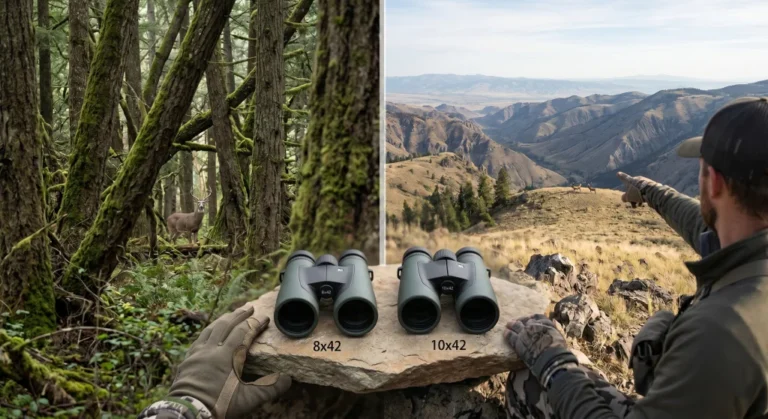
Conversely, if you are moving through heavy brush or scanning enclosed canopies, distance is not your primary obstacle. Your biggest challenge is target acquisition. You simply need to get the optics on the subject before it disappears. A wider field of view and a forgiving depth of field are absolutely essential optical traits when your sightlines are short. If you are struggling to decide which balance makes sense for your specific activities, my comparison guide on 8×42 vs 10×42 binoculars breaks down exactly where that field of view difference matters most.

Select HD glass elements with fully multi-coated, dielectric-coated lenses deliver exceptional sharpness, color fidelity, and light transmission, while Armortek coating protects exterior surfaces from scratches and oil. Argon-purged and O-ring sealed for waterproof, fog-proof performance in any conditions. Includes a glass pak harness and is backed by Vortex's unlimited, unconditional, fully transferable lifetime VIP Warranty.
Check On AmazonIf you click this link and buy, we earn a commission at no additional cost to you.
The Problem with Zoom Binoculars
When people learn about these trade-offs, they often ask why they cannot just buy variable zoom binoculars. An 8-24x model sounds like the perfect solution to having the best of both worlds. You get a wide field of view at 8x and maximum detail at 24x. In practice, variable magnification is a massive optical compromise.
To make a zoom mechanism work, manufacturers have to use moving internal lens elements. As you slide the magnification lever, those elements shift inside the barrel. This shifting inevitably throws off the fine optical alignment, causing you to lose edge sharpness, brightness, and contrast compared to a fixed power binocular at the exact same price point. You are paying for the complicated mechanism rather than the clarity of the glass.

Extra-Low Dispersion glass eliminates color fringing for razor-sharp, true-to-life images, while phase-coated BaK-4 prisms maximize light transmission even at dawn or dusk. The rubber-armored polycarbonate body is fully waterproof, nitrogen-purged, and features built-in tripod adapter threads for shake-free extended viewing. Backed by a Celestron Limited Lifetime Warranty and US-based support.
Check On AmazonIf you click this link and buy, we earn a commission at no additional cost to you.
Final: Balancing Power and Practicality
The biggest trap in buying outdoor optics is assuming that more power automatically equals a better overall view. As we have covered throughout this guide, every single step up the magnification ladder costs you stability, field of view, and depth of field. The goal is never to simply buy the strongest binoculars you can afford at the store. The actual goal is to buy the magnification level that perfectly matches the physical constraints of where you plan to stand.
Higher magnification is a specific tool, not an automatic upgrade. It forces you to trade away brightness and acquisition speed to gain distance detail. When you accept that those trade-offs are unavoidable laws of optical physics, you stop looking for the most powerful binoculars and start looking for the most useful ones. Match the power to your environment, and your eyes will thank you after a long day in the field.
FAQs
🔍 What magnification binoculars do I need for general outdoor use?
For most general outdoor activities, an 8x magnification is the safest and most versatile choice. It provides enough power to bring subjects close while maintaining a wide field of view and a steady image.
⚖️ Is higher magnification always better?
No, higher power is not always better. Increasing magnification amplifies your hand movements and narrows your viewing window.
🏔️ Can I hold 12x binoculars steady without a tripod?
Most people cannot hold 12x binoculars steady enough for comfortable extended viewing. The hand tremor amplification at 12x usually requires a tripod or a leaning post to see fine details clearly.
👁️ Why do my eyes hurt after using 10x binoculars?
Eye fatigue often comes from your brain working overtime to process a shaky image with a very narrow depth of field. Taking frequent breaks or stepping down to an 8x model usually resolves this uncomfortable tension.