The Biological Reality of Glassing
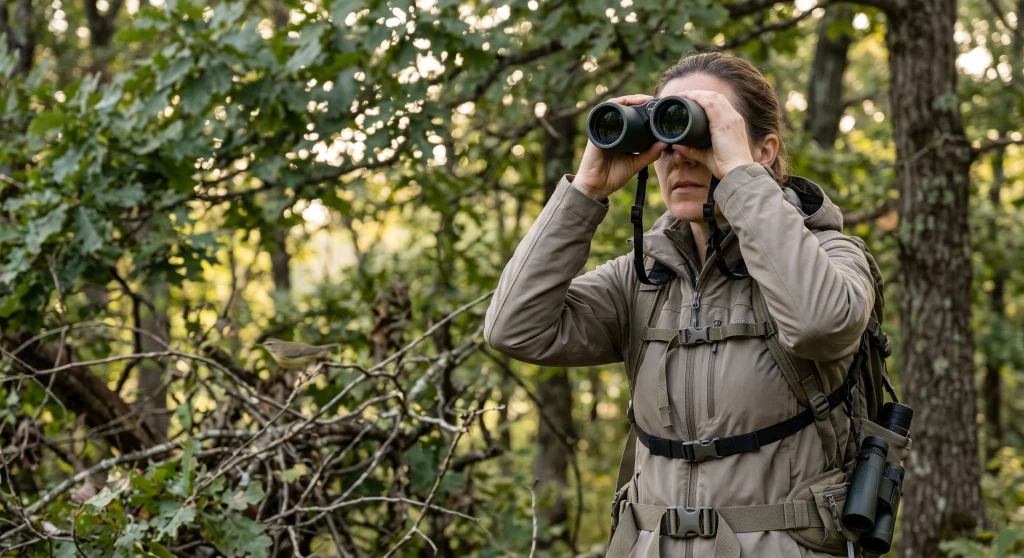
If you are trying to decide between binoculars vs monocular for bird watching, you are likely looking at the obvious differences like weight, size, and price. Those metrics absolutely matter. But the real difference shows up the first time you try to track a warbler moving erratically through a dense oak canopy.
Almost every serious birder uses binoculars. The reason is highly specific. It is not just a blind tradition or a preference for heavier gear. The choice comes down to human biology and how our brains process visual information in three-dimensional space.
I have lost count of how many people walked up to the optics counter wanting to buy a monocular just to save a few ounces in their pack. They figured it was exactly the same as looking through half a binocular. Optically, the math works out. Practically, it changes the entire viewing experience. When you look through a single barrel, you are fundamentally altering how you perceive depth, distance, and movement.
Understanding this distinction is the fastest way to figure out which optic belongs in your pack. We need to look closely at depth perception, acquisition speed, and the hidden cognitive load of using a single eye.
Depth Perception and the Flat Image Problem
When you walk through the woods looking for birds, you are navigating a complex 3D environment. Judging the distance between two branches or anticipating where a descending bird will land requires stereoscopic vision. Your brain uses the slightly different angles from both eyes to calculate depth instantly.
When you raise a monocular for bird watching, you lose that stereoscopic processing. The image you see is beautifully magnified, but it is entirely flat. You are essentially looking at a high-definition photograph rather than a live, three-dimensional space.
For a static object, this lack of natural depth is perfectly fine. If you are looking at a perched hawk on a telephone pole half a mile away, a monocular will give you all the field marks you need. That works well for static observation, but active birding is a completely different game.
Tracking a bird in flight or hopping through foliage requires you to constantly estimate its spatial relationship to the branches around it. With binoculars, your brain does this automatically. With a monocular, you have to consciously decipher those spatial cues, which takes extra mental effort.
Field Note: At the optics counter, I used to take customers outside to the parking lot to test this. I would ask them to follow a gull in flight with a monocular, then switch to standard 8×42 binoculars. The reaction was always the same. With the monocular, they struggled to keep the bird in the frame as it changed altitude. With binoculars, their eyes naturally locked on and tracked the movement seamlessly.
This brings up the issue of cognitive fatigue. Sustained monocular use does not just make you see less depth. It forces your brain to work much harder to construct a spatial environment from a single-lens input. If you are glassing for 15 minutes, you might not notice. But over a three-hour morning session, that mental load accumulates into genuine eye fatigue and headaches.

Fully multi-coated optics and BAK-4 prisms deliver crisp, high-contrast, color-accurate images in bright and low-light conditions alike. Rated IPX7, argon-purged, and O-ring sealed, they handle full submersion and the toughest outdoor elements. At just 1.25 lbs, the rubber-armored body is easy to carry all day, and the package includes an upgraded universal smartphone adapter and a 360-degree swivel tripod for hands-free photo capture.
Check On AmazonIf you click this link and buy, we earn a commission at no additional cost to you.
The Speed Argument: Finding the Bird
The most frustrating experience in birding is hearing a call, spotting the movement with your naked eye, and then failing to find the bird in your optics before it flies away. Acquisition speed is everything.
Bringing binoculars to your eyes is a gross motor movement that quickly becomes trained muscle memory. A practiced birder can lock their eyes on a target and raise their binoculars into their line of sight in under 2 seconds. You do not have to close an eye or consciously align the barrels. You just lift and look.
When comparing a birding monocular vs binoculars, the monocular introduces a mandatory delay. You have to bring the single barrel up, center it over your dominant eye, consciously close your other eye, and then search the field of view.
The Forgiving Window of Two Eyes
That extra second of adjustment is often exactly how long it takes for a target to vanish. Because you are only using one eye, your initial field of view feels more restricted. If your alignment is slightly off when you raise a monocular, you are staring at blackness and have to sweep the area to re-acquire your target.
With binoculars, the combined field of view from both eyes provides a much larger, more forgiving window. Even if your initial aim is slightly imperfect, the wider visual baseline usually captures the edge of the bird, allowing for an instant adjustment.
If you want to understand the broader mechanical differences between these two designs, you should review how binoculars vs monocular compare across all outdoor activities. But for fast-moving wildlife specifically, the speed of two-eye acquisition is almost impossible to beat.
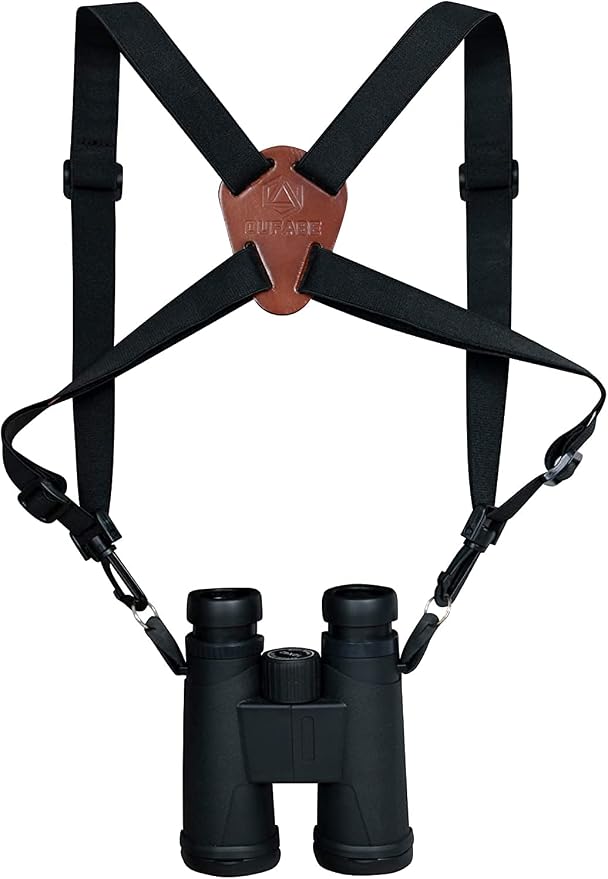
Double-stitched nylon and Lycra construction with premium leather accents delivers maximum durability and a tactical look built to last. The X-shaped shoulder design evenly distributes weight across your shoulders and back, eliminating neck fatigue during extended wear. Fully adjustable straps reduce chest sway and allow quick sliding into viewing position, fitting all binoculars with a half-inch eyelet as well as heavy cameras.
Check On AmazonIf you click this link and buy, we earn a commission at no additional cost to you.
How Habitat and Light Change the Rules
The performance gap between these two tools shrinks or widens drastically depending on where and when you are actually standing with them.
If you are in a dense woodland looking for warblers, binoculars completely dominate. The depth tracking and split-second speed are absolutely critical for following small, erratic birds moving through a chaotic canopy of leaves.
However, if you are doing long-distance shorebird watching at 200 yards across an open mudflat, the monocular disadvantage is much smaller. The subjects are largely stationary, and you are taking your time to study plumage details rather than tracking rapid flight. In an urban garden with a close-range feeder, where birds are slow and predictable, a monocular also functions reasonably well.
Then there is the dawn chorus. At first light, bird movement is high but ambient light is terribly low. This is the exact scenario where a monocular struggles the most. The combination of low-light visual noise, a single-lens image, and a narrower apparent window makes finding small birds in shadows incredibly frustrating. You need the spatial awareness and the natural binocular depth processing that only both eyes working together can provide.

Fully multi-coated 42mm objective lenses deliver bright, crisp images across a wide 307 foot field of view, while shock-absorbing rubber armor provides durable protection in tough weather conditions. Includes a smartphone mount, carrying case, lens covers, cleaning cloth, and neck strap right out of the box.
Check On AmazonIf you click this link and buy, we earn a commission at no additional cost to you.
When a Monocular Actually Makes Sense for Birders
Despite everything above, dismissing monoculars entirely is a mistake. There are highly specific situations where a single barrel is not just an acceptable alternative, but the smarter purchase.
Here are the scenarios where a monocular legitimately wins:
- The glovebox backup optic: You are running errands and spot something interesting in a roadside field. Having a compact optic always within reach beats having premium glass sitting at home in a closet.
- Ultralight backpacking: When every ounce in your pack is calculated, a lightweight monocular gives you magnification without the bulk of a full chest harness system.
- The strict budget constraint: Manufacturing two perfectly matched optical barrels and aligning them flawlessly is expensive. A monocular cuts that manufacturing cost in half. For example, a $500 Maven M.2 monocular delivers optical clarity that would cost well over $1,000 in a full-size binocular.
The same logic applies at the entry level. Spending $150 on a monocular gets you surprisingly sharp glass, whereas a $150 binocular often means accepting dark images and frustrating alignment issues.
| Performance Trait | Binoculars | Monocular |
|---|---|---|
| Target Acquisition Speed | Extremely fast (under 2 seconds) | Slower (requires eye centering) |
| Depth Perception | Full 3D tracking and spatial awareness | Flat single-lens image |
| Extended Use Comfort | High (natural viewing posture) | Low (cognitive fatigue over time) |
| Glass Quality per Dollar | Standard baseline | Exceptional (often double the value) |
| Portability | Requires neck strap or chest harness | Fits easily in a jacket or shirt pocket |
For a deeper dive into the exact specifications that dictate brightness and clarity, reviewing how binoculars are explained will help you understand the optical math behind both designs.

A BAK-4 prism and fully multi-coated lens deliver clear, sharp images with strong light transmission across a wide 352 foot field of view at 12x magnification. IPX7 rated and nitrogen-filled for waterproof, fog-proof, and shockproof performance in any weather, with a twist-up eyecup for comfortable extended viewing. Includes a smartphone adapter for hands-free photo capture and a hand strap for secure grip on the go.
Check On AmazonIf you click this link and buy, we earn a commission at no additional cost to you.
Final Thoughts: Making the Right Purchase
If you want to enjoy birding without fighting your equipment, the choice is straightforward. If bird watching is your primary activity and you plan to spend hours looking into the canopy, you need binoculars. The depth perception, the tracking speed, and the overall eye comfort are simply non-negotiable for sustained sessions in the field.
Buying a monocular as your primary birding optic just to save weight, only to end up frustrated because you cannot track warblers fast enough before they vanish.
Investing in a comfortable 8×42 binocular for your primary field days, and reviewing a complete guide to binoculars for bird watching to find the right model for your budget.
There is no shame in starting with a monocular if your budget is strict. It is far better to have a sharp single barrel than a pair of misaligned, headache-inducing cheap binoculars. But as you progress in the hobby, you will inevitably find yourself reaching for the speed and comfort of two eyes.
FAQs
🦅 Are binoculars or a monocular for birding better for beginners?
Binoculars are significantly better for beginners. The wider combined field of view makes it much easier to locate a bird after raising the optic to your face, reducing early frustration.
✋ Which is easier to hold steady, binoculars or a monocular?
Binoculars are easier to hold steady. Using two hands braced against your face creates a stable triangle. A monocular is often held with one hand, which naturally amplifies body tremor and makes the image shakier.
👁️ Do monoculars cause eye strain during birding?
Yes, they commonly cause eye strain during extended use. Keeping one eye closed while forcing the brain to process a single magnified view without natural depth cues creates cognitive fatigue that usually sets in after 20 to 30 minutes of continuous glassing.
👓 Can I use a monocular if I wear glasses?
Yes, but you must ensure the monocular has adequate eye relief. Just like binoculars, you need a minimum of 14mm to 15mm of eye relief to see the full picture without a dark ring forming around the edges.