The Borrowed Binoculars
The customer did not take his hunting binoculars on a boat. He lent them to a friend who did. Three months later, he stood at my optics counter trying to force the center focus wheel to turn. It was locked completely solid. When I see saltwater damage like this, the story is almost always the same. The owner assumes the gear is ruined because someone dropped it in the ocean.
I asked him if his friend had submerged them. He said no. The friend had simply taken them offshore saltwater fishing for a single weekend. They sat around his neck, rested on the center console of the boat, and were packed away at the end of the day. By all appearances, they survived the trip perfectly fine. There was no water sloshing around inside the barrels. The glass was clear.
The problem did not reveal itself immediately. The customer told me the focus wheel worked when the binoculars were returned to him. Over the next few weeks, it just started feeling a little sluggish. Then it felt gritty. Eventually, it required two hands to move. Finally, it seized completely. He thought maybe some sand had worked its way into the bridge mechanism.
Field Note: One of the most common things I heard at the counter was people assuming a stiff focus wheel meant dirt was trapped inside. Nine times out of ten, if the binoculars had been near the ocean, the issue was internal corrosion, not external debris.
How Salt Mist Bypasses Weather Sealing
The binoculars sitting on my counter were rated IPX4. In practical terms, that means they are weather-resistant. That is not the same as waterproof. And it is nowhere near marine-rated. If you take hunting binoculars into saltwater environments with that rating, you might assume you are protected as long as you do not drop them overboard. That is a very expensive assumption.
Weather resistance is designed to block liquid water in casual contact. It does absolutely nothing to block the fine, salt-laden mist that suspends in the air over the ocean. That microscopic mist behaves more like a gas than a liquid. It infiltrates every unsealed gap in the external casing.
When the moisture evaporates, it leaves the salt behind. Here is what that airborne salt manages to bypass on standard center-focus binoculars:
- The tiny gaps between the focus wheel and the central hinge bridge.
- The sliding diopter adjustment ring on the right eyepiece.
- The exposed threading on twist-up eyecups.
- The internal grease track that allows the eyepieces to move up and down when focusing.
Once the salt settles in those hidden crevices, it waits for ambient humidity. Salt is highly absorbent. It pulls moisture from the air, creating a constant, damp environment deep inside the mechanical parts of the optic.
The Mechanics of the Failure
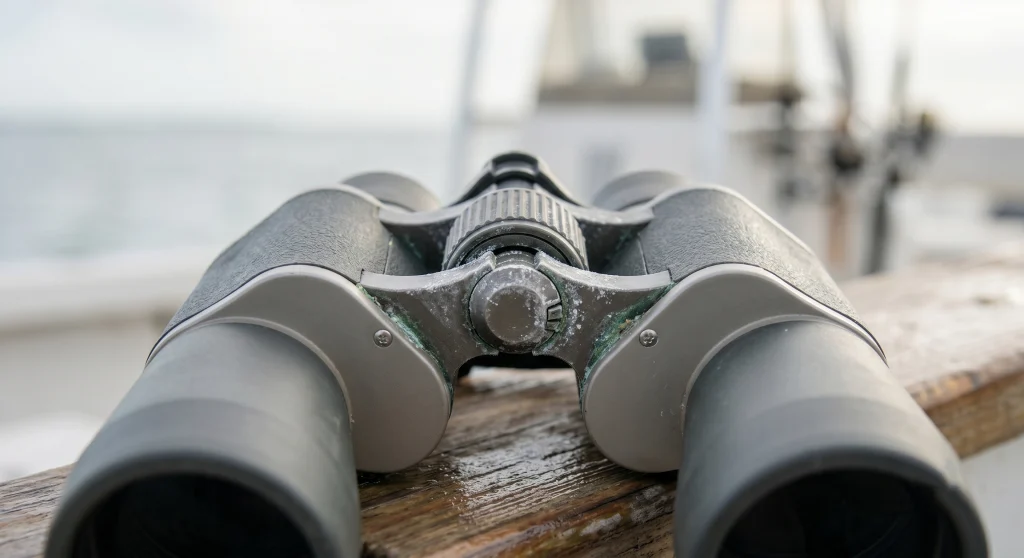
What actually ruined the focus wheel was not just rust. It was galvanic corrosion. Saltwater creates a highly effective electrolytic environment. When you introduce that electrolyte between the dissimilar metals used inside a focusing mechanism, a chemical reaction accelerates rapidly.
When a repair technician opens up a seized bridge mechanism, the damage is unmistakable. The brass components are often covered in green verdigris. Aluminum parts show white, chalky deposits. The factory grease that is supposed to keep the focusing track smooth turns into a stiff, hardened paste.
What I was seeing on the counter aligned exactly with what those technicians describe. On the CloudyNights forum, a user who frequently services vintage optics noted this exact issue. While discussing stiff eyepieces on early versions of Nikon 20×120 II binoculars, they pointed directly to saltwater spray acting as an electrolyte, which turns the internal thinned grease into a solid mess.
This is the reality of the situation. The failure does not happen on the boat. It happens weeks later while the salt slowly eats the internal mechanics.
The Cost of Fixing Boat Damage
I had to tell the customer the bad news. The lenses were fine. The prisms were perfectly aligned. But to fix the focus wheel, a technician would have to completely disassemble the central bridge, clean out the corroded metal, machine or replace the damaged components, re-grease the assembly, and put it all back together.
The repair estimate was higher than the original purchase price of the binoculars. It made zero financial sense to fix them. He ended up buying a brand new pair. But this time, he asked me exactly what kind of optics he actually needed for a boat, which is a completely different conversation.
This is a completely different kind of retail heartbreak than what happens when people buy the wrong specs. I have seen customers buy too much power and regret it. That is a pattern I detailed in my article about the magnification mistake customers make every week. Buying the wrong specs just means you get a frustrating image. Taking the wrong build quality into a harsh environment destroys the investment entirely.
Why Marine Optics Survive
The customer asked me a very logical question. He wanted to know how any binoculars survive on boats if salt air is that destructive. I explained that true marine optics are engineered with a completely different mechanical philosophy.
If you look at purpose-built nautical models, you will notice most of them do not have a center focus wheel at all. They use an individual focus system where you adjust each eyepiece separately. This is not just a quirky tradition. It is a deliberate survival tactic.
| Center Focus (Standard) | Individual Focus (Marine) |
|---|---|
| One central wheel moves both eyepieces simultaneously on an external bridge. | Each eyepiece focuses independently on its own sealed threaded tube. |
| Creates multiple moving external parts and gaps where salt can enter. | Eliminates the central bridge mechanism entirely, reducing entry points. |
| Requires constant turning to track moving subjects. | Set once for your eyes. Everything from about 20 yards to infinity stays in focus. |
| Highly vulnerable to saltwater mist corrosion. | Sealed tight. Mechanically simple. Highly resistant to salt air. |
By eliminating the center focusing mechanism, manufacturers remove the exact vulnerability that ruined my customer’s gear. I often point people to boating communities where experienced captains confirm the same thing: individual focus is chosen because fewer moving parts means fewer attack points for a corrosive environment. On thehulltruth.com, discussions about marine optics consistently highlight this design choice as mandatory.
Note: If you want to understand the exact threshold of when you can use standard optics near the water and when you must upgrade, I break down that decision framework completely in my guide on whether regular binoculars are okay for marine use.
What To Do Immediately After Salt Exposure
If you do end up taking a standard weather-resistant binocular near the ocean, the way you handle it afterward determines whether it survives the month. The goal is to remove the salt before it can pull ambient moisture into the mechanical gaps.
When customers asked me what to do after an accidental exposure, I gave them three steps. First, never wipe the lenses while they are still salty. That will drag abrasive salt crystals across the coating. Second, gently wipe down the entire exterior body with a cloth dampened with fresh water. Do not run the binoculars under a faucet unless they are explicitly rated fully waterproof and submersible.
Finally, do not store them in a sealed case right away. Let them air dry in a well-ventilated room. Trapping slightly damp, salty binoculars inside a dark case just accelerates the corrosion process.
Final Thoughts: Matching Gear to the Environment
The hardest part of my job at the optics counter was explaining that damage often happens invisibly. The customer who lent out his gear made no obvious mistake. He just did not realize that the environment dictates the equipment, not the other way around.
If you take standard hunting or birding optics into a true saltwater environment, you are playing on borrowed time. The damage does not require a dramatic splash or being dropped overboard. It just requires the air, the salt, and enough time in the closet for the chemistry to do its work.
If you spend regular time on the water, you need gear built for the water. You can explore the right tools for that specific job in my complete guide to marine binoculars. Keep your center-focus optics on land. That is where they were built to work.
FAQs
🌊 Can I take my regular binoculars on a boat?
You can take them on a freshwater boat with minimal risk if they are weather-resistant. Taking regular center-focus binoculars on a saltwater boat exposes the internal mechanics to corrosive salt mist, which often causes the focus wheel to seize weeks later.
⚙️ Why is my binocular focus wheel stiff after a beach trip?
A stiff focus wheel is usually caused by salt mist bypassing the exterior seals and drying inside the mechanism. This creates an electrolytic reaction that breaks down the internal lubricants and corrodes the metal parts.
🧽 How do I clean salt off my binoculars?
Wipe the exterior gently with a clean cloth dampened with fresh water. Avoid rinsing them directly under a faucet because standard weather seals are not designed to handle running water, only splash resistance. Only fully submersible, marine-rated models should be rinsed under running water.
🛥️ What is the difference between marine and regular binoculars?
Mechanically, marine binoculars use an individual focus system to eliminate the vulnerable center bridge. From a usage standpoint, this means you set the focus once for your eyes before you leave the dock, and everything from the bow of the boat to the horizon stays in focus without needing adjustments on rolling water.