The Problem with Buying Only by the Numbers
If you have ever bought optics based purely on a specification sheet, picked them up out of the box, and immediately felt that something was off, you are certainly not alone. The simple truth is that the hidden binoculars specs are often the ones that dictate your actual field experience. If you do not know exactly what specs matter, buying binoculars quickly turns into a frustrating guessing game. I watched this exact scenario play out countless times at the retail counter over the years.
A customer would stand in front of me, comparing two different models with the exact same 8×42 numbers printed on the side. They would look through both, hand one back, and strongly prefer the other without being able to articulate why. The glass magnification was the same. The objective lens size was identical. What they were actually reacting to was the mechanical feedback and the physical ergonomics that no manufacturer bothers to put in their marketing materials.
Why Binoculars Focus Wheel Speed Will Make or Break Your Trip
When you are trying to track a moving subject in thick brush, the speed and responsiveness of your focus wheel are absolutely critical. Focus speed is measured by how many full turns the central wheel requires to travel from its closest focal point all the way out to infinity.
Some models are engineered to cover this entire range in about one and a half turns. Other models require up to three and a half turns to accomplish the exact same thing. This creates real frustration for users who buy based on glass quality but ignore mechanics. One user on the Cloudy Nights forums summed up this exact frustration perfectly: “My only complaint is it takes more than 1.5 turns to go from close focus to infinity. I find that quite annoying especially for birding.”
Field Note: I used to hand customers two identical optical models to prove this exact point. The model with a fast focus wheel felt snappy and intuitive. The slow focus model made them feel like they were endlessly spinning a dial while the view remained blurry. Almost every single person walked out with the faster model, even if it cost slightly more money.
If you are scanning static landscapes, a slower focus wheel might be perfectly acceptable. But if you need to react quickly to wildlife, binoculars focus wheel speed is a spec you cannot afford to ignore.
Interpupillary Distance and How Binoculars Fit in Hand
Interpupillary distance, commonly referred to as IPD, is the technical term for how wide or narrow the barrels can hinge to match the physical distance between your eyes. While a few manufacturers occasionally list the raw millimeter range on the back of the box, they never explain how that range actually aligns with your facial structure. How binoculars fit in hand is just part of the equation. If the minimum IPD is too wide for your eyes, you will constantly see a black shadow in your view instead of a single perfect circle.
This is a widespread issue that catches many buyers off guard. As one frustrated hunter noted on the Rokslide forums: “I almost always have to bring the hinge in to a nearly closed position to get a clear picture. Some binos…no go all together.” For those users, certain models are simply incompatible with their face shape regardless of how good the glass is.
One of the most frequent complaints I heard at the counter was from people bringing in newly purchased optics, claiming the glass was horribly blurry or defective out of the box. In almost every single case, they had simply never set the IPD correctly. According to a report by Outdoor Life, roughly 90 percent of people who own optics do not know how to focus them properly. The glass is usually perfectly fine, but the physical adjustment is wrong.
The Ergonomics Nobody Mentions: Armor and Strap Lugs
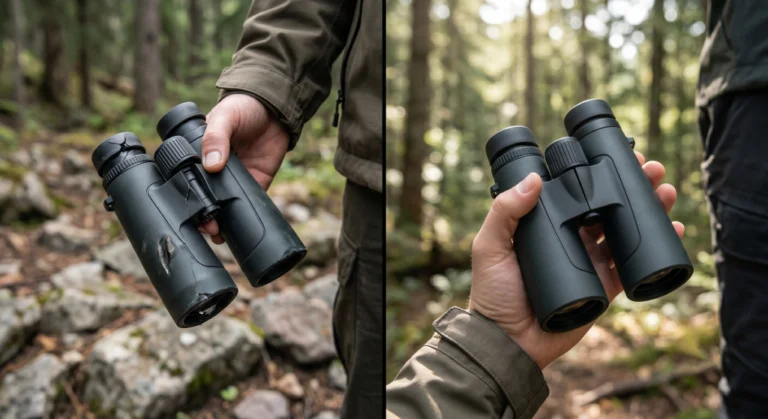
Even when buyers get the IPD correctly dialed in, there are subtle exterior design choices that drastically impact comfort over a long day. These details are equally invisible on the spec sheet. The first is the rubber armoring. The spec sheet will proudly state that the unit is “rubber armored” but it will not tell you the texture. Some budget models use a slick, hard rubber that becomes incredibly slippery in rain or when wearing winter gloves. Premium models use a softer, textured compound that practically sticks to your hand in bad weather.
The second hidden detail is the placement of the strap lugs. These are the small loops on the side of the barrels where your neck strap attaches. Some manufacturers place these lugs too high or angle them poorly. When you walk, the poorly placed lugs cause the binoculars to swing outward and aggressively bounce against your sternum. It sounds like a minor detail until you hike three miles with a heavy piece of glass pounding your chest.
Hinge Tension, Eyecup Precision, and Diopter Rings
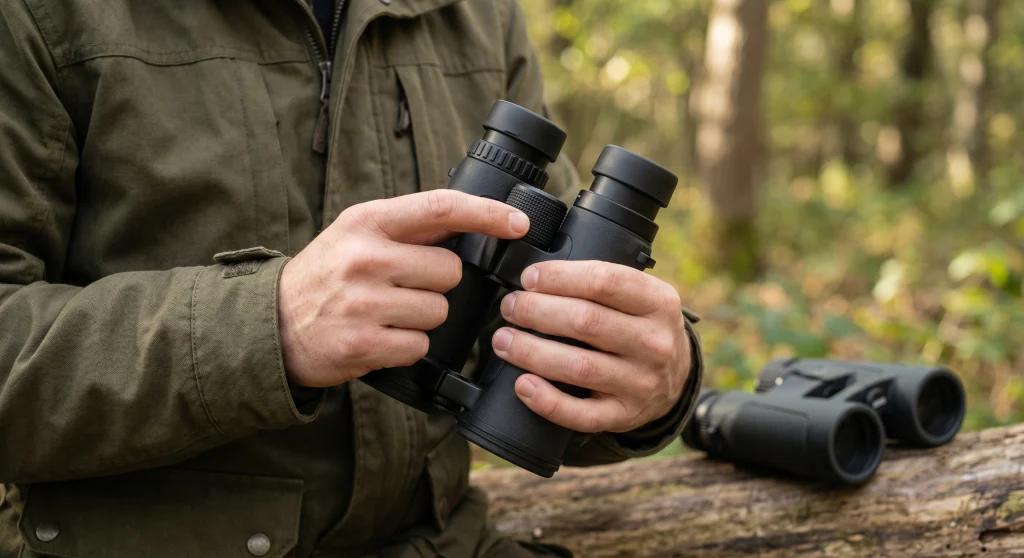
Just like the exterior armor, the resistance of the moving parts dictates your daily field experience. Hinge tension is a prime example. If the center hinge is too loose, your carefully set IPD will drift every time you pull the unit out of your backpack. If the hinge is too tight, trying to adjust it with cold hands becomes a miserable task. You will not find a “hinge tension rating” anywhere on a product page, but you will feel it immediately.
You also need to evaluate the eyecup precision. Modern twist-up eyecups are designed with internal detents, giving you multiple resting positions to accommodate varying eye relief needs.
Pro Tip: Do not forget to check the diopter adjustment ring stiffness. The diopter compensates for differences between your left and right eye. Once you set it, it should not move easily. Cheap models have loose diopter rings that rub against your chest and change focus, forcing you to constantly recalibrate.
How to Evaluate Mechanical Traits Without Holding Them
The biggest challenge with everything I have mentioned so far is that checking these details requires physical handling. The Cornell Lab of Ornithology frequently advises that their top tip for choosing optics is to try as many pairs as you can in person before you actually purchase one. But figuring out how to evaluate these mechanical traits becomes tricky when you are stuck ordering online. You have to completely change how you approach your research.
Instead of just reading the marketing spec sheets, you need to deliberately search for user feedback regarding the mechanical feel and the binoculars ergonomics. Here is what you should actively look for when reading reviews from actual field users.
- Search dedicated hunting and birding forums for specific terms like “fast focus wheel” or “stiff focus”.
- Look for any complaints about the eyecups collapsing, which strongly indicates poor internal click precision.
- Check if users mention the barrels being uncomfortably wide to grip, which speaks to poor overall ergonomics.
- Pay close attention to any mention of the center hinge loosening up over time or requiring constant readjustment.
Bridging the Gap Between the Box and Reality
To help make sense of this, I have broken down how the printed numbers relate to the physical traits you actually need to test. Do not just read the number on the box. Use it as a prompt to check the underlying mechanism.
| The Spec on the Box | The Mechanical Reality You Must Check |
|---|---|
| Close Focus: 6.5 ft | How many turns of the focus wheel it actually takes to get from 6.5 feet out to infinity. |
| Eye Relief: 17mm | Whether the twist-up eyecups have firm detents that lock securely at that 17mm mark without collapsing. |
| IPD Range: 56-74mm | How smoothly the center hinge moves, and whether it holds your setting while bouncing in a backpack. |
| Weight: 24 oz | Where that weight sits in your hands, and whether the strap lugs dig into your chest when you carry them. |
If you are completely new to interpreting these baseline numbers, taking a few minutes to understand the meaning of binocular numbers will give you the foundation you need before evaluating the mechanical feel.
Final Thoughts: The Moment Mechanics Matter Most
There is a specific moment in the field when you spot a rare bird lifting out of the brush, or a buck stepping into a clearing. In that three-second window, you do not care about the light transmission percentage or the specific type of glass coatings. You only care if the binoculars come up to your eyes naturally, if the eyecups stay where you put them, and if the focus wheel snaps onto the target instantly.
That is why I always tell people to buy from retailers with generous return policies. If you order a pair online, set them up properly by learning how to use binoculars, and then spend a weekend handling them. If the focus wheel feels sluggish or the hinge drifts, send them back. If you are trying to find a model that balances great glass with fast, reliable mechanics, checking out a dedicated guide like our binoculars for bird watching recommendations is a great place to start your search.
Sources & References
- Cloudy Nights: User discussions on fast focus vs slow focus speeds and field tracking.
- Rokslide: Hunter feedback regarding IPD fit issues and facial structure compatibility.
- Outdoor Life: Reporting on the high percentage of users who do not know how to adjust binoculars properly.
- Cornell Lab of Ornithology (All About Birds): Expert advice emphasizing the need to test optics in person before buying.
FAQs
🔭 What is the most important binocular spec not on the box?
The focus wheel speed is generally the most important hidden specification. How fast the wheel travels from close focus to infinity dictates how easily you can track moving subjects in the field.
🦅 Why do my binoculars show a figure 8 when I look through them?
A figure-8 shadow means your interpupillary distance (IPD) is set incorrectly. You need to push the central hinge closer together or pull it further apart until the two circles merge into one perfect image.
👓 How can I tell if binoculars have good eyecups?
Quality twist-up eyecups will have firm, audible clicks at various resting positions. They should lock securely into place and resist moderate downward pressure without collapsing against your face.
🖐️ Are heavier binoculars always harder to hold steady?
Not necessarily. The physical balance of the chassis matters more than the raw weight. A well-balanced heavier model is often easier to hold steady than a poorly designed lightweight model.
🤔 Does focus wheel speed matter for stargazing?
Focus wheel speed is rarely important for astronomy because you set the focus to infinity and leave it there. It is much more critical for daytime activities like birding where subjects constantly move.