The most common thing people said when walking up to the optics counter was that they wanted the most powerful pair we sold. Over time, I watched hundreds of people buy massive magnification only to return two weeks later frustrated by shaky, unusable images. This is the pattern of how people choose the wrong power level, why it ruins their experience, and what actually makes a pair of binoculars usable in the real world.
The Daily Request at the Optics Counter
“I want the most powerful one you have.” That was the phrase I heard almost every single day working behind the retail counter. Customers would walk up, completely ignore the standard sizes, and immediately point to the massive lenses sitting on the top shelf. As a retail worker, my job technically was not to tell them what I thought about that choice. I was just there to unlock the glass case and hand them the gear.
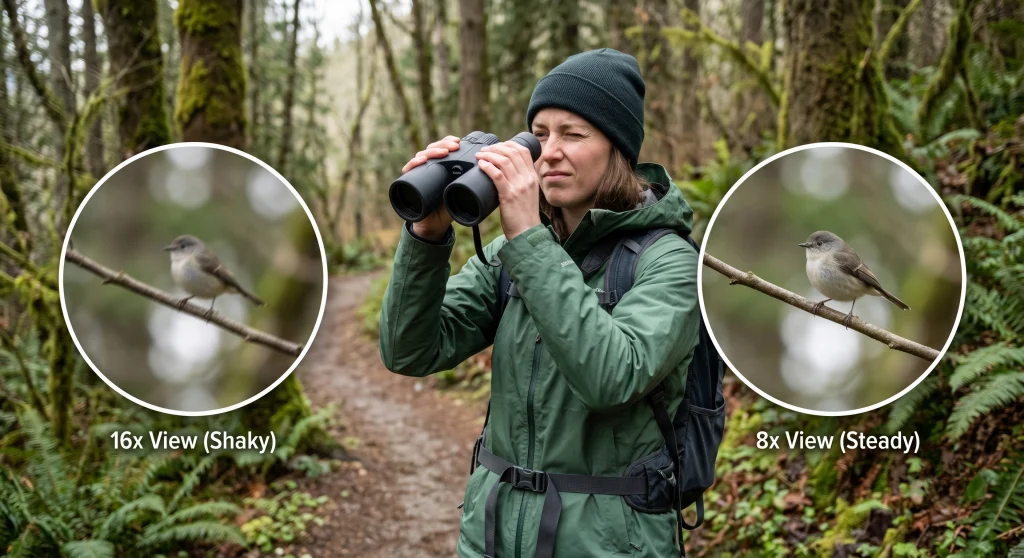
But watching this scenario play out week after week changed my perspective. I realized this was the classic binoculars magnification mistake playing out in real time. People naturally assumed that more power automatically meant a better, clearer view of whatever they were trying to look at. They wanted to see things far away, so they asked for the biggest numbers printed on the box. It sounds entirely logical until you actually put the glass to your eyes in an uncontrolled environment.
The In-Store Testing Trap
Part of the problem is how people test optics before buying them. A customer would pick up the heaviest, highest-power model on the shelf. They would look through it inside the brightly lit, climate-controlled store. More importantly, they would inevitably lean forward and rest their elbows solidly on the glass counter to steady themselves.
In that perfect environment, holding perfectly still while looking at a static exit sign fifty yards away, the image felt completely fine. They would nod in satisfaction, pack up the box, and confidently walk out to their car with their new purchase. They had no idea that the testing conditions were masking a major problem. The real world does not have convenient glass counters to lean on when a bird suddenly takes flight or a deer steps out of the brush.
The Two-Week Return Cycle
The second half of this pattern was entirely predictable. About two weeks later, I would see that same customer walking back through the front doors. They always looked a little defeated, carrying the slightly worn box in their hands. When I processed the return and asked what went wrong, the complaint was rarely about the glass quality itself.
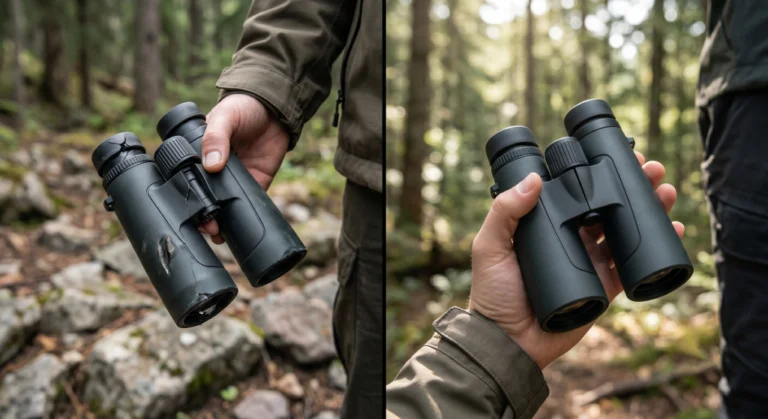
Instead, they discovered that high power binoculars problems go far beyond just a shaky image. The sheer weight of those massive lenses caused arm fatigue within minutes. Once their arms got tired, they could not hold the optic steady to save their lives. Instead of seeing incredible detail, the image bounced wildly across their eyes, leaving them with nothing but a headache and a missed opportunity.
What I Could Say Versus What I Wanted To Say
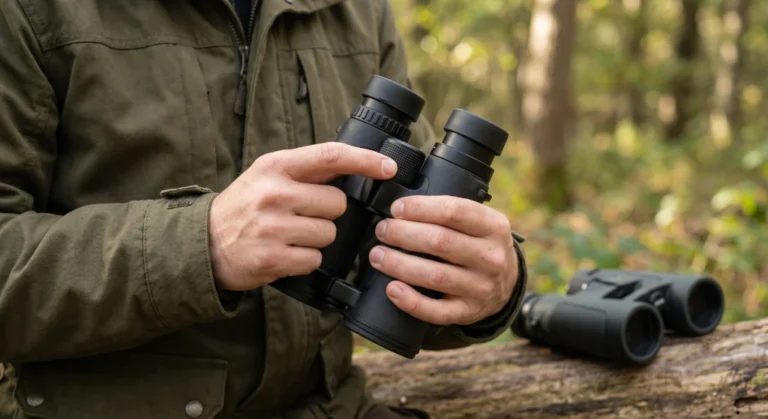
When someone is absolutely determined to buy maximum power, retail etiquette requires a very gentle approach. What I could safely say at work was that higher power simply makes hand movement more noticeable, so many users find a lower power much easier to hold steady. Sometimes they listened and reconsidered. Often they did not.
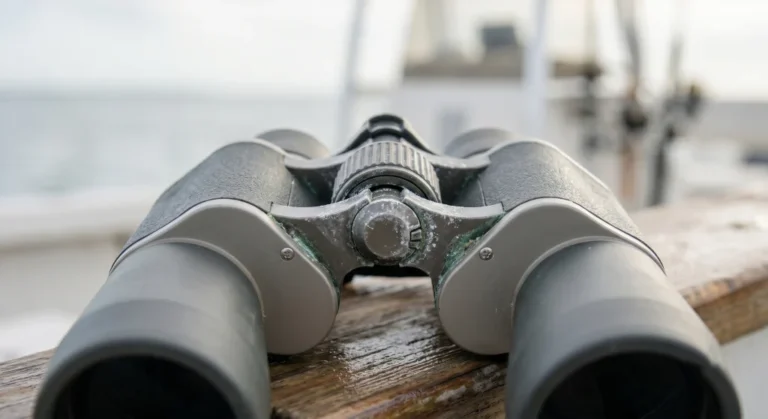
What I actually wanted to say was much more blunt. You are solving the wrong problem entirely. Magnification you cannot stabilize is magnification you cannot use. It does not matter if your lenses have the mathematical reach to see a boat three miles away if that boat is jumping out of your view every half second. If you want the deep technical breakdown of why this happens, you can read our full guide on how magnification actually works. But when I tried to gently explain that hand-holding these giants was nearly impossible, customers usually had the exact same rebuttal ready.
The Tripod Defense That Rarely Works Out
Whenever I warned a customer about the inevitable image shake of a maximum-power optic, the defense was immediate. They would tell me they planned to just use a tripod. In theory, this is the correct solution. In practice, it almost never happens the way people envision.
The reality is that dragging a heavy tripod along on a casual weekend hike or a morning birding walk gets old very quickly. People buy the gear, leave the bulky tripod in the trunk of their car, and try to freehand the heavy optics anyway. That is when they discover that their purchase actively ruins their experience. They leave the expensive glass sitting at home in the closet.
The Field Failures That Proved the Point
At the retail counter, I heard exactly how this mistake ruined trips across entirely different activities. The scenarios were always variations of the same core problem.
Field Note: The most telling version came from a hunter who returned after a failed trip in wide-open country. He had bought a massive, high-power setup specifically to scan distant ridges. He came back incredibly frustrated because he couldn’t scan a hillside without losing his place every few seconds due to the shake. We swapped his gear out for a standard, moderate-power model. The next season, he spotted game. Nothing about the terrain changed, only his ability to hold his optic still.
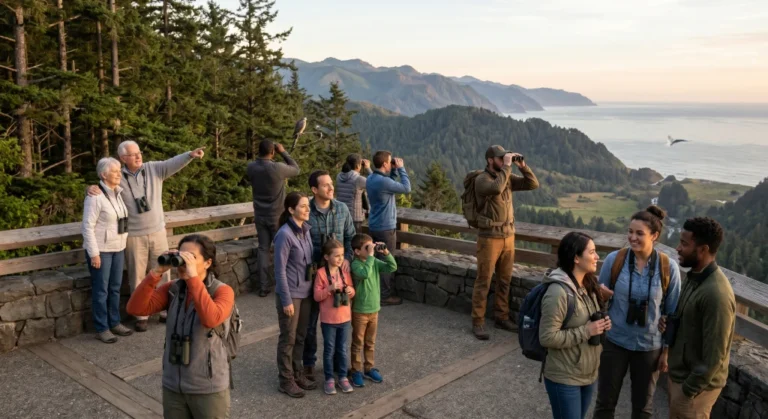
I saw the exact same disappointment from birders. A customer came in fuming because he missed a rare warbler hopping through the canopy. His binoculars were so incredibly powerful that his field of view was practically looking through a straw. By the time he found the right branch in his lenses, the bird was long gone. More power actually prevented him from doing what he went out there to do.
How to Actually Measure Usability
What actually determines whether binoculars are usable in the field is not the rating on the box. It is whether you can hold them steady long enough to find what you are looking for, without wearing out your arms. When I helped frustrated people find a pair they actually kept, we focused on these practical realities:
- How long you plan to hold them up: I watched people’s arms start trembling right there in the store after just thirty seconds of holding the heaviest models. Scanning a distant treeline for ten uninterrupted minutes requires something lightweight.
- Whether you are standing or resting: Leaning on a truck hood makes high power manageable, but most people use their optics while standing freehand on a trail where there is zero support.
- How fast you need to find your target: High power severely narrows your field of view. As that birder found out, looking through a tight straw makes it nearly impossible to quickly locate a small, moving object.
| Maximum Power Expectations | The Reality in the Field |
|---|---|
| Seeing incredible detail miles away | Bouncing image makes fine details impossible to focus on |
| Quickly spotting distant animals | Narrow field of view makes finding the target very difficult |
| Holding steady for quick looks | Arm fatigue sets in within minutes due to heavy glass |
If you want to stop guessing and actually see which standard configuration fits your activity, comparing standard options like 8×42 and 10×42 is the next immediate step you should take before buying anything.
Final Thoughts: Adjusting Your Expectations
Once customers understood that a steady, clear image at a lower power revealed far more actual detail than a massive, shaking image, their whole approach to buying changed. The goal is never to buy the most powerful tool on the retail shelf. The goal is to buy the tool that gets out of your way and lets you comfortably see what you came to see.
The best optic is the one you can hold steady without thinking about it. Give yourself a wider view and lighter glass. If you are ready to match specs to your real-world needs, take a look at our guide on understanding what the numbers on the box actually mean.
FAQs
🔭 Why is the image shaking so much in my new binoculars?
The magnification level is likely too high for freehand use. High power acts like a magnifying glass for every tiny movement your body makes, causing the image to appear to bounce constantly.
🦅 Is maximum magnification good for bird watching?
In most cases, no. It requires a tripod to keep steady and gives you a very narrow field of view. This makes it incredibly difficult to find and track small, fast-moving birds in trees before they fly away.
🦌 What happens if I buy binoculars with too much power?
You will experience arm fatigue from the heavy weight, eye strain from trying to focus on a shaky image, and frustration because the narrow field of view makes locating your target much harder.
✋ How do I know if I need a tripod?
From what I have seen at the counter, if you step out of the standard sizes and move into the highest power categories, you will almost certainly need a resting point or a tripod for extended viewing.